

showed that the reaction of two molecules of 1 was very slow, and the reaction of
1 with 2 or with the polymer end group was much faster. However, the polymer that
precipitated during the course of the reaction was not soluble; and its molecular
weight, as estimated by elemental analysis, was rather low, in contrast to the
supposition that the polymerization proceeded by chain polymerization from
2. The actual polymerization mechanism appeared to be more complicated:
step-growth polymerization could occur together with chain-growth polymerization,
and chain transfer to the polymer backbone could also occur, both effects resulting
in a decreased molecular weight.
Oxidative polymerization of 2,6-dimethylphenol (3) or 4-bromo-2,6-dimethylphenol
(4) has the character of chain-growth polymerization. In the oxidative polymerization of
3 catalyzed by cupric amine complexes, Heitz found that the degree of polymerization
of poly(2,6-dimethyl-1,4-phenylene oxide) obtained at low conversion was much higher
than expected from the conversion according to Flory’s theory [9, 10]. The mole fraction
of the oligomers was much lower than that of monomer 3, indicating that the reactivity
of dimer, trimer, and the higher homologues was greater than that of the monomer. This
polymerization behavior was attributed to a lower redox potential of the oligomers,
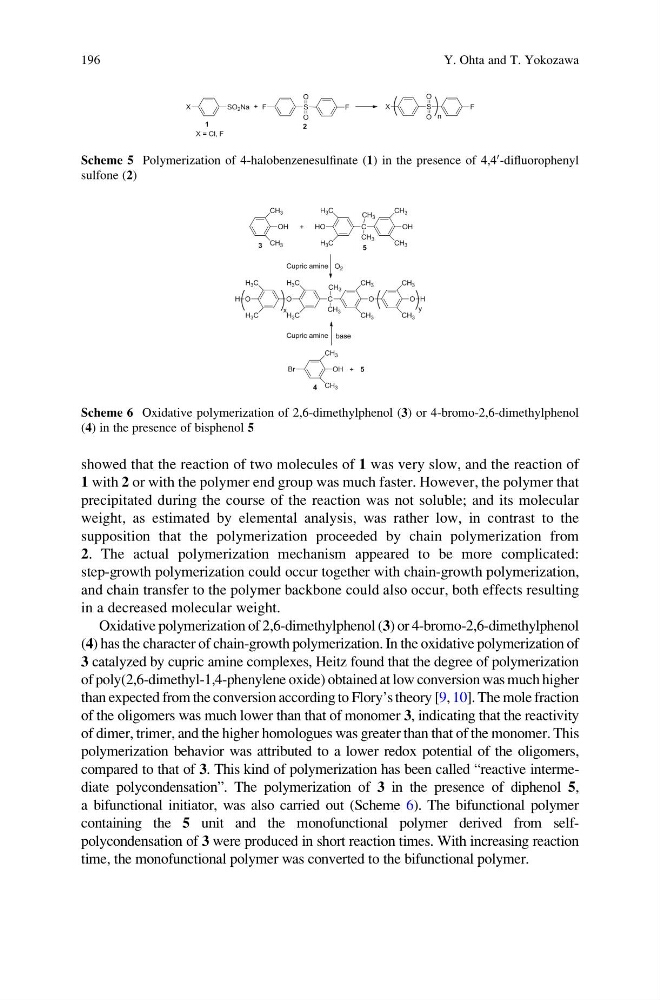
compared to that of 3. This kind of polymerization has been called “reactive intermediate polycondensation”. The polymerization of 3 in the presence of diphenol 5,
a bifunctional initiator, was also carried out (Scheme 6). The bifunctional polymer
containing the 5 unit and the monofunctional polymer derived from selfpolycondensation of 3 were produced in short reaction times. With increasing reaction
time, the monofunctional polymer was converted to the bifunctional polymer.
Scheme 5 Polymerization of 4-halobenzenesulfinate (1) in the presence of 4,4
0 -difluorophenyl
sulfone (2)
Scheme 6 Oxidative polymerization of 2,6-dimethylphenol (3) or 4-bromo-2,6-dimethylphenol
(4) in the presence of bisphenol 5
196
Y. Ohta and T. Yokozawa
1 with 2 or with the polymer end group was much faster. However, the polymer that
precipitated during the course of the reaction was not soluble; and its molecular
weight, as estimated by elemental analysis, was rather low, in contrast to the
supposition that the polymerization proceeded by chain polymerization from
2. The actual polymerization mechanism appeared to be more complicated:
step-growth polymerization could occur together with chain-growth polymerization,
and chain transfer to the polymer backbone could also occur, both effects resulting
in a decreased molecular weight.
Oxidative polymerization of 2,6-dimethylphenol (3) or 4-bromo-2,6-dimethylphenol
(4) has the character of chain-growth polymerization. In the oxidative polymerization of
3 catalyzed by cupric amine complexes, Heitz found that the degree of polymerization
of poly(2,6-dimethyl-1,4-phenylene oxide) obtained at low conversion was much higher
than expected from the conversion according to Flory’s theory [9, 10]. The mole fraction
of the oligomers was much lower than that of monomer 3, indicating that the reactivity
of dimer, trimer, and the higher homologues was greater than that of the monomer. This
polymerization behavior was attributed to a lower redox potential of the oligomers,
compared to that of 3. This kind of polymerization has been called “reactive intermediate polycondensation”. The polymerization of 3 in the presence of diphenol 5,
a bifunctional initiator, was also carried out (Scheme 6). The bifunctional polymer
containing the 5 unit and the monofunctional polymer derived from selfpolycondensation of 3 were produced in short reaction times. With increasing reaction
time, the monofunctional polymer was converted to the bifunctional polymer.
Scheme 5 Polymerization of 4-halobenzenesulfinate (1) in the presence of 4,4
0 -difluorophenyl
sulfone (2)
Scheme 6 Oxidative polymerization of 2,6-dimethylphenol (3) or 4-bromo-2,6-dimethylphenol
(4) in the presence of bisphenol 5
196
Y. Ohta and T. Yokozawa