

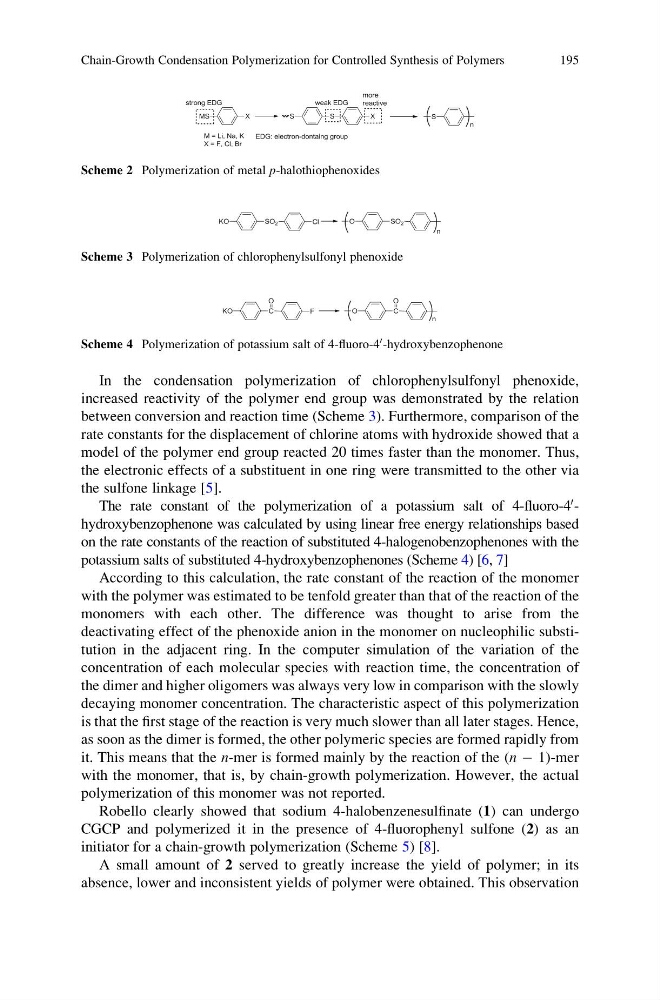
In the condensation polymerization of chlorophenylsulfonyl phenoxide,
increased reactivity of the polymer end group was demonstrated by the relation
between conversion and reaction time (Scheme 3). Furthermore, comparison of the
rate constants for the displacement of chlorine atoms with hydroxide showed that a
model of the polymer end group reacted 20 times faster than the monomer. Thus,
the electronic effects of a substituent in one ring were transmitted to the other via
the sulfone linkage [5].
The rate constant of the polymerization of a potassium salt of 4-fluoro-4
0 -
hydroxybenzophenone was calculated by using linear free energy relationships based
on the rate constants of the reaction of substituted 4-halogenobenzophenones with the
potassium salts of substituted 4-hydroxybenzophenones (Scheme 4) [6, 7]
According to this calculation, the rate constant of the reaction of the monomer
with the polymer was estimated to be tenfold greater than that of the reaction of the
monomers with each other. The difference was thought to arise from the
deactivating effect of the phenoxide anion in the monomer on nucleophilic substitution in the adjacent ring. In the computer simulation of the variation of the
concentration of each molecular species with reaction time, the concentration of
the dimer and higher oligomers was always very low in comparison with the slowly
decaying monomer concentration. The characteristic aspect of this polymerization
is that the first stage of the reaction is very much slower than all later stages. Hence,
as soon as the dimer is formed, the other polymeric species are formed rapidly from
it. This means that the n-mer is formed mainly by the reaction of the (n À 1)-mer
with the monomer, that is, by chain-growth polymerization. However, the actual
polymerization of this monomer was not reported.
Robello clearly showed that sodium 4-halobenzenesulfinate (1) can undergo
CGCP and polymerized it in the presence of 4-fluorophenyl sulfone (2) as an
initiator for a chain-growth polymerization (Scheme 5) [8].
A small amount of 2 served to greatly increase the yield of polymer; in its
absence, lower and inconsistent yields of polymer were obtained. This observation
Scheme 2 Polymerization of metal p-halothiophenoxides
Scheme 3 Polymerization of chlorophenylsulfonyl phenoxide
Scheme 4 Polymerization of potassium salt of 4-fluoro-4
0 -hydroxybenzophenone
Chain-Growth Condensation Polymerization for Controlled Synthesis of Polymers
195
increased reactivity of the polymer end group was demonstrated by the relation
between conversion and reaction time (Scheme 3). Furthermore, comparison of the
rate constants for the displacement of chlorine atoms with hydroxide showed that a
model of the polymer end group reacted 20 times faster than the monomer. Thus,
the electronic effects of a substituent in one ring were transmitted to the other via
the sulfone linkage [5].
The rate constant of the polymerization of a potassium salt of 4-fluoro-4
0 -
hydroxybenzophenone was calculated by using linear free energy relationships based
on the rate constants of the reaction of substituted 4-halogenobenzophenones with the
potassium salts of substituted 4-hydroxybenzophenones (Scheme 4) [6, 7]
According to this calculation, the rate constant of the reaction of the monomer
with the polymer was estimated to be tenfold greater than that of the reaction of the
monomers with each other. The difference was thought to arise from the
deactivating effect of the phenoxide anion in the monomer on nucleophilic substitution in the adjacent ring. In the computer simulation of the variation of the
concentration of each molecular species with reaction time, the concentration of
the dimer and higher oligomers was always very low in comparison with the slowly
decaying monomer concentration. The characteristic aspect of this polymerization
is that the first stage of the reaction is very much slower than all later stages. Hence,
as soon as the dimer is formed, the other polymeric species are formed rapidly from
it. This means that the n-mer is formed mainly by the reaction of the (n À 1)-mer
with the monomer, that is, by chain-growth polymerization. However, the actual
polymerization of this monomer was not reported.
Robello clearly showed that sodium 4-halobenzenesulfinate (1) can undergo
CGCP and polymerized it in the presence of 4-fluorophenyl sulfone (2) as an
initiator for a chain-growth polymerization (Scheme 5) [8].
A small amount of 2 served to greatly increase the yield of polymer; in its
absence, lower and inconsistent yields of polymer were obtained. This observation
Scheme 2 Polymerization of metal p-halothiophenoxides
Scheme 3 Polymerization of chlorophenylsulfonyl phenoxide
Scheme 4 Polymerization of potassium salt of 4-fluoro-4
0 -hydroxybenzophenone
Chain-Growth Condensation Polymerization for Controlled Synthesis of Polymers
195