

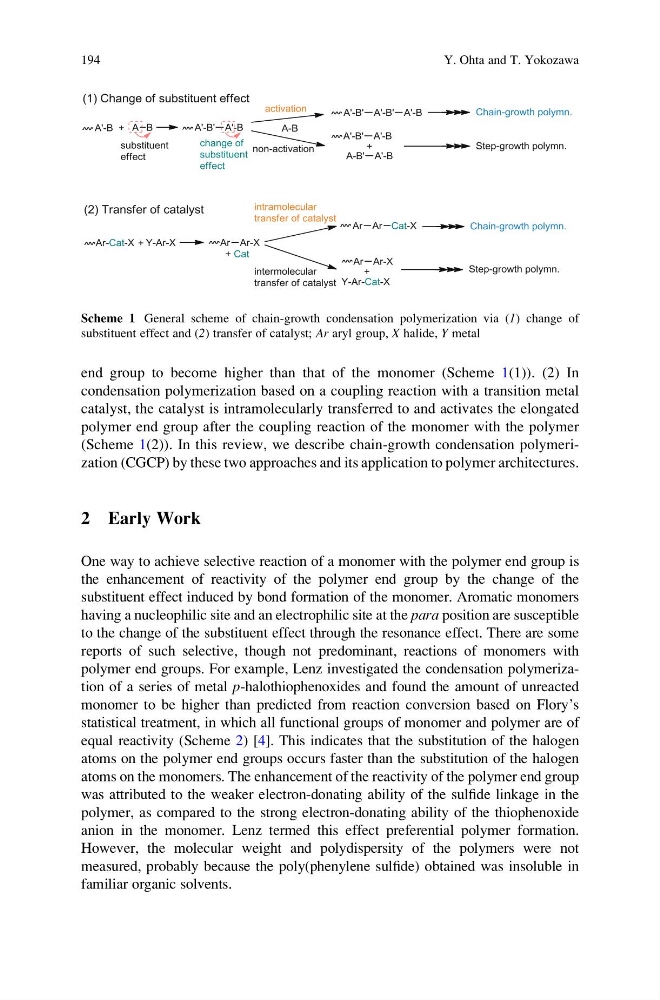
end group to become higher than that of the monomer (Scheme 1(1)). (2) In
condensation polymerization based on a coupling reaction with a transition metal
catalyst, the catalyst is intramolecularly transferred to and activates the elongated
polymer end group after the coupling reaction of the monomer with the polymer
(Scheme 1(2)). In this review, we describe chain-growth condensation polymerization (CGCP) by these two approaches and its application to polymer architectures.
2 Early Work
One way to achieve selective reaction of a monomer with the polymer end group is
the enhancement of reactivity of the polymer end group by the change of the
substituent effect induced by bond formation of the monomer. Aromatic monomers
having a nucleophilic site and an electrophilic site at the para position are susceptible
to the change of the substituent effect through the resonance effect. There are some
reports of such selective, though not predominant, reactions of monomers with
polymer end groups. For example, Lenz investigated the condensation polymerization of a series of metal p-halothiophenoxides and found the amount of unreacted
monomer to be higher than predicted from reaction conversion based on Flory’s
statistical treatment, in which all functional groups of monomer and polymer are of
equal reactivity (Scheme 2) [4]. This indicates that the substitution of the halogen
atoms on the polymer end groups occurs faster than the substitution of the halogen
atoms on the monomers. The enhancement of the reactivity of the polymer end group
was attributed to the weaker electron-donating ability of the sulfide linkage in the
polymer, as compared to the strong electron-donating ability of the thiophenoxide
anion in the monomer. Lenz termed this effect preferential polymer formation.
However, the molecular weight and polydispersity of the polymers were not
measured, probably because the poly(phenylene sulfide) obtained was insoluble in
familiar organic solvents.
Scheme 1 General scheme of chain-growth condensation polymerization via (1) change of
substituent effect and (2) transfer of catalyst; Ar aryl group, X halide, Y metal
194
Y. Ohta and T. Yokozawa
condensation polymerization based on a coupling reaction with a transition metal
catalyst, the catalyst is intramolecularly transferred to and activates the elongated
polymer end group after the coupling reaction of the monomer with the polymer
(Scheme 1(2)). In this review, we describe chain-growth condensation polymerization (CGCP) by these two approaches and its application to polymer architectures.
2 Early Work
One way to achieve selective reaction of a monomer with the polymer end group is
the enhancement of reactivity of the polymer end group by the change of the
substituent effect induced by bond formation of the monomer. Aromatic monomers
having a nucleophilic site and an electrophilic site at the para position are susceptible
to the change of the substituent effect through the resonance effect. There are some
reports of such selective, though not predominant, reactions of monomers with
polymer end groups. For example, Lenz investigated the condensation polymerization of a series of metal p-halothiophenoxides and found the amount of unreacted
monomer to be higher than predicted from reaction conversion based on Flory’s
statistical treatment, in which all functional groups of monomer and polymer are of
equal reactivity (Scheme 2) [4]. This indicates that the substitution of the halogen
atoms on the polymer end groups occurs faster than the substitution of the halogen
atoms on the monomers. The enhancement of the reactivity of the polymer end group
was attributed to the weaker electron-donating ability of the sulfide linkage in the
polymer, as compared to the strong electron-donating ability of the thiophenoxide
anion in the monomer. Lenz termed this effect preferential polymer formation.
However, the molecular weight and polydispersity of the polymers were not
measured, probably because the poly(phenylene sulfide) obtained was insoluble in
familiar organic solvents.
Scheme 1 General scheme of chain-growth condensation polymerization via (1) change of
substituent effect and (2) transfer of catalyst; Ar aryl group, X halide, Y metal
194
Y. Ohta and T. Yokozawa