

3.2 Enzymatically Degradable PEGs
The pool of biodegradable units incorporated in PEG also contains enzymatically
cleavable moieties. Most prominent among these are amino acid or oligopeptide
linkages, which were applied for the coupling of monofunctional PEG derivatives
[31, 112, 113, 119, 123] and as monomers for polycondensation with difunctional
PEGs [111, 115–119]. Depending on the inserted amino acid or sequence, the
polymers can be cleaved by different proteases such as collagenase, chymotrypsin,
or cathepsin B. Of course, PEG-based polypeptides can also be degraded under
simple hydrolysis conditions [111, 119]. First studies on such systems exposed the
strong dependence of the degradation rate on the length and structure of the peptide
linker [111–113]. Whereas chymotrypsin requires a single in-chain phenylalanine
residue for the PEG degradation [111], cathepsin B does not cleave PEGs with just a
glutamic acid linker [113]. In the latter case, the degradation rate increases by
adding a phenylalanine at the C-terminus of the glutamic acid and is even higher by
coupling it to the N-terminal site. Further, the corresponding pendant benzylesters
undergo proteolysis much faster than the free acid derivatives [113]. The degradable PEGs of this type are also suitable carriers for DOX, which can be bound via
enzymatically cleavable oligopeptides [114–117] or an acid-sensitive hydrazone
[118]. In contrast to free DOX, these polymer therapeutics exhibited no signs
of toxicity in in vivo studies on mice and seemed to inhibit tumor growth
[116]. However, no PDI values have been published for most of the PEG
copolymers derived from polycondensation, but the available SEC traces indicate
broad molecular weight distributions, which is an obstacle for eventual FDA
approval [116–118]. PEGs with in-chain amino acid peptide bonds have also
140
120
100
80
60
40
20
0
120
100
80
60
40
20
0
.001
.01
.1
1
10
Concentration (mg/ml)
Concentration (mg/ml)
Cell viability (%)
Poly-L-lysine
Dextran
Dextran
Polyacetal 16
Polyacetal 16
PEI
Degradation products of polyacetal 16
Haemoglobin release (%)
0
1
2
3
4
5
a
b
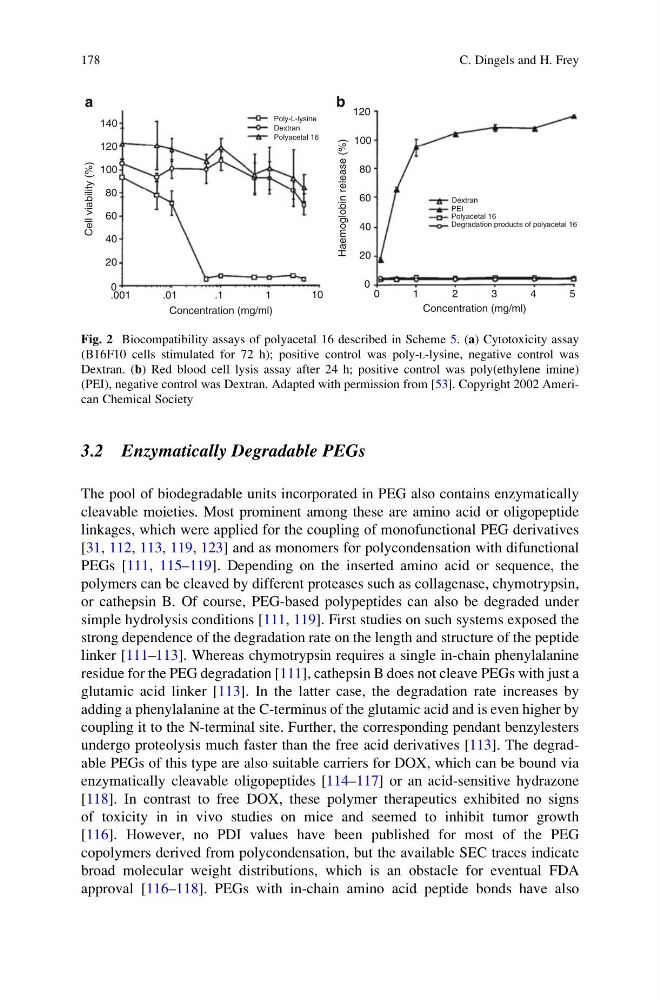
Fig. 2 Biocompatibility assays of polyacetal 16 described in Scheme 5. (a) Cytotoxicity assay
(B16F10 cells stimulated for 72 h); positive control was poly-L-lysine, negative control was
Dextran. (b) Red blood cell lysis assay after 24 h; positive control was poly(ethylene imine)
(PEI), negative control was Dextran. Adapted with permission from [53]. Copyright 2002 American Chemical Society
178
C. Dingels and H. Frey
The pool of biodegradable units incorporated in PEG also contains enzymatically
cleavable moieties. Most prominent among these are amino acid or oligopeptide
linkages, which were applied for the coupling of monofunctional PEG derivatives
[31, 112, 113, 119, 123] and as monomers for polycondensation with difunctional
PEGs [111, 115–119]. Depending on the inserted amino acid or sequence, the
polymers can be cleaved by different proteases such as collagenase, chymotrypsin,
or cathepsin B. Of course, PEG-based polypeptides can also be degraded under
simple hydrolysis conditions [111, 119]. First studies on such systems exposed the
strong dependence of the degradation rate on the length and structure of the peptide
linker [111–113]. Whereas chymotrypsin requires a single in-chain phenylalanine
residue for the PEG degradation [111], cathepsin B does not cleave PEGs with just a
glutamic acid linker [113]. In the latter case, the degradation rate increases by
adding a phenylalanine at the C-terminus of the glutamic acid and is even higher by
coupling it to the N-terminal site. Further, the corresponding pendant benzylesters
undergo proteolysis much faster than the free acid derivatives [113]. The degradable PEGs of this type are also suitable carriers for DOX, which can be bound via
enzymatically cleavable oligopeptides [114–117] or an acid-sensitive hydrazone
[118]. In contrast to free DOX, these polymer therapeutics exhibited no signs
of toxicity in in vivo studies on mice and seemed to inhibit tumor growth
[116]. However, no PDI values have been published for most of the PEG
copolymers derived from polycondensation, but the available SEC traces indicate
broad molecular weight distributions, which is an obstacle for eventual FDA
approval [116–118]. PEGs with in-chain amino acid peptide bonds have also
140
120
100
80
60
40
20
0
120
100
80
60
40
20
0
.001
.01
.1
1
10
Concentration (mg/ml)
Concentration (mg/ml)
Cell viability (%)
Poly-L-lysine
Dextran
Dextran
Polyacetal 16
Polyacetal 16
PEI
Degradation products of polyacetal 16
Haemoglobin release (%)
0
1
2
3
4
5
a
b
Fig. 2 Biocompatibility assays of polyacetal 16 described in Scheme 5. (a) Cytotoxicity assay
(B16F10 cells stimulated for 72 h); positive control was poly-L-lysine, negative control was
Dextran. (b) Red blood cell lysis assay after 24 h; positive control was poly(ethylene imine)
(PEI), negative control was Dextran. Adapted with permission from [53]. Copyright 2002 American Chemical Society
178
C. Dingels and H. Frey