

groups are hydrolyzed [53]. Further, the chemical composition of the acetal (i.e.,
the nature of the aldehyde and alcohol) influences the rate of its hydrolysis:
Benzaldehyde acetals degrade faster than aliphatic aldehydes (compare [59] and
[65]), and phenolic acetaldehyde acetals are hydrolyzed faster than purely aliphatic
ones [56, 57]. Cyclic acetals require harsher conditions than linear ones [58] (also
true for PG-based polyketals [154]) and basic moieties, such as amino groups
adjacent to the acetal also lead to decreased hydrolysis rates [70]. Biocompatibility
and pharmacokinetic tests of acetal-containing PEGs and polymeric prodrugs
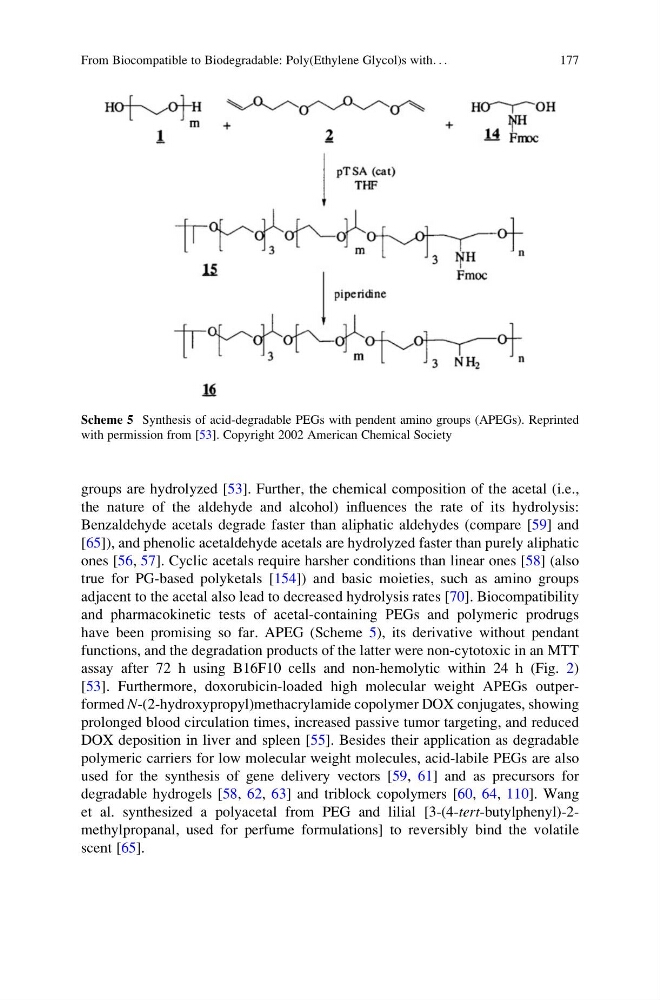
have been promising so far. APEG (Scheme 5), its derivative without pendant
functions, and the degradation products of the latter were non-cytotoxic in an MTT
assay after 72 h using B16F10 cells and non-hemolytic within 24 h (Fig. 2)
[53]. Furthermore, doxorubicin-loaded high molecular weight APEGs outperformed N-(2-hydroxypropyl)methacrylamide copolymer DOX conjugates, showing
prolonged blood circulation times, increased passive tumor targeting, and reduced
DOX deposition in liver and spleen [55]. Besides their application as degradable
polymeric carriers for low molecular weight molecules, acid-labile PEGs are also
used for the synthesis of gene delivery vectors [59, 61] and as precursors for
degradable hydrogels [58, 62, 63] and triblock copolymers [60, 64, 110]. Wang
et al. synthesized a polyacetal from PEG and lilial [3-(4-tert-butylphenyl)-2methylpropanal, used for perfume formulations] to reversibly bind the volatile
scent [65].
Scheme 5 Synthesis of acid-degradable PEGs with pendent amino groups (APEGs). Reprinted
with permission from [53]. Copyright 2002 American Chemical Society
From Biocompatible to Biodegradable: Poly(Ethylene Glycol)s with. . .
177
the nature of the aldehyde and alcohol) influences the rate of its hydrolysis:
Benzaldehyde acetals degrade faster than aliphatic aldehydes (compare [59] and
[65]), and phenolic acetaldehyde acetals are hydrolyzed faster than purely aliphatic
ones [56, 57]. Cyclic acetals require harsher conditions than linear ones [58] (also
true for PG-based polyketals [154]) and basic moieties, such as amino groups
adjacent to the acetal also lead to decreased hydrolysis rates [70]. Biocompatibility
and pharmacokinetic tests of acetal-containing PEGs and polymeric prodrugs
have been promising so far. APEG (Scheme 5), its derivative without pendant
functions, and the degradation products of the latter were non-cytotoxic in an MTT
assay after 72 h using B16F10 cells and non-hemolytic within 24 h (Fig. 2)
[53]. Furthermore, doxorubicin-loaded high molecular weight APEGs outperformed N-(2-hydroxypropyl)methacrylamide copolymer DOX conjugates, showing
prolonged blood circulation times, increased passive tumor targeting, and reduced
DOX deposition in liver and spleen [55]. Besides their application as degradable
polymeric carriers for low molecular weight molecules, acid-labile PEGs are also
used for the synthesis of gene delivery vectors [59, 61] and as precursors for
degradable hydrogels [58, 62, 63] and triblock copolymers [60, 64, 110]. Wang
et al. synthesized a polyacetal from PEG and lilial [3-(4-tert-butylphenyl)-2methylpropanal, used for perfume formulations] to reversibly bind the volatile
scent [65].
Scheme 5 Synthesis of acid-degradable PEGs with pendent amino groups (APEGs). Reprinted
with permission from [53]. Copyright 2002 American Chemical Society
From Biocompatible to Biodegradable: Poly(Ethylene Glycol)s with. . .
177