

been prepared, mainly to add pending functionalities to the polyether rather than
labile joints [120–122] and can be generated in a monodisperse fashion by multistep
protection/deprotection protocols [31].
If the required enzyme is solely available at the desired site of drug release,
enzymatically degradable PEGs can be applicable for site-specific drug delivery.
Azo compounds of 5-aminosalicylic acid (5ASA), a non-steroidal antiinflammatory drug, are potent prodrugs for colon-specific delivery of this
pharmacon. The free drug would be absorbed in the small intestine, whereas the
corresponding azo compounds can reach the colon, where reductive enzymes
release 5ASA from its carriers [159]. The copolymerization of PEG diacids of
various molecular weights with an Olsalazin (OLZ, 5,5
0 -azodiscalicylic acid)
derivative resulted in PEG-based prodrugs with molecular weights up to
47,000 g mol
À1 and in-chain carboxylates as well as enzymatically cleavable azo
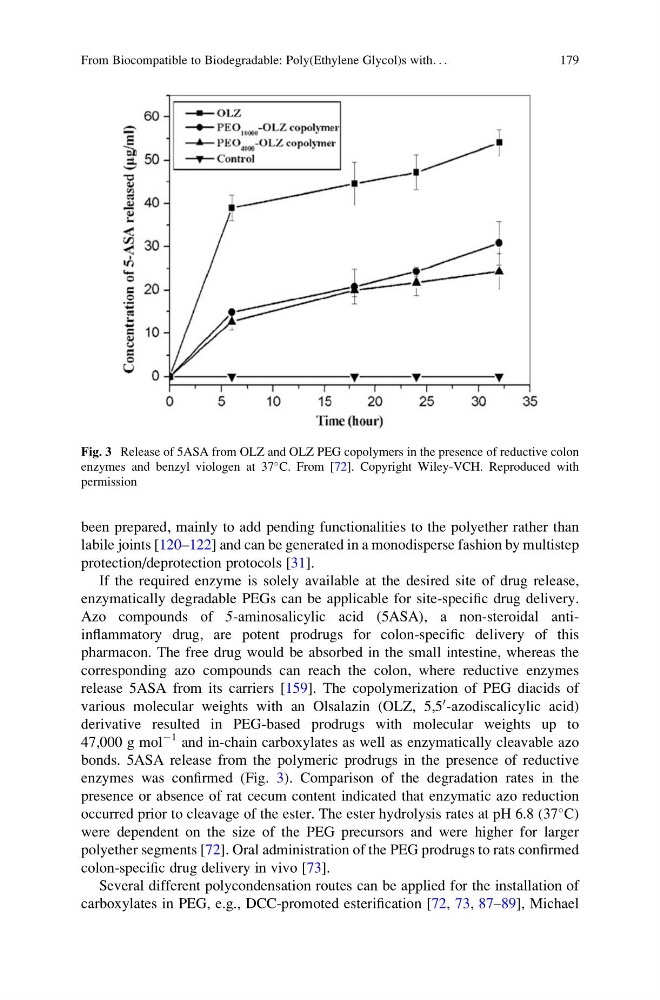
bonds. 5ASA release from the polymeric prodrugs in the presence of reductive
enzymes was confirmed (Fig. 3). Comparison of the degradation rates in the
presence or absence of rat cecum content indicated that enzymatic azo reduction
occurred prior to cleavage of the ester. The ester hydrolysis rates at pH 6.8 (37
C)
were dependent on the size of the PEG precursors and were higher for larger
polyether segments [72]. Oral administration of the PEG prodrugs to rats confirmed
colon-specific drug delivery in vivo [73].
Several different polycondensation routes can be applied for the installation of
carboxylates in PEG, e.g., DCC-promoted esterification [72, 73, 87–89], Michael
Fig. 3 Release of 5ASA from OLZ and OLZ PEG copolymers in the presence of reductive colon
enzymes and benzyl viologen at 37
C. From [72]. Copyright Wiley-VCH. Reproduced with
permission
From Biocompatible to Biodegradable: Poly(Ethylene Glycol)s with. . .
179
labile joints [120–122] and can be generated in a monodisperse fashion by multistep
protection/deprotection protocols [31].
If the required enzyme is solely available at the desired site of drug release,
enzymatically degradable PEGs can be applicable for site-specific drug delivery.
Azo compounds of 5-aminosalicylic acid (5ASA), a non-steroidal antiinflammatory drug, are potent prodrugs for colon-specific delivery of this
pharmacon. The free drug would be absorbed in the small intestine, whereas the
corresponding azo compounds can reach the colon, where reductive enzymes
release 5ASA from its carriers [159]. The copolymerization of PEG diacids of
various molecular weights with an Olsalazin (OLZ, 5,5
0 -azodiscalicylic acid)
derivative resulted in PEG-based prodrugs with molecular weights up to
47,000 g mol
À1 and in-chain carboxylates as well as enzymatically cleavable azo
bonds. 5ASA release from the polymeric prodrugs in the presence of reductive
enzymes was confirmed (Fig. 3). Comparison of the degradation rates in the
presence or absence of rat cecum content indicated that enzymatic azo reduction
occurred prior to cleavage of the ester. The ester hydrolysis rates at pH 6.8 (37
C)
were dependent on the size of the PEG precursors and were higher for larger
polyether segments [72]. Oral administration of the PEG prodrugs to rats confirmed
colon-specific drug delivery in vivo [73].
Several different polycondensation routes can be applied for the installation of
carboxylates in PEG, e.g., DCC-promoted esterification [72, 73, 87–89], Michael
Fig. 3 Release of 5ASA from OLZ and OLZ PEG copolymers in the presence of reductive colon
enzymes and benzyl viologen at 37
C. From [72]. Copyright Wiley-VCH. Reproduced with
permission
From Biocompatible to Biodegradable: Poly(Ethylene Glycol)s with. . .
179