

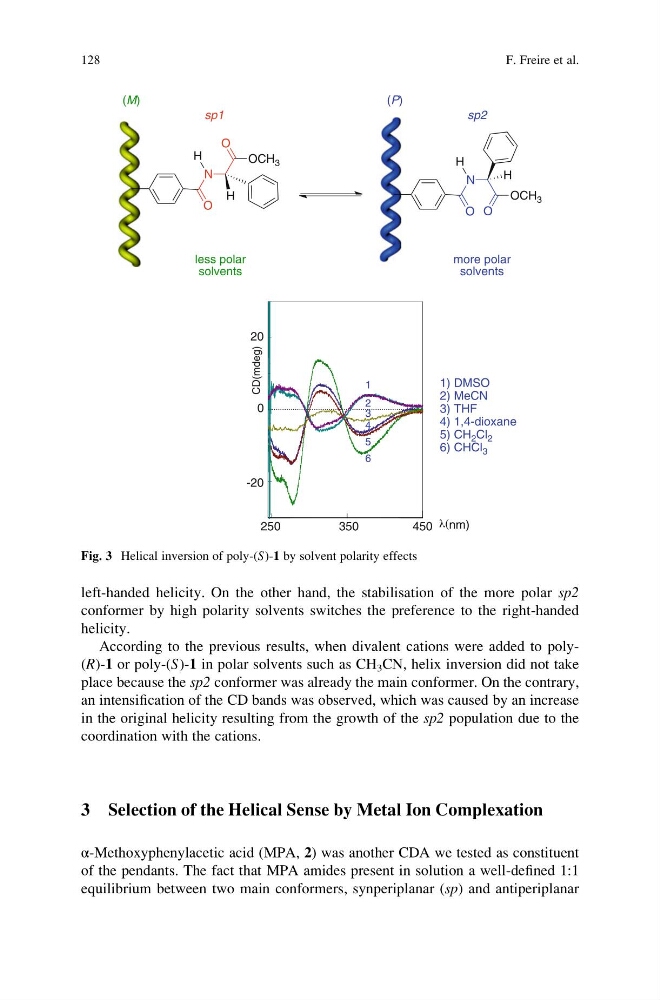
left-handed helicity. On the other hand, the stabilisation of the more polar sp2
conformer by high polarity solvents switches the preference to the right-handed
helicity.
According to the previous results, when divalent cations were added to poly(R)-1 or poly-(S)-1 in polar solvents such as CH 3 CN, helix inversion did not take
place because the sp2 conformer was already the main conformer. On the contrary,
an intensification of the CD bands was observed, which was caused by an increase
in the original helicity resulting from the growth of the sp2 population due to the
coordination with the cations.
3 Selection of the Helical Sense by Metal Ion Complexation
α-Methoxyphenylacetic acid (MPA, 2) was another CDA we tested as constituent
of the pendants. The fact that MPA amides present in solution a well-defined 1:1
equilibrium between two main conformers, synperiplanar (sp) and antiperiplanar
O
N
OCH 3
O
H
H
O
N
H
O
OCH 3
H
(M)
(P)
sp1
sp2
less polar
solvents
more polar
solvents
250
350
450
20
0
-20
( nm)
CD(mdeg)
1
2
3
4
5
6
1) DMSO
2) MeCN
3) THF
4) 1,4-dioxane
5) CH 2 Cl 2
6) CHCl 3
Fig. 3 Helical inversion of poly-(S)-1 by solvent polarity effects
128
F. Freire et al.
conformer by high polarity solvents switches the preference to the right-handed
helicity.
According to the previous results, when divalent cations were added to poly(R)-1 or poly-(S)-1 in polar solvents such as CH 3 CN, helix inversion did not take
place because the sp2 conformer was already the main conformer. On the contrary,
an intensification of the CD bands was observed, which was caused by an increase
in the original helicity resulting from the growth of the sp2 population due to the
coordination with the cations.
3 Selection of the Helical Sense by Metal Ion Complexation
α-Methoxyphenylacetic acid (MPA, 2) was another CDA we tested as constituent
of the pendants. The fact that MPA amides present in solution a well-defined 1:1
equilibrium between two main conformers, synperiplanar (sp) and antiperiplanar
O
N
OCH 3
O
H
H
O
N
H
O
OCH 3
H
(M)
(P)
sp1
sp2
less polar
solvents
more polar
solvents
250
350
450
20
0
-20
( nm)
CD(mdeg)
1
2
3
4
5
6
1) DMSO
2) MeCN
3) THF
4) 1,4-dioxane
5) CH 2 Cl 2
6) CHCl 3
Fig. 3 Helical inversion of poly-(S)-1 by solvent polarity effects
128
F. Freire et al.