

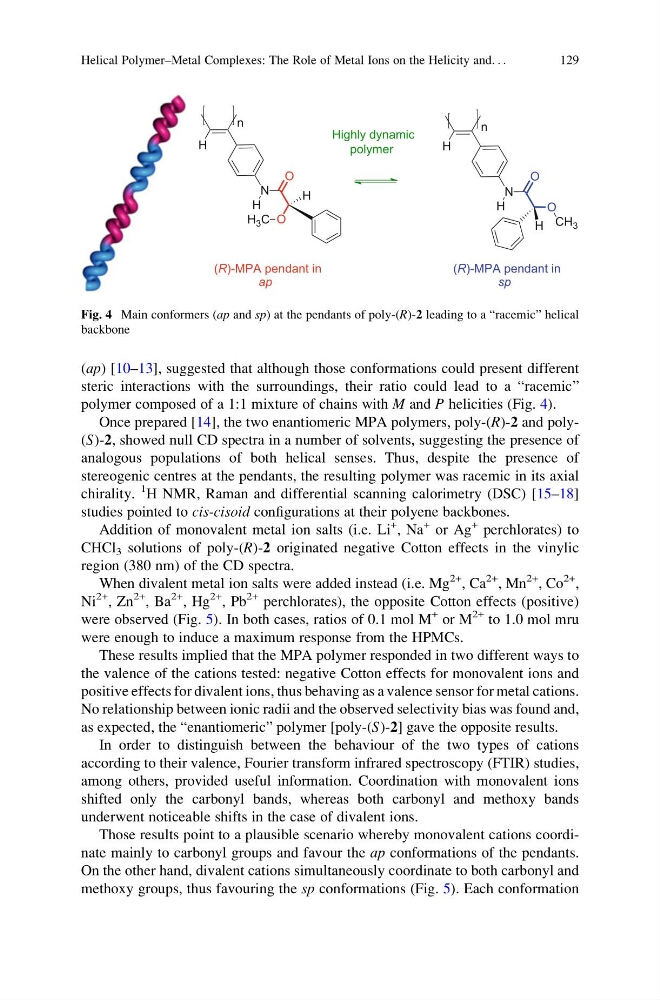
(ap) [10–13], suggested that although those conformations could present different
steric interactions with the surroundings, their ratio could lead to a “racemic”
polymer composed of a 1:1 mixture of chains with M and P helicities (Fig. 4).
Once prepared [14], the two enantiomeric MPA polymers, poly-(R)-2 and poly(S)-2, showed null CD spectra in a number of solvents, suggesting the presence of
analogous populations of both helical senses. Thus, despite the presence of
stereogenic centres at the pendants, the resulting polymer was racemic in its axial
chirality.
1 H NMR, Raman and differential scanning calorimetry (DSC) [15–18]
studies pointed to cis-cisoid configurations at their polyene backbones.
Addition of monovalent metal ion salts (i.e. Li
+ , Na
+ or Ag
+ perchlorates) to
CHCl 3 solutions of poly-(R)-2 originated negative Cotton effects in the vinylic
region (380 nm) of the CD spectra.
When divalent metal ion salts were added instead (i.e. Mg
2+ , Ca
2+ , Mn
2+ , Co
2+ ,
Ni
2+ , Zn
2+ , Ba
2+ , Hg
2+ , Pb
2+ perchlorates), the opposite Cotton effects (positive)
were observed (Fig. 5). In both cases, ratios of 0.1 mol M
+ or M
2+ to 1.0 mol mru
were enough to induce a maximum response from the HPMCs.
These results implied that the MPA polymer responded in two different ways to
the valence of the cations tested: negative Cotton effects for monovalent ions and
positive effects for divalent ions, thus behaving as a valence sensor for metal cations.
No relationship between ionic radii and the observed selectivity bias was found and,
as expected, the “enantiomeric” polymer [poly-(S)-2] gave the opposite results.
In order to distinguish between the behaviour of the two types of cations
according to their valence, Fourier transform infrared spectroscopy (FTIR) studies,
among others, provided useful information. Coordination with monovalent ions
shifted only the carbonyl bands, whereas both carbonyl and methoxy bands
underwent noticeable shifts in the case of divalent ions.
Those results point to a plausible scenario whereby monovalent cations coordinate mainly to carbonyl groups and favour the ap conformations of the pendants.
On the other hand, divalent cations simultaneously coordinate to both carbonyl and
methoxy groups, thus favouring the sp conformations (Fig. 5). Each conformation
N
H
N
O
H
O
O
O
H
H
H 3 C
CH 3
(R)-MPA pendant in
ap
(R)-MPA pendant in
sp
Highly dynamic
polymer
H
H
n
n
Fig. 4 Main conformers (ap and sp) at the pendants of poly-(R)-2 leading to a “racemic” helical
backbone
Helical Polymer–Metal Complexes: The Role of Metal Ions on the Helicity and. . .
129
steric interactions with the surroundings, their ratio could lead to a “racemic”
polymer composed of a 1:1 mixture of chains with M and P helicities (Fig. 4).
Once prepared [14], the two enantiomeric MPA polymers, poly-(R)-2 and poly(S)-2, showed null CD spectra in a number of solvents, suggesting the presence of
analogous populations of both helical senses. Thus, despite the presence of
stereogenic centres at the pendants, the resulting polymer was racemic in its axial
chirality.
1 H NMR, Raman and differential scanning calorimetry (DSC) [15–18]
studies pointed to cis-cisoid configurations at their polyene backbones.
Addition of monovalent metal ion salts (i.e. Li
+ , Na
+ or Ag
+ perchlorates) to
CHCl 3 solutions of poly-(R)-2 originated negative Cotton effects in the vinylic
region (380 nm) of the CD spectra.
When divalent metal ion salts were added instead (i.e. Mg
2+ , Ca
2+ , Mn
2+ , Co
2+ ,
Ni
2+ , Zn
2+ , Ba
2+ , Hg
2+ , Pb
2+ perchlorates), the opposite Cotton effects (positive)
were observed (Fig. 5). In both cases, ratios of 0.1 mol M
+ or M
2+ to 1.0 mol mru
were enough to induce a maximum response from the HPMCs.
These results implied that the MPA polymer responded in two different ways to
the valence of the cations tested: negative Cotton effects for monovalent ions and
positive effects for divalent ions, thus behaving as a valence sensor for metal cations.
No relationship between ionic radii and the observed selectivity bias was found and,
as expected, the “enantiomeric” polymer [poly-(S)-2] gave the opposite results.
In order to distinguish between the behaviour of the two types of cations
according to their valence, Fourier transform infrared spectroscopy (FTIR) studies,
among others, provided useful information. Coordination with monovalent ions
shifted only the carbonyl bands, whereas both carbonyl and methoxy bands
underwent noticeable shifts in the case of divalent ions.
Those results point to a plausible scenario whereby monovalent cations coordinate mainly to carbonyl groups and favour the ap conformations of the pendants.
On the other hand, divalent cations simultaneously coordinate to both carbonyl and
methoxy groups, thus favouring the sp conformations (Fig. 5). Each conformation
N
H
N
O
H
O
O
O
H
H
H 3 C
CH 3
(R)-MPA pendant in
ap
(R)-MPA pendant in
sp
Highly dynamic
polymer
H
H
n
n
Fig. 4 Main conformers (ap and sp) at the pendants of poly-(R)-2 leading to a “racemic” helical
backbone
Helical Polymer–Metal Complexes: The Role of Metal Ions on the Helicity and. . .
129