

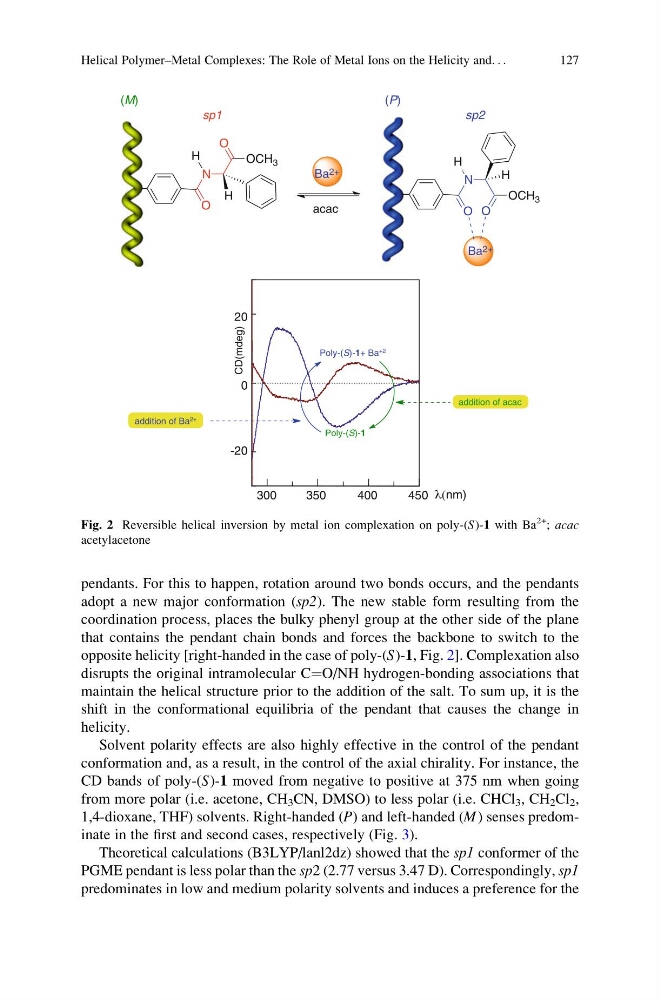
pendants. For this to happen, rotation around two bonds occurs, and the pendants
adopt a new major conformation (sp2). The new stable form resulting from the
coordination process, places the bulky phenyl group at the other side of the plane
that contains the pendant chain bonds and forces the backbone to switch to the
opposite helicity [right-handed in the case of poly-(S)-1, Fig. 2]. Complexation also
disrupts the original intramolecular C¼O/NH hydrogen-bonding associations that
maintain the helical structure prior to the addition of the salt. To sum up, it is the
shift in the conformational equilibria of the pendant that causes the change in
helicity.
Solvent polarity effects are also highly effective in the control of the pendant
conformation and, as a result, in the control of the axial chirality. For instance, the
CD bands of poly-(S)-1 moved from negative to positive at 375 nm when going
from more polar (i.e. acetone, CH 3 CN, DMSO) to less polar (i.e. CHCl 3 , CH 2 Cl 2 ,
1,4-dioxane, THF) solvents. Right-handed (P) and left-handed (M ) senses predominate in the first and second cases, respectively (Fig. 3).
Theoretical calculations (B3LYP/lanl2dz) showed that the sp1 conformer of the
PGME pendant is less polar than the sp2 (2.77 versus 3.47 D). Correspondingly, sp1
predominates in low and medium polarity solvents and induces a preference for the
O
N
OCH 3
O
H
H
O
N
H
O
OCH 3
H
Ba 2+
Ba 2+
acac
Poly-(S)-1
Poly-(S)-1+ Ba +2
addition of acac
300
350
400
20
0
-20
(nm)
CD(mdeg)
450
addition of Ba 2+
(M)
(P)
sp1
sp2
Fig. 2 Reversible helical inversion by metal ion complexation on poly-(S)-1 with Ba
2+ ; acac
acetylacetone
Helical Polymer–Metal Complexes: The Role of Metal Ions on the Helicity and. . .
127
adopt a new major conformation (sp2). The new stable form resulting from the
coordination process, places the bulky phenyl group at the other side of the plane
that contains the pendant chain bonds and forces the backbone to switch to the
opposite helicity [right-handed in the case of poly-(S)-1, Fig. 2]. Complexation also
disrupts the original intramolecular C¼O/NH hydrogen-bonding associations that
maintain the helical structure prior to the addition of the salt. To sum up, it is the
shift in the conformational equilibria of the pendant that causes the change in
helicity.
Solvent polarity effects are also highly effective in the control of the pendant
conformation and, as a result, in the control of the axial chirality. For instance, the
CD bands of poly-(S)-1 moved from negative to positive at 375 nm when going
from more polar (i.e. acetone, CH 3 CN, DMSO) to less polar (i.e. CHCl 3 , CH 2 Cl 2 ,
1,4-dioxane, THF) solvents. Right-handed (P) and left-handed (M ) senses predominate in the first and second cases, respectively (Fig. 3).
Theoretical calculations (B3LYP/lanl2dz) showed that the sp1 conformer of the
PGME pendant is less polar than the sp2 (2.77 versus 3.47 D). Correspondingly, sp1
predominates in low and medium polarity solvents and induces a preference for the
O
N
OCH 3
O
H
H
O
N
H
O
OCH 3
H
Ba 2+
Ba 2+
acac
Poly-(S)-1
Poly-(S)-1+ Ba +2
addition of acac
300
350
400
20
0
-20
(nm)
CD(mdeg)
450
addition of Ba 2+
(M)
(P)
sp1
sp2
Fig. 2 Reversible helical inversion by metal ion complexation on poly-(S)-1 with Ba
2+ ; acac
acetylacetone
Helical Polymer–Metal Complexes: The Role of Metal Ions on the Helicity and. . .
127