

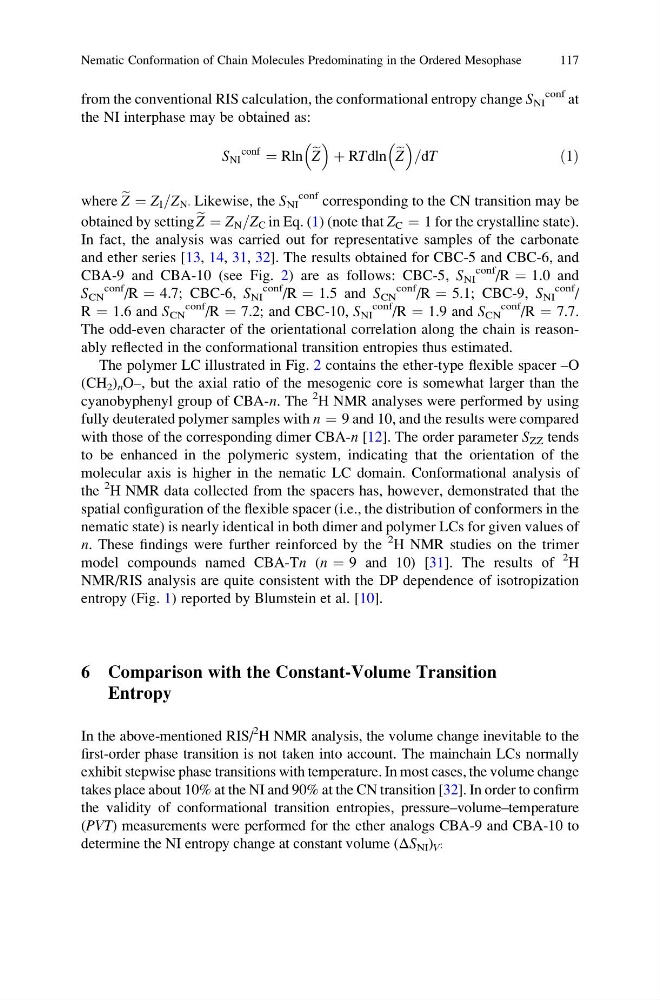
from the conventional RIS calculation, the conformational entropy change S NI
conf at
the NI interphase may be obtained as:
S NI
conf
¼ Rln e
Z
þ RTdln e
Z
=dT
ð1Þ
where e
Z ¼ Z I =Z N . Likewise, the S NI
conf corresponding to the CN transition may be
obtained by setting e
Z ¼ Z N =Z C in Eq. (1) (note that Z C ¼ 1 for the crystalline state).
In fact, the analysis was carried out for representative samples of the carbonate
and ether series [13, 14, 31, 32]. The results obtained for CBC-5 and CBC-6, and
CBA-9 and CBA-10 (see Fig. 2) are as follows: CBC-5, S NI
conf /R ¼ 1.0 and
S CN
conf /R ¼ 4.7; CBC-6, S NI
conf /R ¼ 1.5 and S CN
conf /R ¼ 5.1; CBC-9, S NI
conf
/
R ¼ 1.6 and S CN
conf /R ¼ 7.2; and CBC-10, S NI
conf
/R ¼ 1.9 and S CN
conf /R ¼ 7.7.
The odd-even character of the orientational correlation along the chain is reasonably reflected in the conformational transition entropies thus estimated.
The polymer LC illustrated in Fig. 2 contains the ether-type flexible spacer –O
(CH 2 ) n O–, but the axial ratio of the mesogenic core is somewhat larger than the
cyanobyphenyl group of CBA-n. The
2 H NMR analyses were performed by using
fully deuterated polymer samples with n ¼ 9 and 10, and the results were compared
with those of the corresponding dimer CBA-n [12]. The order parameter S ZZ tends
to be enhanced in the polymeric system, indicating that the orientation of the
molecular axis is higher in the nematic LC domain. Conformational analysis of
the
2 H NMR data collected from the spacers has, however, demonstrated that the
spatial configuration of the flexible spacer (i.e., the distribution of conformers in the
nematic state) is nearly identical in both dimer and polymer LCs for given values of
n. These findings were further reinforced by the
2 H NMR studies on the trimer
model compounds named CBA-Tn (n ¼ 9 and 10) [31]. The results of
2 H
NMR/RIS analysis are quite consistent with the DP dependence of isotropization
entropy (Fig. 1) reported by Blumstein et al. [10].
6 Comparison with the Constant-Volume Transition
Entropy
In the above-mentioned RIS/
2
H NMR analysis, the volume change inevitable to the
first-order phase transition is not taken into account. The mainchain LCs normally
exhibit stepwise phase transitions with temperature. In most cases, the volume change
takes place about 10% at the NI and 90% at the CN transition [32]. In order to confirm
the validity of conformational transition entropies, pressure–volume–temperature
(PVT) measurements were performed for the ether analogs CBA-9 and CBA-10 to
determine the NI entropy change at constant volume (ΔS NI ) V :
Nematic Conformation of Chain Molecules Predominating in the Ordered Mesophase
117
conf at
the NI interphase may be obtained as:
S NI
conf
¼ Rln e
Z
þ RTdln e
Z
=dT
ð1Þ
where e
Z ¼ Z I =Z N . Likewise, the S NI
conf corresponding to the CN transition may be
obtained by setting e
Z ¼ Z N =Z C in Eq. (1) (note that Z C ¼ 1 for the crystalline state).
In fact, the analysis was carried out for representative samples of the carbonate
and ether series [13, 14, 31, 32]. The results obtained for CBC-5 and CBC-6, and
CBA-9 and CBA-10 (see Fig. 2) are as follows: CBC-5, S NI
conf /R ¼ 1.0 and
S CN
conf /R ¼ 4.7; CBC-6, S NI
conf /R ¼ 1.5 and S CN
conf /R ¼ 5.1; CBC-9, S NI
conf
/
R ¼ 1.6 and S CN
conf /R ¼ 7.2; and CBC-10, S NI
conf
/R ¼ 1.9 and S CN
conf /R ¼ 7.7.
The odd-even character of the orientational correlation along the chain is reasonably reflected in the conformational transition entropies thus estimated.
The polymer LC illustrated in Fig. 2 contains the ether-type flexible spacer –O
(CH 2 ) n O–, but the axial ratio of the mesogenic core is somewhat larger than the
cyanobyphenyl group of CBA-n. The
2 H NMR analyses were performed by using
fully deuterated polymer samples with n ¼ 9 and 10, and the results were compared
with those of the corresponding dimer CBA-n [12]. The order parameter S ZZ tends
to be enhanced in the polymeric system, indicating that the orientation of the
molecular axis is higher in the nematic LC domain. Conformational analysis of
the
2 H NMR data collected from the spacers has, however, demonstrated that the
spatial configuration of the flexible spacer (i.e., the distribution of conformers in the
nematic state) is nearly identical in both dimer and polymer LCs for given values of
n. These findings were further reinforced by the
2 H NMR studies on the trimer
model compounds named CBA-Tn (n ¼ 9 and 10) [31]. The results of
2 H
NMR/RIS analysis are quite consistent with the DP dependence of isotropization
entropy (Fig. 1) reported by Blumstein et al. [10].
6 Comparison with the Constant-Volume Transition
Entropy
In the above-mentioned RIS/
2
H NMR analysis, the volume change inevitable to the
first-order phase transition is not taken into account. The mainchain LCs normally
exhibit stepwise phase transitions with temperature. In most cases, the volume change
takes place about 10% at the NI and 90% at the CN transition [32]. In order to confirm
the validity of conformational transition entropies, pressure–volume–temperature
(PVT) measurements were performed for the ether analogs CBA-9 and CBA-10 to
determine the NI entropy change at constant volume (ΔS NI ) V :
Nematic Conformation of Chain Molecules Predominating in the Ordered Mesophase
117