

ΔS NI
ð
Þ V ¼ ΔS NI
ð
Þ P À ΔS V
ð2Þ
with:
ΔS V ¼ γΔV NI
ð3Þ
where (ΔS NI ) P is the NI transition entropy under constant pressure, γ ¼ (∂P/∂T ) V
is the thermal-pressure coefficient, and ΔV NI represents the volume change at the
NI transition [33–35]. Essentially the same procedure can be applicable for the
estimation of the entropy change at constant volume (ΔS CN ) V for the CN transition.
The values obtained in this manner are as follows: for CBA-9 (ΔS NI ) V /R ¼ 0.7
À 1.0 and (ΔS CN ) V /R ¼ 7.3 À 9.7, and for CBA-10 (ΔS NI ) V /R ¼ 0.8 À 1.8 and
(ΔS CN ) V /R ¼ 7.8 À 9.2 [36–38]. In view of the uncertainties involved in the
multistage deduction of these values, the correspondence with the conformational
entropy changes, S NI
conf /R and S CN
conf /R, estimated by the RIS/
2 H NMR technique
is reasonable. It should be noted that the order–disorder characteristics inherent to
the primary structure of the flexible spacer are precisely controlled in order to
develop the LC mesophase. Combined use of spectroscopic and thermodynamic
technique has been extended to treat the trimer models CBA-T9 and CBA-T10, and
MBBE-6 [26, 38]. As a result, it has been confirmed that 50–60% of the transition
entropy (ΔS tr ) p (tr ¼ NI or CN) arises from the variation in the conformational
distribution of the spacer at the phase boundary. Although PVT data are not
available for carbonate LCs, the thermodynamic role of the nematic conformation
found between the isotropic and crystalline phases may be similar.
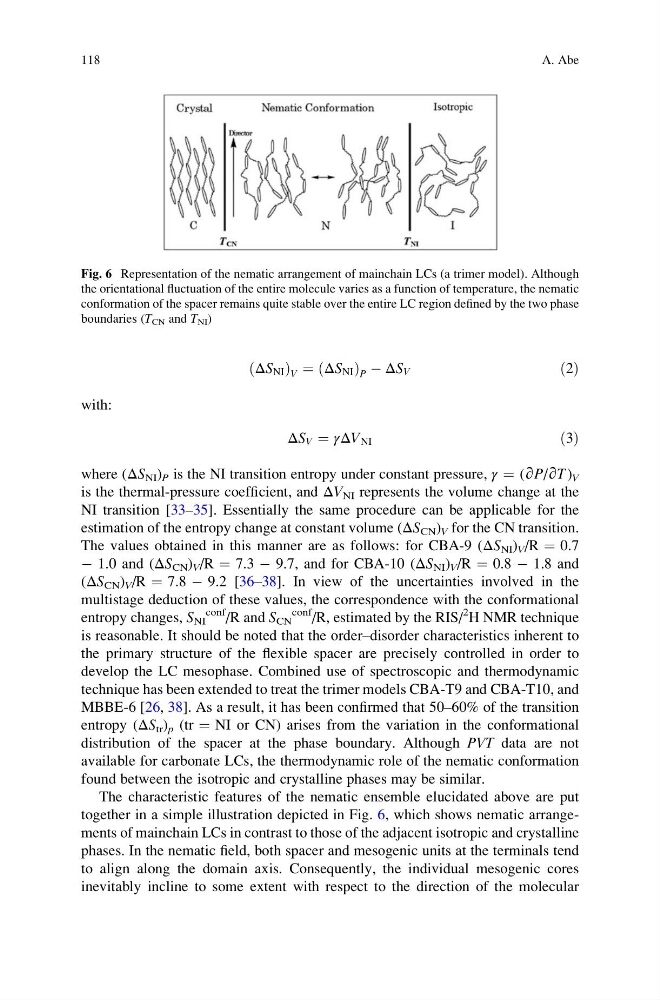
The characteristic features of the nematic ensemble elucidated above are put
together in a simple illustration depicted in Fig. 6, which shows nematic arrangements of mainchain LCs in contrast to those of the adjacent isotropic and crystalline
phases. In the nematic field, both spacer and mesogenic units at the terminals tend
to align along the domain axis. Consequently, the individual mesogenic cores
inevitably incline to some extent with respect to the direction of the molecular
Fig. 6 Representation of the nematic arrangement of mainchain LCs (a trimer model). Although
the orientational fluctuation of the entire molecule varies as a function of temperature, the nematic
conformation of the spacer remains quite stable over the entire LC region defined by the two phase
boundaries (T CN and T NI )
118
A. Abe
ð
Þ V ¼ ΔS NI
ð
Þ P À ΔS V
ð2Þ
with:
ΔS V ¼ γΔV NI
ð3Þ
where (ΔS NI ) P is the NI transition entropy under constant pressure, γ ¼ (∂P/∂T ) V
is the thermal-pressure coefficient, and ΔV NI represents the volume change at the
NI transition [33–35]. Essentially the same procedure can be applicable for the
estimation of the entropy change at constant volume (ΔS CN ) V for the CN transition.
The values obtained in this manner are as follows: for CBA-9 (ΔS NI ) V /R ¼ 0.7
À 1.0 and (ΔS CN ) V /R ¼ 7.3 À 9.7, and for CBA-10 (ΔS NI ) V /R ¼ 0.8 À 1.8 and
(ΔS CN ) V /R ¼ 7.8 À 9.2 [36–38]. In view of the uncertainties involved in the
multistage deduction of these values, the correspondence with the conformational
entropy changes, S NI
conf /R and S CN
conf /R, estimated by the RIS/
2 H NMR technique
is reasonable. It should be noted that the order–disorder characteristics inherent to
the primary structure of the flexible spacer are precisely controlled in order to
develop the LC mesophase. Combined use of spectroscopic and thermodynamic
technique has been extended to treat the trimer models CBA-T9 and CBA-T10, and
MBBE-6 [26, 38]. As a result, it has been confirmed that 50–60% of the transition
entropy (ΔS tr ) p (tr ¼ NI or CN) arises from the variation in the conformational
distribution of the spacer at the phase boundary. Although PVT data are not
available for carbonate LCs, the thermodynamic role of the nematic conformation
found between the isotropic and crystalline phases may be similar.
The characteristic features of the nematic ensemble elucidated above are put
together in a simple illustration depicted in Fig. 6, which shows nematic arrangements of mainchain LCs in contrast to those of the adjacent isotropic and crystalline
phases. In the nematic field, both spacer and mesogenic units at the terminals tend
to align along the domain axis. Consequently, the individual mesogenic cores
inevitably incline to some extent with respect to the direction of the molecular
Fig. 6 Representation of the nematic arrangement of mainchain LCs (a trimer model). Although
the orientational fluctuation of the entire molecule varies as a function of temperature, the nematic
conformation of the spacer remains quite stable over the entire LC region defined by the two phase
boundaries (T CN and T NI )
118
A. Abe