

conformational disordering due to the gauche preference around the OC–CO bond
involved in the OE sequence.
5 Elucidation of the Nematic Conformation and Its
Contribution to the NI Transition Entropy
The
2 H NMR technique has been shown to be very useful in studying the orientational characteristics of nematic LCs [28–30]. Under an NMR magnetic field, the
axis of the nematic domain tends to align along the applied field, and thus the
resulting LC phase is taken to be of a monodomain texture. The order parameters
S ZZ
M , and S XX
M
À S YY
M of the mesogenic core comprising a linear array of
aromatic nuclei can be accurately determined from the observed dipolar and
quadrupolar splittings. The orientational characteristics of the spacer can be similarly estimated by using samples carrying a per-deuterated n-alkane sequence. The
nematic conformation of the flexible segment is a quantity defined in the intramolecular coordinate system. With a proper assumption for the molecular axis,
approximate values of the bond conformation around the internal C–O and C–C
bonds can be elucidated. In fact, a RIS simulation has been performed on the
configuration map defined in the intramolecular coordinate system until the
observed quadrupolar splittings are properly reproduced [12]. The conformer
distribution thus estimated leads to the configurational partition function Z N for
the nematic state. Since the partition function Z I for the isotropic state is available
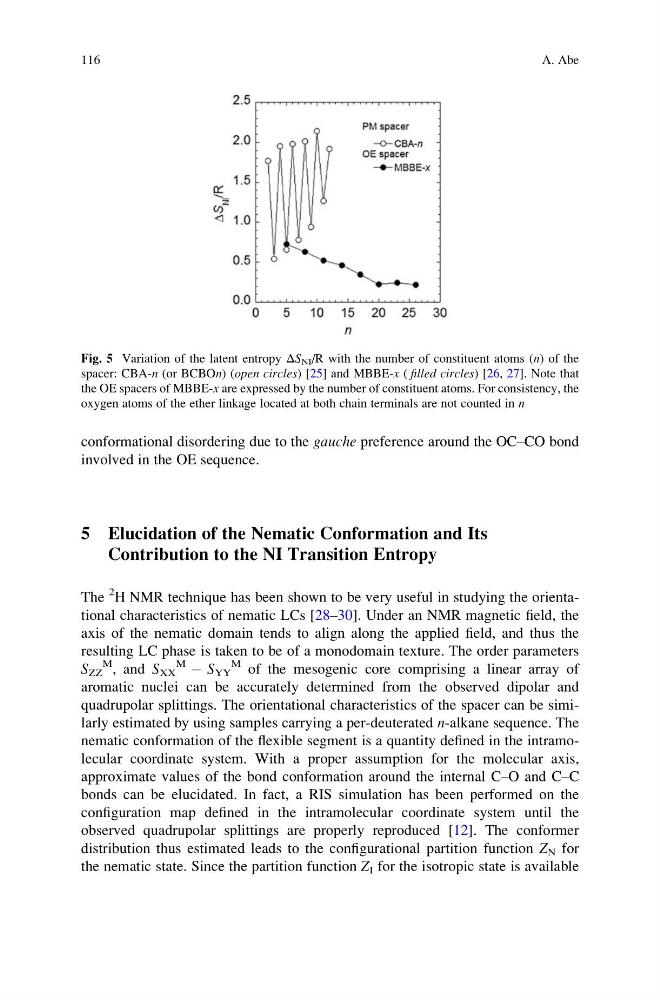
Fig. 5 Variation of the latent entropy ΔS NI /R with the number of constituent atoms (n) of the
spacer: CBA-n (or BCBOn) (open circles) [25] and MBBE-x ( filled circles) [26, 27]. Note that
the OE spacers of MBBE-x are expressed by the number of constituent atoms. For consistency, the
oxygen atoms of the ether linkage located at both chain terminals are not counted in n
116
A. Abe
involved in the OE sequence.
5 Elucidation of the Nematic Conformation and Its
Contribution to the NI Transition Entropy
The
2 H NMR technique has been shown to be very useful in studying the orientational characteristics of nematic LCs [28–30]. Under an NMR magnetic field, the
axis of the nematic domain tends to align along the applied field, and thus the
resulting LC phase is taken to be of a monodomain texture. The order parameters
S ZZ
M , and S XX
M
À S YY
M of the mesogenic core comprising a linear array of
aromatic nuclei can be accurately determined from the observed dipolar and
quadrupolar splittings. The orientational characteristics of the spacer can be similarly estimated by using samples carrying a per-deuterated n-alkane sequence. The
nematic conformation of the flexible segment is a quantity defined in the intramolecular coordinate system. With a proper assumption for the molecular axis,
approximate values of the bond conformation around the internal C–O and C–C
bonds can be elucidated. In fact, a RIS simulation has been performed on the
configuration map defined in the intramolecular coordinate system until the
observed quadrupolar splittings are properly reproduced [12]. The conformer
distribution thus estimated leads to the configurational partition function Z N for
the nematic state. Since the partition function Z I for the isotropic state is available
Fig. 5 Variation of the latent entropy ΔS NI /R with the number of constituent atoms (n) of the
spacer: CBA-n (or BCBOn) (open circles) [25] and MBBE-x ( filled circles) [26, 27]. Note that
the OE spacers of MBBE-x are expressed by the number of constituent atoms. For consistency, the
oxygen atoms of the ether linkage located at both chain terminals are not counted in n
116
A. Abe