

Growth of Present� Day Concepts, 1978-1988
0
2k m
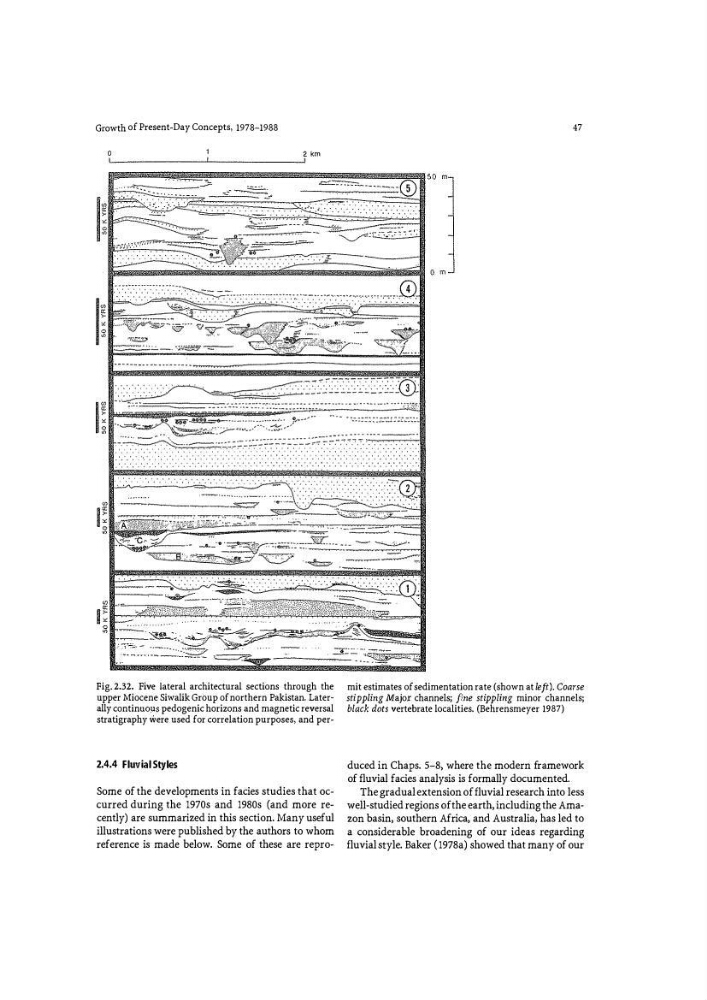
Fig. 2.32. Five lateral architectural sections through the
upper Miocene Siwalik Group of northern Pakistan. Later�
ally continUO!JS pedogenic horizons and magnetic reversal
stratigraphy Were used for correlation purposes, and per�
2.4.4 Fluvial Styles
Some of the developments in facies studies that occurred during the 1970s and 1980s (and more recently) are summarized in this section. Many useful
illustrations were published by the authors to whom
reference is made below. Some of these are repro47
mit estimates of sedimentation rate (shown at left). Coarse
stippling Major channels; fine stippling minor channels;
black dots vertebrate localities. (Behrensmeyer 1987)
duced in Chaps. S-8, where the modern fr amework
of fluvial facies analysis is formally documented.
The gradual extension of fluvial research into less
well-studied regions of the earth, including the Ama�
zon basin, southern Africa, and Australia, has led to
a considerable broadening of our ideas regarding
fluvial style. Baker ( 1978a) showed that many of our
0
2k m
Fig. 2.32. Five lateral architectural sections through the
upper Miocene Siwalik Group of northern Pakistan. Later�
ally continUO!JS pedogenic horizons and magnetic reversal
stratigraphy Were used for correlation purposes, and per�
2.4.4 Fluvial Styles
Some of the developments in facies studies that occurred during the 1970s and 1980s (and more recently) are summarized in this section. Many useful
illustrations were published by the authors to whom
reference is made below. Some of these are repro47
mit estimates of sedimentation rate (shown at left). Coarse
stippling Major channels; fine stippling minor channels;
black dots vertebrate localities. (Behrensmeyer 1987)
duced in Chaps. S-8, where the modern fr amework
of fluvial facies analysis is formally documented.
The gradual extension of fluvial research into less
well-studied regions of the earth, including the Ama�
zon basin, southern Africa, and Australia, has led to
a considerable broadening of our ideas regarding
fluvial style. Baker ( 1978a) showed that many of our