

Paleovalley Fields (PV Type)
TWO-WAY
Til!lE (SEC)
0.3
' ( �(
Q
)
:<:
:<:
503
FORMATIONS
.�
:<::
N UOBRARA
lio c ARLII.E
( ( ( \ �� ) n :
'\ <:.. :\<
)))I • )HH I ) G REENHORII
RAN EROS
SANDSTONE
�· 'r·= .�
0.4
<;, <\\" X::: ,;!r!rrr rr:>?
??X'c"?�!c(('- 'l'J'
UNTSMAN
SANDSTONE
Trace lnleNai = 220 It Sampling Rale = 1 msec
Wavelel = Ricker 60 Hz
B
A
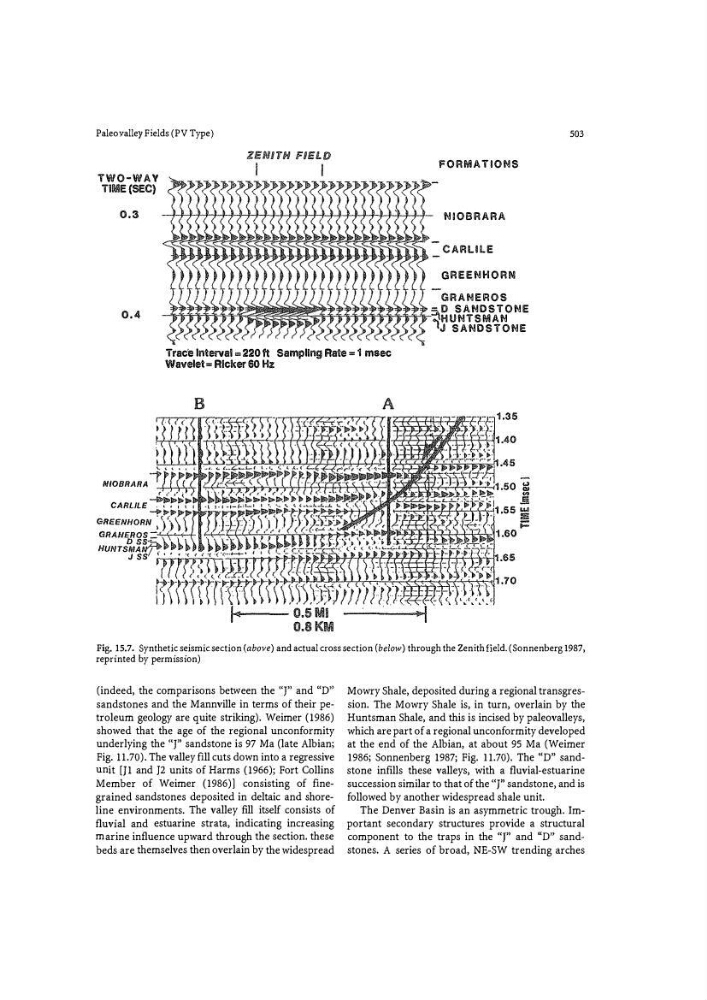
Fig. 15.7. Synthetic seismic section (above) and actual cross section (below) through the Zenith field. (Sonnenberg 1987,
reprinted by permission)
(indeed, the comparisons between the "t and "D')
sandstones and the Mannville in terms of their petroleum geology are quite striking). Weimer (1986)
showed that the age of the regional unconformity
underlying the 'T' sandstone is 97 Ma (late Albian;
Fig. 1 1.70). The valley fill cuts down into a regressive
unit [)1 and )2 units of Harms (1966); Fort Collins
Member of Weimer (1986)] consisting of finegrained sandstones deposited in deltaic and shoreline environments. The valley fill itself consists of
fluvial and estuarine strata, indicating increasing
marine influence upward through the section. these
beds are themselves then overlain by the widespread
Mowry Shale, deposited during a regional transgression. The Mowry Shale is, in turn, overlain by the
Huntsman Shale, and this is incised by paleovalleys,
which are part of a regional unconformity developed
at the end of the Albian, at about 95 Ma (Weimer
1986; Sonnenberg 1987; Fig. 11.70). The "D" sandstone infills these valleys, with a fluvial-estuarine
succession similar to that of the 'T' sandstone, and is
followed by another widespread shale unit.
The Denver Basin is an asymmetric trough. Important secondary structures provide a structural
component to the traps in the «J" and cc D" sandstones. A series of broad, NE-SW trending arches