

502
Case Studies of Oil and Gas Fields in Fluvial Reservoirs
B
B'
NwNw S&c. 20, T3S, R62W SwSwS0e. 17, T3S,RI!i2W NwNw Sec. 17, T3S, R62W
SwNw Sec. 17, T3S, RG2W
v
•
•
•
�
-g..
..
-�0
GRANEROS
-gSP
c
-=VALLEY
= FILL
SP
c•
SwNw he. 24, T3S, R83W NwNw Sec. 24, T3S, R63W
SeSw Sec. 13, T3S, R63W
•
•
v
---T- -1--- -- -- - -�=-��--- -- -- -- -- -1- --+- -- -- --g
GRANEROS
..
-gSP
R
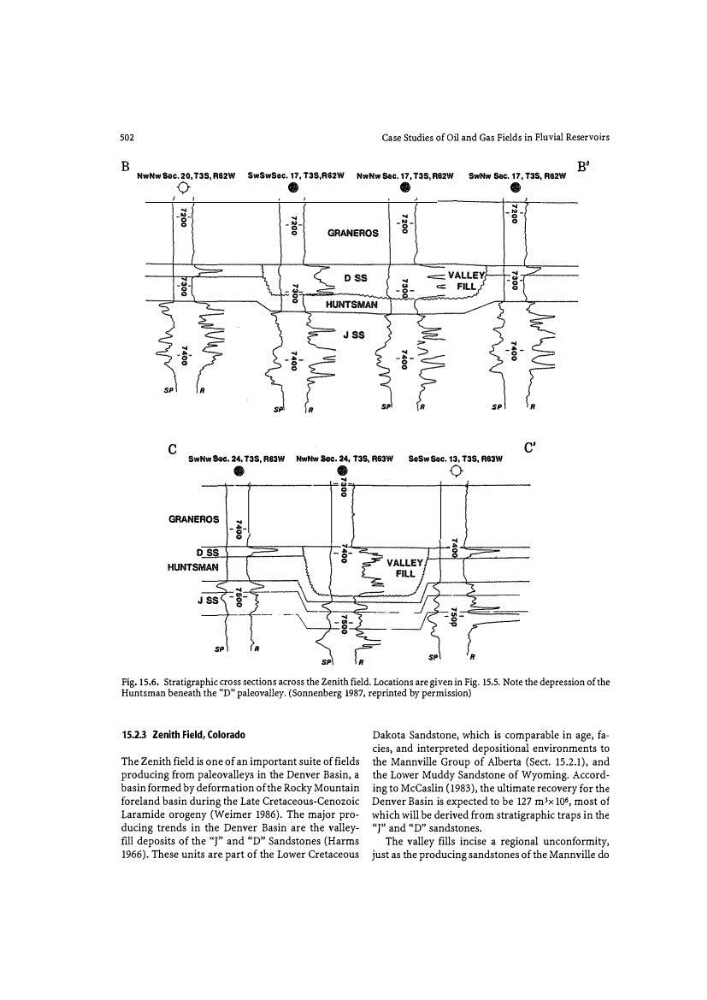
Fig. 15.6. Stratigraphic cross sections across the Zenith field. Locations are given in Fig. 15.5. Note the depression of the
Huntsman beneath the "D" paleovalley. (Sonnenberg 1987, reprinted by permission)
15.2.3 Zenith Field, Colorado
The Zenith field is one of an important suite of fields
producing from paleovalleys in the Denver Basin, a
basin formed by deformation of the Rocky Mountain
foreland basin during the Late Cretaceous-Cenozoic
Laramide orogeny (Weimer 1986). The major producing trends in the Denver Basin are the valleyfiJI deposits of the ")" and "D" Sandstones (Harms
1966). These units are part of the Lower Cretaceous
Dakota Sandstone, which is comparable in age, facies, and interpreted depositional environments to
the Mannville Group of Alberta (Sect. 15.2.1), and
the Lower Muddy Sandstone of Wyoming. According to McCaslin (1983), the ultimate recovery for the
Denver Basin is expected to be 127 m3x 106, most of
which will be derived from stratigraphic traps in the
just as the producing sandstones of the Mannville do