

Styles of Fluvial Reservoir
the trap occurs where bends in the paleovalley in�
elude a convexity facing updip. South Ceres field,
Oklahoma (Lyons and Dobrin 1972; Sect. 15.2.4),
Recluse field, in Powder River Basin (Woncik 1972),
and Midland field, Kentucky (Reynolds and Vincent
1972) are good examples. Another type of trap is
where the paleovalley is folded over an anticline.
Glenrock field, Wyoming (Curry and Curry 1972),
and Lane field, Colorado (Harms 1966), are examples. Cheyenne Valley field, Oklahoma (Withrow
1968), occurs where a paleovalley is oriented oblique
to regional dip but porosity decreases updip, provid�
ing a trapping mechanism.
A subtle paleogeomorphic trapping mechanism
may be created by the erosional topography over a
bar deposit. Such is the case in the Bellshill Lake and
Hughenden fields, Alberta (Martin 1966; Conybeare
1976), in which the actual trap occurs where penecontemporaneous fluvial erosion sculpted the top of
the sandstone body into a series of terraces.
Nearly all PV-type fields documented to date
occur in foreland-basin settings, including the those
in the Cretaceous of the Western Interior Basin
(Mannville fields, Alberta; 'T' and "D" Sandstone,
Denver Basin; South Glenrock and Recluse fields,
Powder River Basin, Wyoming), Arkoma Basin
(South Ceres and Cheyenne Valley fields), and those
in Ordos Basin, China. Paleovalleys are, of course,
common in other structural settings, but most do
not appear to be associated with significant petro�
leurn trapped in fluvial reservoirs. For example, a
major unconformity with incised valleys underlies
the Tuscaloosa Sandstone of Mississippi, in the extensional-margin setting of the Gulf Coast (Hogg
1988; Garrison and Chancellor 1991), but fluvial proPermeability in mi!lidarcies
0
491
duction is located in a fluvial�deltaic complex that
overlies the valley fill. Incised valley complexes are
an important component of the Wilcox Group in
Texas, but they are mainly mud filled (Devine and
Wheeler 1989). There is believed to be minor fluvial
sandstone reservoir potential in the base of some of
the channels, but production from them is not
known to this writer. Similarly, the Latrobe Group in
the Gippsland Basin contains incised valley fills
that are largely mud dominated, but some isolated
channel�sand deposits are present which may have
future potential as exploration targets, given improvements in seismic methods (Mebberson 1989;
Rahmanian et al. 1990). Exceptions to this generalization include the Jiyang Depression of Bohai Bay
basin, China, and Mississippian-Pennsylvanian
fields of the U.S. Midcontinent. The ·former is an
extensional backarc basin, in which sandstone
pinchouts within erosional valleys constitute one
of four types of "lithologic" trap, providing about 3%
of total oil reserves (Shaui Defu 1988). The U.S.
Midcontinent fields include the Morrow Sandstone
trend of Colorado and Kansas (Bowen et al. 1993)
and Main Consolidated field in the Illinois Basin
(Howard and Whitaker 1990).
14.4.2 Sheet Bodies (SH Type)
Sheet sandstones reflect high source-area relief and
steep paleoslopes, with the development in most
cases of a broad braidplain. Such conditions do not
occur in any particular tectonic setting, although
they might be expected to be rare within cratonic
areas, except in association with an active local
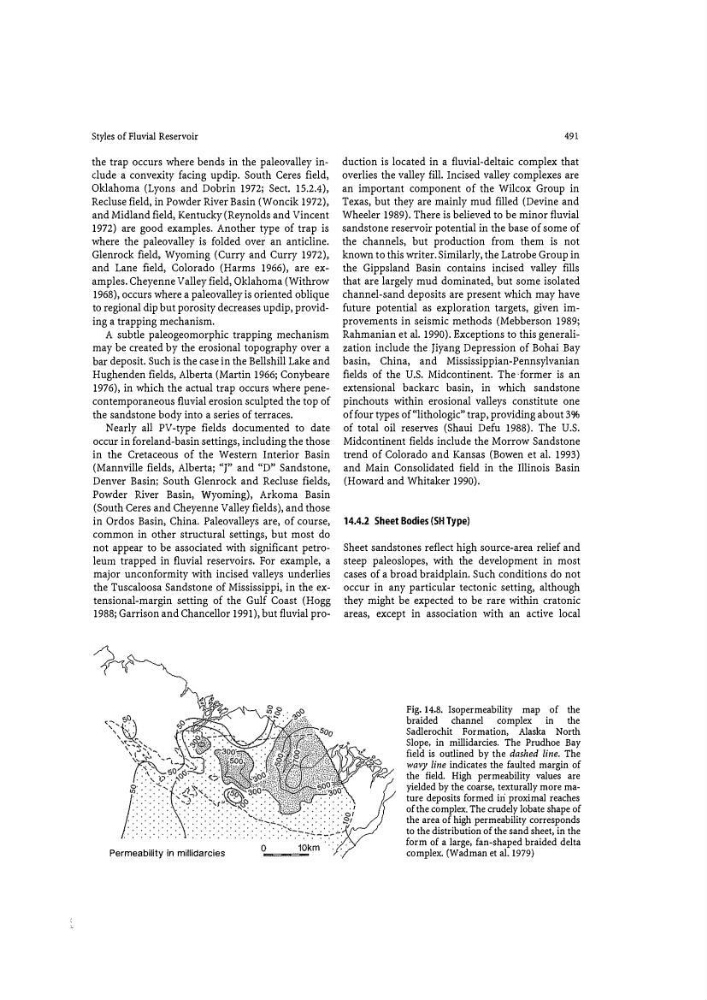
Fig. 14.8. Isopermeability map of the
braided channel
complex
in
the
Sadlerochit Formation, Alaska North
Slope, in millidarcies. The Prudhoe Bay
field is outlined by the dashed line. The
wavy line indicates the faulted margin of
the field. High permeability values are
yielded by the. coarse, texturally more mature deposits formed iri proximal reaches
of the complex. The crudely lobate shape of
the area of high permeability corresponds
to the distribution of the sand sheet, in the
form of a large, fan�shaped braided delta
complex. (Wadman et al. 1979)
the trap occurs where bends in the paleovalley in�
elude a convexity facing updip. South Ceres field,
Oklahoma (Lyons and Dobrin 1972; Sect. 15.2.4),
Recluse field, in Powder River Basin (Woncik 1972),
and Midland field, Kentucky (Reynolds and Vincent
1972) are good examples. Another type of trap is
where the paleovalley is folded over an anticline.
Glenrock field, Wyoming (Curry and Curry 1972),
and Lane field, Colorado (Harms 1966), are examples. Cheyenne Valley field, Oklahoma (Withrow
1968), occurs where a paleovalley is oriented oblique
to regional dip but porosity decreases updip, provid�
ing a trapping mechanism.
A subtle paleogeomorphic trapping mechanism
may be created by the erosional topography over a
bar deposit. Such is the case in the Bellshill Lake and
Hughenden fields, Alberta (Martin 1966; Conybeare
1976), in which the actual trap occurs where penecontemporaneous fluvial erosion sculpted the top of
the sandstone body into a series of terraces.
Nearly all PV-type fields documented to date
occur in foreland-basin settings, including the those
in the Cretaceous of the Western Interior Basin
(Mannville fields, Alberta; 'T' and "D" Sandstone,
Denver Basin; South Glenrock and Recluse fields,
Powder River Basin, Wyoming), Arkoma Basin
(South Ceres and Cheyenne Valley fields), and those
in Ordos Basin, China. Paleovalleys are, of course,
common in other structural settings, but most do
not appear to be associated with significant petro�
leurn trapped in fluvial reservoirs. For example, a
major unconformity with incised valleys underlies
the Tuscaloosa Sandstone of Mississippi, in the extensional-margin setting of the Gulf Coast (Hogg
1988; Garrison and Chancellor 1991), but fluvial proPermeability in mi!lidarcies
0
491
duction is located in a fluvial�deltaic complex that
overlies the valley fill. Incised valley complexes are
an important component of the Wilcox Group in
Texas, but they are mainly mud filled (Devine and
Wheeler 1989). There is believed to be minor fluvial
sandstone reservoir potential in the base of some of
the channels, but production from them is not
known to this writer. Similarly, the Latrobe Group in
the Gippsland Basin contains incised valley fills
that are largely mud dominated, but some isolated
channel�sand deposits are present which may have
future potential as exploration targets, given improvements in seismic methods (Mebberson 1989;
Rahmanian et al. 1990). Exceptions to this generalization include the Jiyang Depression of Bohai Bay
basin, China, and Mississippian-Pennsylvanian
fields of the U.S. Midcontinent. The ·former is an
extensional backarc basin, in which sandstone
pinchouts within erosional valleys constitute one
of four types of "lithologic" trap, providing about 3%
of total oil reserves (Shaui Defu 1988). The U.S.
Midcontinent fields include the Morrow Sandstone
trend of Colorado and Kansas (Bowen et al. 1993)
and Main Consolidated field in the Illinois Basin
(Howard and Whitaker 1990).
14.4.2 Sheet Bodies (SH Type)
Sheet sandstones reflect high source-area relief and
steep paleoslopes, with the development in most
cases of a broad braidplain. Such conditions do not
occur in any particular tectonic setting, although
they might be expected to be rare within cratonic
areas, except in association with an active local
Fig. 14.8. Isopermeability map of the
braided channel
complex
in
the
Sadlerochit Formation, Alaska North
Slope, in millidarcies. The Prudhoe Bay
field is outlined by the dashed line. The
wavy line indicates the faulted margin of
the field. High permeability values are
yielded by the. coarse, texturally more mature deposits formed iri proximal reaches
of the complex. The crudely lobate shape of
the area of high permeability corresponds
to the distribution of the sand sheet, in the
form of a large, fan�shaped braided delta
complex. (Wadman et al. 1979)