

Styles of Fluvial Reservoir
489
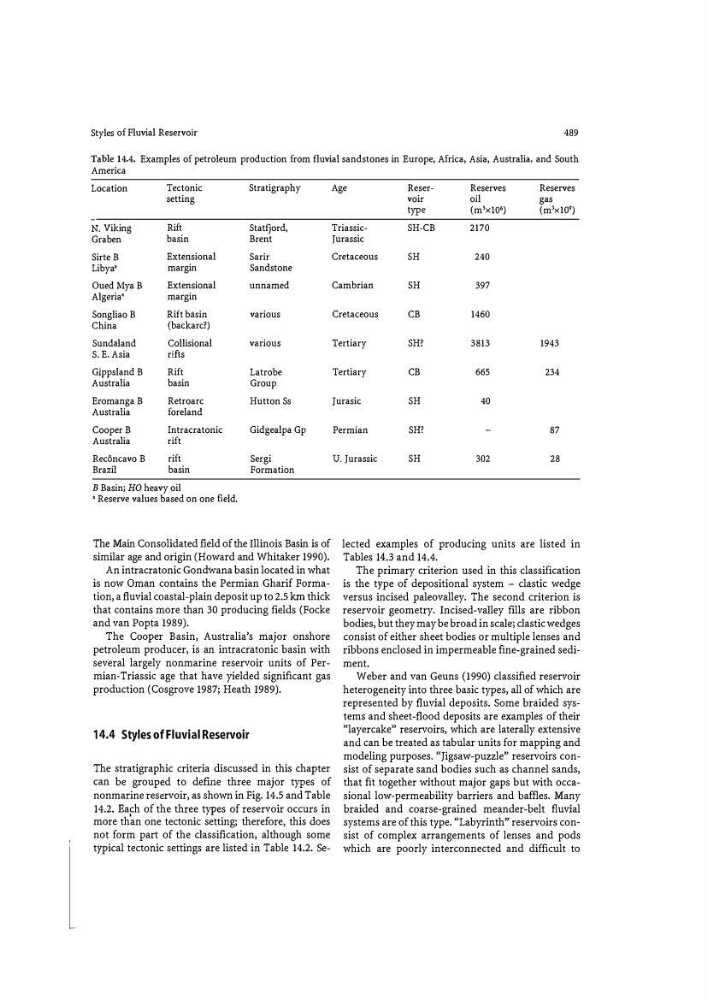
Table 14.4. Examples of petroleum production from fluvial sandstones in Europe, Africa, Asia, Australia, and South
America
Location
Tectonic
Stratigraphy
setting
N. Viking
Rift
Statfjord,
Graben
basin
Brent
Sirte B
Extensional
Sarir
Libya•
margin
Sandstone
Oued Mya B
Extensional
unnamed
Algeria'
margin
Songliao B
Rift basin
various
China
(backarc?)
Sundaland
Collisional
various
S. E. Asia
rifts
Gippsland B
Rift
Latrobe
Australia
basin
Group
Eromanga B
Retroarc
Hutton Ss
Australia
foreland
Cooper B
Intracratonic
Gidgealpa Gp
Australia
rift
Rec6ncavo B
rift
Sergi
Brazil
basin
Formation
B Basin; HO heavy oil
• Reserve values based on one field.
The Main Consolidated fi eld of the Illinois Basin is of
similar age and origin (Howard and Whitaker 1990).
An intracratonic Gondwana basin located in what
is now Oman contains the Permian Gharif Formation, a fl uvial coastal-plain deposit up to 2.5 km thick
that contains more than 30 producing fields (Focke
and van Popta 1989).
The Cooper Basin, Australia's major onshore
petroleum producer, is an intracratonic basin with
several largely nonmarine reservoir units of Permian-Triassic age that have yielded significant gas
production (Cosgrove 1987; Heath 1989).
14.4 Styles of Fluvial Reservoir
The stratigraphic criteria discussed in this chapter
can be grouped to defme three major types of
nonmarine reservoir, as shown in Fig. 14.5 and Table
14.2. Each of the three types of reservoir occurs in
more th
1 an one tectonic setting; therefore, this does
not form part of the classifi cation, although some
typical tectonic settings are listed in Table 14.2. SeAge
ReserReserves
Reserves
voir
oil
gas
(m;xlQ6)
(mlx109)
Triassic�
SH-CB
2170
jurassic
Cretaceous
SH
240
Cambrian
SH
397
Cretaceous
CB
1460
Tertiary
SH?
3813
1943
Tertiary
CB
665
234
Jurasic
SH
40
Permian
SH?
87
U. Jurassic
SH
302
28
lected examples of producing units are listed in
Tables 14.3 and 14.4.
The primary criterion used in this classification
is the type of depositional system - clastic wedge
versus incised paleovalley. The second criterion is
reservoir geometry. Incised-valley fills are ribbon
bodies, but they may be broad in scale; clastic wedges
consist of either sheet bodies or multiple lenses and
ribbons enclosed in impermeable fine-grained sediment.
Weber and van Geuns (1990) classified reservoir
heterogeneity into three basic types, all of which are
represented by fluvial deposits. Some braided systems and sheet-fl ood deposits are examples of their
"layercake" reservoirs, which are laterally extensive
and can be treated as tabular units for mapping and
modeling purposes. '7igsaw-puzzle'� reservoirs consist of separate sand bodies such as channel sands,
that fit together without major gaps but with occasional low-permeability barriers and baffles. Many
braided and coarse-grained meander-belt fluvial
systems are of this type. ''Labyrinth'' reservoirs consist of complex arrangements of lenses and pods
which are poorly interconnected and difficult to
489
Table 14.4. Examples of petroleum production from fluvial sandstones in Europe, Africa, Asia, Australia, and South
America
Location
Tectonic
Stratigraphy
setting
N. Viking
Rift
Statfjord,
Graben
basin
Brent
Sirte B
Extensional
Sarir
Libya•
margin
Sandstone
Oued Mya B
Extensional
unnamed
Algeria'
margin
Songliao B
Rift basin
various
China
(backarc?)
Sundaland
Collisional
various
S. E. Asia
rifts
Gippsland B
Rift
Latrobe
Australia
basin
Group
Eromanga B
Retroarc
Hutton Ss
Australia
foreland
Cooper B
Intracratonic
Gidgealpa Gp
Australia
rift
Rec6ncavo B
rift
Sergi
Brazil
basin
Formation
B Basin; HO heavy oil
• Reserve values based on one field.
The Main Consolidated fi eld of the Illinois Basin is of
similar age and origin (Howard and Whitaker 1990).
An intracratonic Gondwana basin located in what
is now Oman contains the Permian Gharif Formation, a fl uvial coastal-plain deposit up to 2.5 km thick
that contains more than 30 producing fields (Focke
and van Popta 1989).
The Cooper Basin, Australia's major onshore
petroleum producer, is an intracratonic basin with
several largely nonmarine reservoir units of Permian-Triassic age that have yielded significant gas
production (Cosgrove 1987; Heath 1989).
14.4 Styles of Fluvial Reservoir
The stratigraphic criteria discussed in this chapter
can be grouped to defme three major types of
nonmarine reservoir, as shown in Fig. 14.5 and Table
14.2. Each of the three types of reservoir occurs in
more th
1 an one tectonic setting; therefore, this does
not form part of the classifi cation, although some
typical tectonic settings are listed in Table 14.2. SeAge
ReserReserves
Reserves
voir
oil
gas
(m;xlQ6)
(mlx109)
Triassic�
SH-CB
2170
jurassic
Cretaceous
SH
240
Cambrian
SH
397
Cretaceous
CB
1460
Tertiary
SH?
3813
1943
Tertiary
CB
665
234
Jurasic
SH
40
Permian
SH?
87
U. Jurassic
SH
302
28
lected examples of producing units are listed in
Tables 14.3 and 14.4.
The primary criterion used in this classification
is the type of depositional system - clastic wedge
versus incised paleovalley. The second criterion is
reservoir geometry. Incised-valley fills are ribbon
bodies, but they may be broad in scale; clastic wedges
consist of either sheet bodies or multiple lenses and
ribbons enclosed in impermeable fine-grained sediment.
Weber and van Geuns (1990) classified reservoir
heterogeneity into three basic types, all of which are
represented by fluvial deposits. Some braided systems and sheet-fl ood deposits are examples of their
"layercake" reservoirs, which are laterally extensive
and can be treated as tabular units for mapping and
modeling purposes. '7igsaw-puzzle'� reservoirs consist of separate sand bodies such as channel sands,
that fit together without major gaps but with occasional low-permeability barriers and baffles. Many
braided and coarse-grained meander-belt fluvial
systems are of this type. ''Labyrinth'' reservoirs consist of complex arrangements of lenses and pods
which are poorly interconnected and difficult to