

B
Growth of Present�Day Concepts, up to 1977
whose ideas were based on those of Schumm (1963).
Schumm proposed the use of the term for a type of
arid fluvial system in Australia, whereas those anastomosed rivers described by D.G. Smith are perennial streams in a humid-temperate climate. The
differences in sedimentological style between these
two types of rivers have yet to be clearly and definitively evaluated, although some common factors re�
lating to low slope and cohesive banks appear to be
emerging (see Chap. 8). The Australian anastomosed
rivers are now regarded as something of a special
case (Sect. 8.2.10). Baker (1978a) and Taylor and
Woodyer (1978) described modern fluvial systems
in, respectively, the Amazon basin and New South
Wales (Australia) that obey very few of the the
«norms" of depositional behavior, " as they were understood in the late 1970s. McKee et al. (1967) described the deposits of a flash flood in a small
ephemeral stream, Bijou Creek in Colorado, and this
work was incorporated into the braided fluvial models of Miall (1977), establishing a category of fluvial
depositional styles that is now recognized to be of
considerable importance in the ancient record (Sect.
8.2.16). The study of ephemeral streams in Australia
by Williams (1971) also played an important part in
the development of the ephemeral-stream model
(Sect. 8.2.15).
In the 1970s, difficulties were also appearing in
the application of geomorphological models to the
� Surface current
___ ,... Bottom current
33
ancient record. For example, it was shown that under
certain circumstances sequences of apparently
braided origin could be formed in a single-channel,
high-sinuosity fluvial environment (Jackson 1978i
Nijman and Puigdefabregas 1978). Collinson (1978)
pointed out that not all sandstone units in meandering-stream successions are point-bar deposits, but
some are the product of overbank sheet floods.
jackson (1978) provided a devastating critique of
the conventions being used at that time to identify
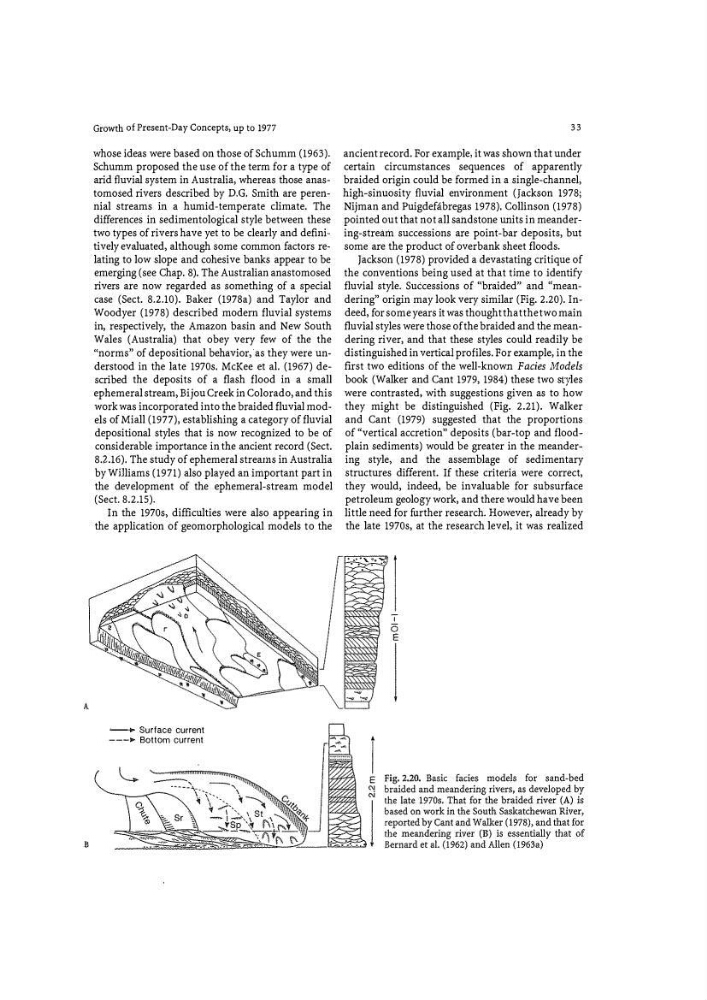
fluvial style. Successions of "braided" and "meandering" origin may look very similar (Fig. 2.20). Indeed, for some years it was thought that the two main
fluvial styles were those of the braided and the meandering river, and that these styles could readily be
distinguished in vertical profiles. For example) in the
first two editions of the well-known Facies Models
book (Walker and Cant 1979, 1984) these two styl es
were contrasted, with suggestions given as to how
they might be distinguished (Fig. 2.21). Walker
and Cant (1979) suggested that the proportions
of "vertical accretion" deposits (bar-top and floodplain sediments) would be greater in the meandering style, and the assemblage of sedimentary
structures different. If these criteria were correct,
they would, indeed, be invaluable for subsurface
petroleum geology work, and there would have been
little need for further research. However) already by
the late 1970s, at the research level) it was realized
Growth of Present�Day Concepts, up to 1977
whose ideas were based on those of Schumm (1963).
Schumm proposed the use of the term for a type of
arid fluvial system in Australia, whereas those anastomosed rivers described by D.G. Smith are perennial streams in a humid-temperate climate. The
differences in sedimentological style between these
two types of rivers have yet to be clearly and definitively evaluated, although some common factors re�
lating to low slope and cohesive banks appear to be
emerging (see Chap. 8). The Australian anastomosed
rivers are now regarded as something of a special
case (Sect. 8.2.10). Baker (1978a) and Taylor and
Woodyer (1978) described modern fluvial systems
in, respectively, the Amazon basin and New South
Wales (Australia) that obey very few of the the
«norms" of depositional behavior, " as they were understood in the late 1970s. McKee et al. (1967) described the deposits of a flash flood in a small
ephemeral stream, Bijou Creek in Colorado, and this
work was incorporated into the braided fluvial models of Miall (1977), establishing a category of fluvial
depositional styles that is now recognized to be of
considerable importance in the ancient record (Sect.
8.2.16). The study of ephemeral streams in Australia
by Williams (1971) also played an important part in
the development of the ephemeral-stream model
(Sect. 8.2.15).
In the 1970s, difficulties were also appearing in
the application of geomorphological models to the
� Surface current
___ ,... Bottom current
33
ancient record. For example, it was shown that under
certain circumstances sequences of apparently
braided origin could be formed in a single-channel,
high-sinuosity fluvial environment (Jackson 1978i
Nijman and Puigdefabregas 1978). Collinson (1978)
pointed out that not all sandstone units in meandering-stream successions are point-bar deposits, but
some are the product of overbank sheet floods.
jackson (1978) provided a devastating critique of
the conventions being used at that time to identify
fluvial style. Successions of "braided" and "meandering" origin may look very similar (Fig. 2.20). Indeed, for some years it was thought that the two main
fluvial styles were those of the braided and the meandering river, and that these styles could readily be
distinguished in vertical profiles. For example) in the
first two editions of the well-known Facies Models
book (Walker and Cant 1979, 1984) these two styl es
were contrasted, with suggestions given as to how
they might be distinguished (Fig. 2.21). Walker
and Cant (1979) suggested that the proportions
of "vertical accretion" deposits (bar-top and floodplain sediments) would be greater in the meandering style, and the assemblage of sedimentary
structures different. If these criteria were correct,
they would, indeed, be invaluable for subsurface
petroleum geology work, and there would have been
little need for further research. However) already by
the late 1970s, at the research level) it was realized