

32
Historical Background
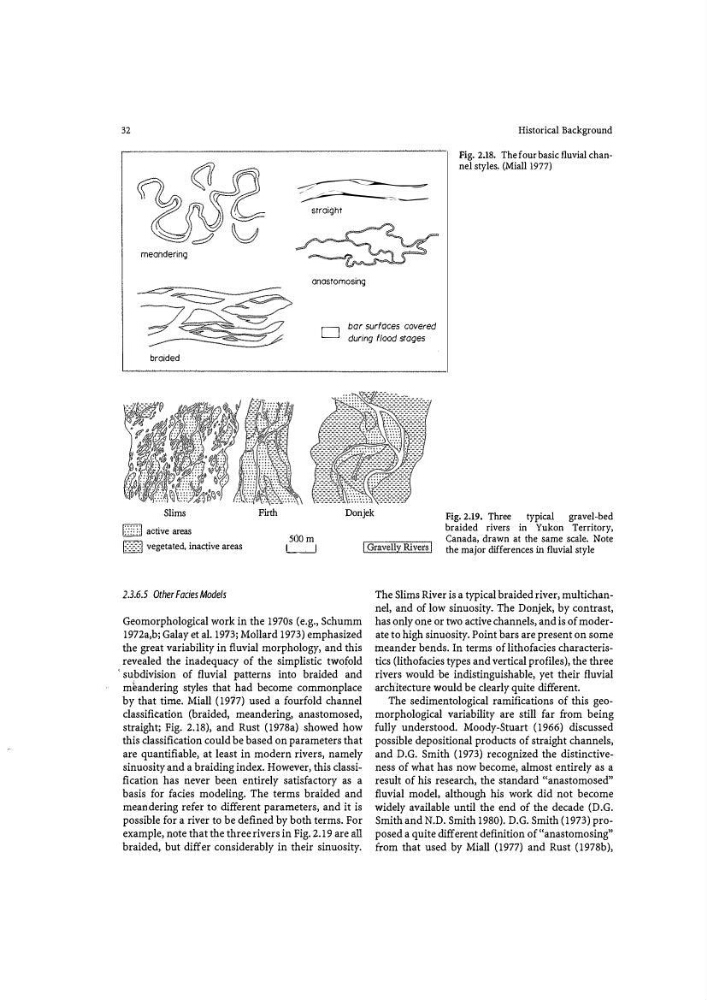
Fig. 2.18. the four basic fluvial channel styles. (Miall l977)
�
straight
meandering
anastomosing
D
bar surfaces covered
during flood stages
braided
Slims
[iJ active areas
Firth
Donjek
Fig. 2.19. Three
typical
gravel�bed
braided rivers in Yukon Territory,
Canada, drawn at the same scale. Note
the major differences in fluvial style
Fj vegetated, inactive areas
2.3.6.5 Other Facies Models
500 m
l_._j
Geomorphological work in the 1970s (e.g., Schumm
1972a,b; Galay et al. 1973; Mollard 1973) emphasized
the great variability in fluvial morphology, and this
revealed the inadequacy of the simplistic twofold
· subdivision of fluvial patterns into braided and
m�andering styles that had become commonplace
by that time. Miall ( 1977) used a fourfold channel
classification (braided, meandering, anastomosed,
straight; Fig. 2.18), and Rust (1978a) showed how
this classification could be based on parameters that
are quantifiable, at least in modern rivers, namely
sinuosity and a braiding index. However, this classification has never been entirely satisfactory as a
basis for facies modeling. The terms braided and
meartdering refer to different parameters, and it is
possible for a river to be defined by both terms. For
example, note that the three rivers in Fig. 2.19 are all
braided, but differ considerably in their sinuosity.
I . Gravelly Rivers I
The Slims River is a typical braided river, multichannel, and of low sinuosity. The Donjek, by contrast,
has only one or two active channels, and is of moderate to high sinuosity. Point bars are present on some
meander bends. In terms of lithofacies characteristics (lithofacies types and vertical profiles), the three
rivers would be indistinguishable, yet their fluvial
architecture would be clearly quite different.
The sedimentological ramifications of this geomorphological variability are still far from being
fully understood. Moody-Stuart (1966) discussed
possible depositional products of straight channels,
and D.G. Smith (1973) recognized the distinctiveness of what has now become, almost entirely as a
result of his research, the standard <(anastomosed"
fl uvial model, although his work did not become
widely available until the end of the decade (D.G.
Smith and N.D. Smith 1980). D.G. Smith (1973) proposed a quite different definition of <(anastomosing"
from that used by Miall (1977) and Rust (1978b),
Historical Background
Fig. 2.18. the four basic fluvial channel styles. (Miall l977)
�
straight
meandering
anastomosing
D
bar surfaces covered
during flood stages
braided
Slims
[iJ active areas
Firth
Donjek
Fig. 2.19. Three
typical
gravel�bed
braided rivers in Yukon Territory,
Canada, drawn at the same scale. Note
the major differences in fluvial style
Fj vegetated, inactive areas
2.3.6.5 Other Facies Models
500 m
l_._j
Geomorphological work in the 1970s (e.g., Schumm
1972a,b; Galay et al. 1973; Mollard 1973) emphasized
the great variability in fluvial morphology, and this
revealed the inadequacy of the simplistic twofold
· subdivision of fluvial patterns into braided and
m�andering styles that had become commonplace
by that time. Miall ( 1977) used a fourfold channel
classification (braided, meandering, anastomosed,
straight; Fig. 2.18), and Rust (1978a) showed how
this classification could be based on parameters that
are quantifiable, at least in modern rivers, namely
sinuosity and a braiding index. However, this classification has never been entirely satisfactory as a
basis for facies modeling. The terms braided and
meartdering refer to different parameters, and it is
possible for a river to be defined by both terms. For
example, note that the three rivers in Fig. 2.19 are all
braided, but differ considerably in their sinuosity.
I . Gravelly Rivers I
The Slims River is a typical braided river, multichannel, and of low sinuosity. The Donjek, by contrast,
has only one or two active channels, and is of moderate to high sinuosity. Point bars are present on some
meander bends. In terms of lithofacies characteristics (lithofacies types and vertical profiles), the three
rivers would be indistinguishable, yet their fluvial
architecture would be clearly quite different.
The sedimentological ramifications of this geomorphological variability are still far from being
fully understood. Moody-Stuart (1966) discussed
possible depositional products of straight channels,
and D.G. Smith (1973) recognized the distinctiveness of what has now become, almost entirely as a
result of his research, the standard <(anastomosed"
fl uvial model, although his work did not become
widely available until the end of the decade (D.G.
Smith and N.D. Smith 1980). D.G. Smith (1973) proposed a quite different definition of <(anastomosing"
from that used by Miall (1977) and Rust (1978b),