

34
Historical Background
ss
G
BATTERY POINT
SUMMARY SEQUENCE
MEANDERING"
FINING "UPWARD
SEQUENCE
F
0
8
c
B
c
/'
"""
I
V. A
I
BAR
ToP•
CHANNEL
FLOOR
VA
I
POINT BAR
TOP
POINT
BAR
CHANNEL
FLOOR
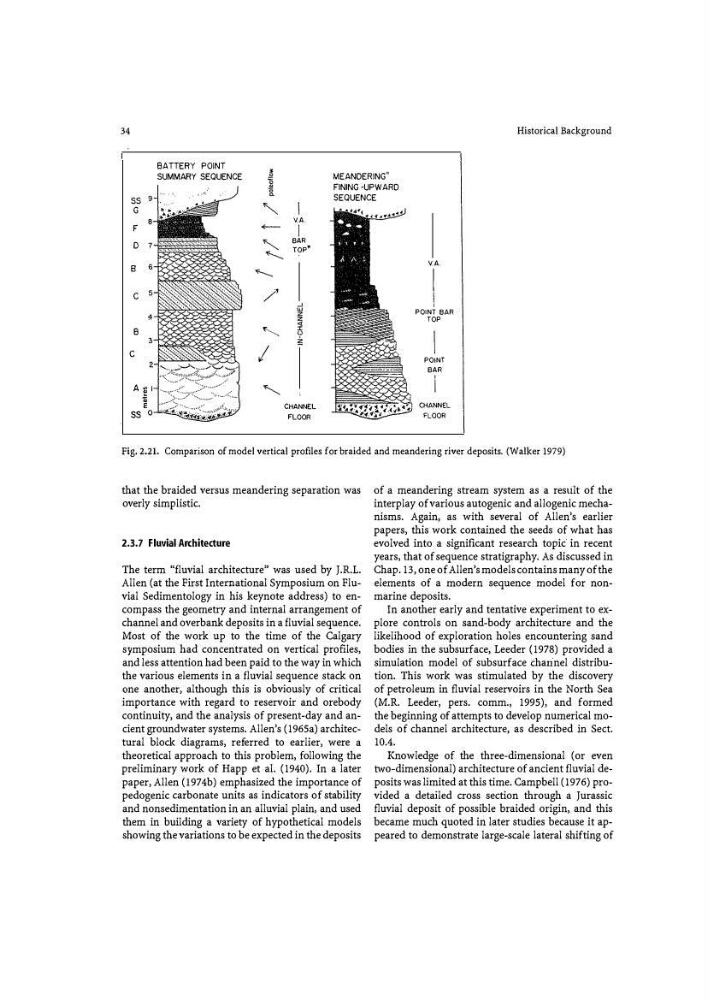
Fig. 2.21. Comparison of model vertical profiles for braided and meandering river deposits. (Walker 1979)
that the braided versus meandering separation was
overly simplistic.
2.3.7 Fluvial Arc hitecture
The term "fluvial architecture" was used by J.R.L.
Allen (at the First International Symposium on Fluvial Sedimentology in his keynote address) to encompass the geometry and internal arrangement of
channel and overbank deposits in a fluvial sequence.
Most of the work up to the time of the Calgary
symposium had concentrated on vertical profiles,
and less attention had been paid to the way in which
the various elements in a fluvial sequence stack on
one another, although this is obviously of critical
importance with regard to reservoir and orebody
continuity, and the analysis of present-day and ancient groundwater systems. Allen's (1965a) architectural block diagrams, referred to earlier, were a
theoretical approach to this problem, following the
preliminary work of Happ et al. (1940). In a later
paper, Allen (l974b) emphasized the importance of
pedogenic carbonate units as indicators of stability
and nonsedimentation in an alluvial plain1 and used
them in building a variety of hypothetical models
showing the variations to be expected in the deposits
of a meandering stream system as a restilt of the
interplay of various autogenic and allogenic mechanisms. Again, as with several of Allen's earlier
papers, this work contained the seeds of what has
evolved into a significant research topic" in recent
years� that of sequence stratigraphy. As discussed in
Chap. 13, one of Allen's models contains many of the
elements of a modern sequence model for nonmarine deposits.
In another early and tentative experiment to explore controls on sand-body architecture and the
likelihood of exploration holes encountering sand
bodies in the subsurface, Leeder (1978) provided a
simulation model of subsurface Charinel distribution. This work was stimulated by the discovery
of petroleum in fluvial reservoirs in the North Sea
(M.R. Leeder, pers. comm., 1995), and formed
the beginning of attempts to develop numerical models of channel architecture, as described in Sect.
10.4.
Knowledge of the three-dimensional (or even
two-dimensional) architecture of ancient fluvial deposits was limited at this time. Campbell (1976) provided a detailed cross section through a Jurassic
fluvial deposit of possible braided origin, and this
became much quoted in later studies because it appeared to demonstrate large-scale lateral shifting of
Historical Background
ss
G
BATTERY POINT
SUMMARY SEQUENCE
MEANDERING"
FINING "UPWARD
SEQUENCE
F
0
8
c
B
c
/'
"""
I
V. A
I
BAR
ToP•
CHANNEL
FLOOR
VA
I
POINT BAR
TOP
POINT
BAR
CHANNEL
FLOOR
Fig. 2.21. Comparison of model vertical profiles for braided and meandering river deposits. (Walker 1979)
that the braided versus meandering separation was
overly simplistic.
2.3.7 Fluvial Arc hitecture
The term "fluvial architecture" was used by J.R.L.
Allen (at the First International Symposium on Fluvial Sedimentology in his keynote address) to encompass the geometry and internal arrangement of
channel and overbank deposits in a fluvial sequence.
Most of the work up to the time of the Calgary
symposium had concentrated on vertical profiles,
and less attention had been paid to the way in which
the various elements in a fluvial sequence stack on
one another, although this is obviously of critical
importance with regard to reservoir and orebody
continuity, and the analysis of present-day and ancient groundwater systems. Allen's (1965a) architectural block diagrams, referred to earlier, were a
theoretical approach to this problem, following the
preliminary work of Happ et al. (1940). In a later
paper, Allen (l974b) emphasized the importance of
pedogenic carbonate units as indicators of stability
and nonsedimentation in an alluvial plain1 and used
them in building a variety of hypothetical models
showing the variations to be expected in the deposits
of a meandering stream system as a restilt of the
interplay of various autogenic and allogenic mechanisms. Again, as with several of Allen's earlier
papers, this work contained the seeds of what has
evolved into a significant research topic" in recent
years� that of sequence stratigraphy. As discussed in
Chap. 13, one of Allen's models contains many of the
elements of a modern sequence model for nonmarine deposits.
In another early and tentative experiment to explore controls on sand-body architecture and the
likelihood of exploration holes encountering sand
bodies in the subsurface, Leeder (1978) provided a
simulation model of subsurface Charinel distribution. This work was stimulated by the discovery
of petroleum in fluvial reservoirs in the North Sea
(M.R. Leeder, pers. comm., 1995), and formed
the beginning of attempts to develop numerical models of channel architecture, as described in Sect.
10.4.
Knowledge of the three-dimensional (or even
two-dimensional) architecture of ancient fluvial deposits was limited at this time. Campbell (1976) provided a detailed cross section through a Jurassic
fluvial deposit of possible braided origin, and this
became much quoted in later studies because it appeared to demonstrate large-scale lateral shifting of