

B
c
The Geometry of Fluvial Reservoirs
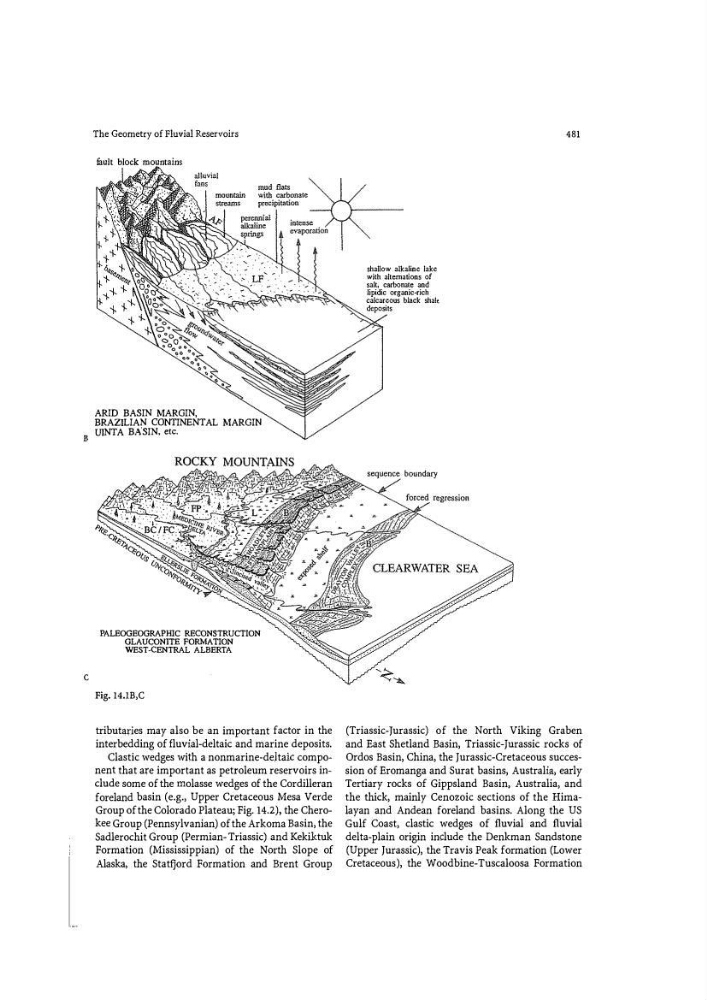
fa ult block mountains
ARID BASIN MARGIN,
BRAZILIAN CONTINENTAL MARGIN
UINTA BASIN, etc.
PA LEOGEOGRAPHIC RECONSTRUCTION
GLAUCONITE FORMATION
WEST-CENTRAL ALBERTA
Fig. 14.1B,C
tribut&des may also be an important factor in the
interbedding of fluvial-deltaic and marine deposits.
Clastic wedges with a nonmarine-deJtak componen� that are important as petroleum reservoirs include some of the molasse wedges of the Cordilleran
foreland basin (e.g., Upper Cretaceous Mesa Verde
Group of the Colorado Plateau; Fig. 14.2), the Cherokee Group (Pennsylvanian) of the Arkoma - Basin, the
Sadlerochit Group (Permian- Triassic) and Kekiktuk
Formation (Mississippian) of the North Slope of
Alaska, the Statfjord Formation and Brent Group
shallow alkaline lake
with alternations of
salt, carbonate and
lipidic organic-rich
calcareous black shale
deposits
481
(Triassic-jurassic) of the North Viking Graben
and East Shetland Basin, Triassic-Jurassic rocks of
Ordos Basin, China, the Jurassic-Cretaceous succession of Eromanga and Surat basins, Australia, early
Tertiary rocks of Gippsland Basin, Australia, and
the thick, mainly Cenozoic sections of the Himalayan and Andean foreland basins. Along the US
Gulf Coast, clastic wedges of fl uvial and fl uvial
delta-plain origin include the Denkman Sandstone
(Upper jurassic), the Travis Peak formation (Lower
Cretaceous), the Woodbine-Tuscaloosa Formation
c
The Geometry of Fluvial Reservoirs
fa ult block mountains
ARID BASIN MARGIN,
BRAZILIAN CONTINENTAL MARGIN
UINTA BASIN, etc.
PA LEOGEOGRAPHIC RECONSTRUCTION
GLAUCONITE FORMATION
WEST-CENTRAL ALBERTA
Fig. 14.1B,C
tribut&des may also be an important factor in the
interbedding of fluvial-deltaic and marine deposits.
Clastic wedges with a nonmarine-deJtak componen� that are important as petroleum reservoirs include some of the molasse wedges of the Cordilleran
foreland basin (e.g., Upper Cretaceous Mesa Verde
Group of the Colorado Plateau; Fig. 14.2), the Cherokee Group (Pennsylvanian) of the Arkoma - Basin, the
Sadlerochit Group (Permian- Triassic) and Kekiktuk
Formation (Mississippian) of the North Slope of
Alaska, the Statfjord Formation and Brent Group
shallow alkaline lake
with alternations of
salt, carbonate and
lipidic organic-rich
calcareous black shale
deposits
481
(Triassic-jurassic) of the North Viking Graben
and East Shetland Basin, Triassic-Jurassic rocks of
Ordos Basin, China, the Jurassic-Cretaceous succession of Eromanga and Surat basins, Australia, early
Tertiary rocks of Gippsland Basin, Australia, and
the thick, mainly Cenozoic sections of the Himalayan and Andean foreland basins. Along the US
Gulf Coast, clastic wedges of fl uvial and fl uvial
delta-plain origin include the Denkman Sandstone
(Upper jurassic), the Travis Peak formation (Lower
Cretaceous), the Woodbine-Tuscaloosa Formation