

Main Components of the Fluvial Sequence Model
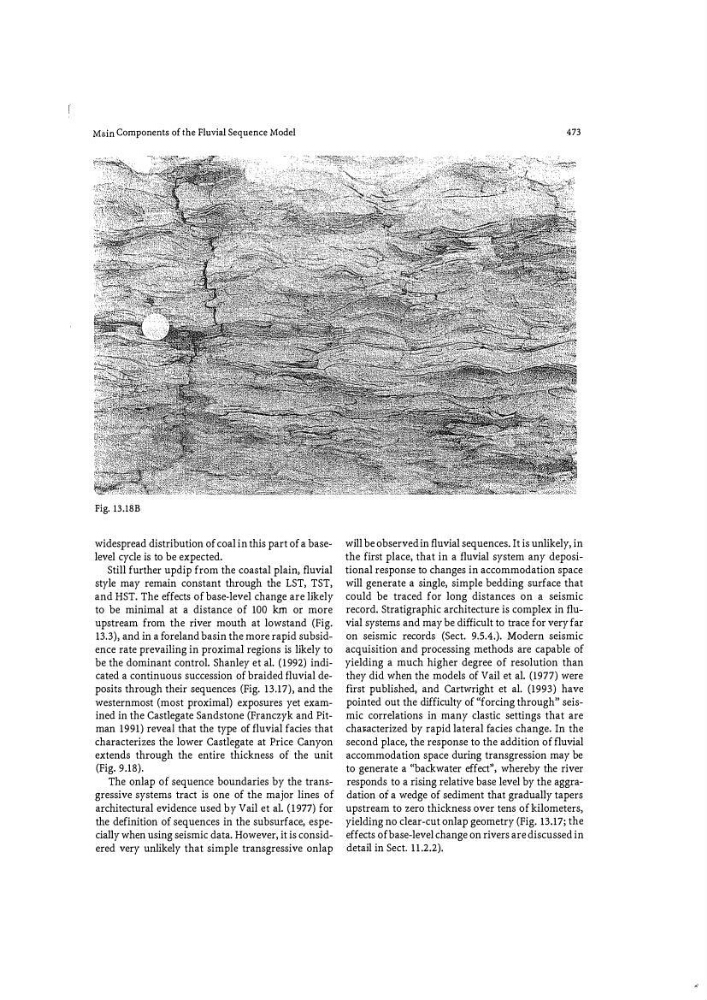
Fig. 13.18B
widespread distribution of coal in this part of a baselevel cycle is to be expected.
Still further updip from the coastal plain, fluvial
style may remain constant through the LST, TST,
and HST. The effects of base-level change are likely
to be minimal at a distance of 100 km or more
upstream from the river mouth at lowstand (Fig.
13.3), and in a fo reland basin the more rapid subsidence rate prevailing in proximal regions is likely to
be the dominant control. Shanley et al. (1992) indicated a continuous succession of braided fluvial deposits through their sequences (Fig. 13.17), and the
westernmost (most proximal) exposures yet examined in the Castlegate Sandstone (Franczyk and Pitman 1991) reveal that the type of fluvial facies that
characterizes the lower Castlegate at Price Canyon
extends through the entire thickness of the unit
(Fig. 9.18).
The onlap of sequence boundaries by the transgressive systems tract is one of the major lines of
architectural evidence used by Vail et al. (1977) for
the definition of sequences in the subsurface, especially when using seismic data. However, it is considered very unlikely that simple transgressive onlap
473
will be observed in fluvial sequences. It is unlikely, in
the first place, that in a fluvial system any depositional response to changes in accommodation space
will generate a single, simple bedding surface that
could be traced for long distances on a seismic
record. Stratigraphic architecture is complex in fluvial systems and may be difficult to trace for very far
on seismic records (Sect. 9.5.4.). Modern seismic
acquisition and processing methods are capable of
yielding a much higher degree of resolution than
they did when the models of Vail et al. (1977) were
first published, and Cartwright et al. (1993) have
pointed out the difficulty of "forcing through" seismic correlations in many clastic settings that are
cha�cterized by rapid lateral fa cies change. In the
second place, the response to the addition of fluvial
accommodation space · during transgression may be
to generate a "backwater effect'\ whereby the river
responds to a rising relative base level by the aggradation of a wedge of sediment that gradually tapers
upstream to zero thickness over tens of kilometers,
yielding no clear-cut onlap geometry (Fig. 13.17; the
effects ofbase-level change on rivers are discussed in
detail in Sect. 11.2.2).
Fig. 13.18B
widespread distribution of coal in this part of a baselevel cycle is to be expected.
Still further updip from the coastal plain, fluvial
style may remain constant through the LST, TST,
and HST. The effects of base-level change are likely
to be minimal at a distance of 100 km or more
upstream from the river mouth at lowstand (Fig.
13.3), and in a fo reland basin the more rapid subsidence rate prevailing in proximal regions is likely to
be the dominant control. Shanley et al. (1992) indicated a continuous succession of braided fluvial deposits through their sequences (Fig. 13.17), and the
westernmost (most proximal) exposures yet examined in the Castlegate Sandstone (Franczyk and Pitman 1991) reveal that the type of fluvial facies that
characterizes the lower Castlegate at Price Canyon
extends through the entire thickness of the unit
(Fig. 9.18).
The onlap of sequence boundaries by the transgressive systems tract is one of the major lines of
architectural evidence used by Vail et al. (1977) for
the definition of sequences in the subsurface, especially when using seismic data. However, it is considered very unlikely that simple transgressive onlap
473
will be observed in fluvial sequences. It is unlikely, in
the first place, that in a fluvial system any depositional response to changes in accommodation space
will generate a single, simple bedding surface that
could be traced for long distances on a seismic
record. Stratigraphic architecture is complex in fluvial systems and may be difficult to trace for very far
on seismic records (Sect. 9.5.4.). Modern seismic
acquisition and processing methods are capable of
yielding a much higher degree of resolution than
they did when the models of Vail et al. (1977) were
first published, and Cartwright et al. (1993) have
pointed out the difficulty of "forcing through" seismic correlations in many clastic settings that are
cha�cterized by rapid lateral fa cies change. In the
second place, the response to the addition of fluvial
accommodation space · during transgression may be
to generate a "backwater effect'\ whereby the river
responds to a rising relative base level by the aggradation of a wedge of sediment that gradually tapers
upstream to zero thickness over tens of kilometers,
yielding no clear-cut onlap geometry (Fig. 13.17; the
effects ofbase-level change on rivers are discussed in
detail in Sect. 11.2.2).