

Main Components of the Fluvial Sequence Model
conditions. Type 2 unconformities are much more
difficult to indentify in seismic and outcrop records
because they are not characterized by deep erosion
or major facies shifts.
On extensional continental margins, where the
nonmarine environment occupies the proximal part
of the basin, close to the hinge line, subsidence rates
are relatively slow, and type 1 unconformities are
common. The Quaternary record of modern contiM
nental margins has been characterized by rapid
glacioeustatic fluctuations, and the record of fluvial
deposition is condensed, fr agmentary, and cut by
numerous erosional unconformities (e.g., Atlantic
Coastal Plain: Pazzaglia 1993), except where the hinterland provides an unusually large sediment supply, as along the Gulf Coast (Galloway 1989b; Sect.
1!.3.4).
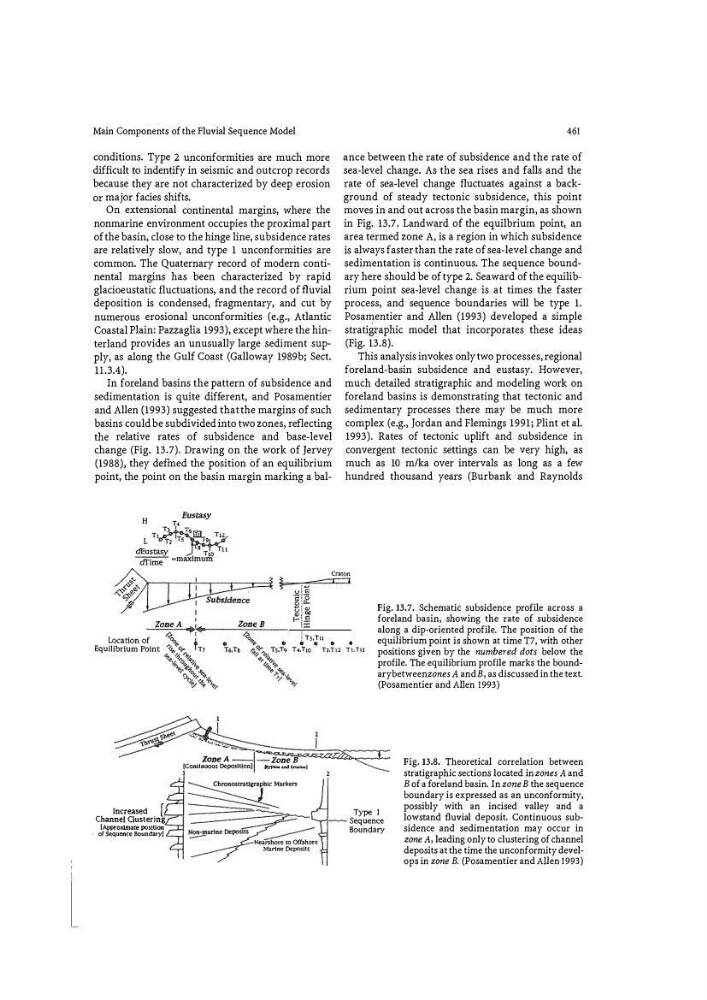
In foreland basins the pattern of subsidence and
sedimentation is quite different, and Posamentier
and Allen (1993) suggested thatthe margins of such
basins could be subdivided into two zones, reflecting
the relative rates of subsidence and base-level
change (Fig. 13.7). Drawing on the work of )ervey
(1988), they defmed the position of an equilibrium
point, the point on the basin margin marking a bal! TJ,Tl\
461
ance between the rate of subsidence and the rate of
sea-level change. As the sea rises and falls and the
rate of sea-level change fluctuates against a background of steady tectonic subsidence, this point
moves in and out across the basin margin, as shown
in Fig. 13.7. Landward of the equilbrium point, an
area termed zone A, is a region in which subsidence
is always faster than the rate of sea-level change and
sedimentation is continuous. The sequence boundary here should be of type 2. Seaward of the equilibrium point sea-level change is at times the faster
process, and sequence boundaries will be type 1.
Posamentier and Allen (1993) developed a simple
stratigraphic model that incorporates these ideas
(Fig. 13.8).
This analysis invokes only two processes, regional
foreland-basin subsidence and eustasy. However,
much detailed stratigraphic and modeling work on
fo reland basins is demonstrating that tectonic and
sedimentary processes there may be much more
complex (e.g., jordan and Flemings 1991; Plint et al.
1993). Rates of tectonic uplift and subsidence in
convergent tectonic settings can be very high, as
much as 10 m/ka over intervals as long as a few
hundred thousand years (Burbank and Raynolds
•
c
e
e
Fig. 13.7. Schematic subsidence profile across a
foreland basin, showing the rate of subsidence
along a dip-oriented profile. The position of the
equilibrium point is shown at time T7, with other
positions given by the numbered dots below the
profile. The equilibrium profile marks the boundarybetweenzones A an dB, as discussed in the text.
(Posamentier and Allen 1993)
Increased
[
Channel Clustering
[Approximate pos!tlon
or sequence lloundaryj
T4,T!O
T1,T12 TJ,T!l
Zone A =_· :_ :_ l[ ::�z �o �n �e�B F�:z;;zzz;;;::.: : =:I:::
[Continuous Do:: posltJonj
JBn-o ,.,.. Er<>
Fig. 13.8. Theoretical correlation between
stratigraphic sections located in zones A and
B of a foreland basin. In zone B the sequence
boundary is expressed as an unconformity,
possibly with an incised valley and a
lowstand fl uvial deposit. Continuous subsidence and sedimentation may occur in
zone A, leading only to clustering of channel
deposits at the time the unconformity devel�
ops in zone B. (Posamentier and Allen 1993)
conditions. Type 2 unconformities are much more
difficult to indentify in seismic and outcrop records
because they are not characterized by deep erosion
or major facies shifts.
On extensional continental margins, where the
nonmarine environment occupies the proximal part
of the basin, close to the hinge line, subsidence rates
are relatively slow, and type 1 unconformities are
common. The Quaternary record of modern contiM
nental margins has been characterized by rapid
glacioeustatic fluctuations, and the record of fluvial
deposition is condensed, fr agmentary, and cut by
numerous erosional unconformities (e.g., Atlantic
Coastal Plain: Pazzaglia 1993), except where the hinterland provides an unusually large sediment supply, as along the Gulf Coast (Galloway 1989b; Sect.
1!.3.4).
In foreland basins the pattern of subsidence and
sedimentation is quite different, and Posamentier
and Allen (1993) suggested thatthe margins of such
basins could be subdivided into two zones, reflecting
the relative rates of subsidence and base-level
change (Fig. 13.7). Drawing on the work of )ervey
(1988), they defmed the position of an equilibrium
point, the point on the basin margin marking a bal! TJ,Tl\
461
ance between the rate of subsidence and the rate of
sea-level change. As the sea rises and falls and the
rate of sea-level change fluctuates against a background of steady tectonic subsidence, this point
moves in and out across the basin margin, as shown
in Fig. 13.7. Landward of the equilbrium point, an
area termed zone A, is a region in which subsidence
is always faster than the rate of sea-level change and
sedimentation is continuous. The sequence boundary here should be of type 2. Seaward of the equilibrium point sea-level change is at times the faster
process, and sequence boundaries will be type 1.
Posamentier and Allen (1993) developed a simple
stratigraphic model that incorporates these ideas
(Fig. 13.8).
This analysis invokes only two processes, regional
foreland-basin subsidence and eustasy. However,
much detailed stratigraphic and modeling work on
fo reland basins is demonstrating that tectonic and
sedimentary processes there may be much more
complex (e.g., jordan and Flemings 1991; Plint et al.
1993). Rates of tectonic uplift and subsidence in
convergent tectonic settings can be very high, as
much as 10 m/ka over intervals as long as a few
hundred thousand years (Burbank and Raynolds
•
c
e
e
Fig. 13.7. Schematic subsidence profile across a
foreland basin, showing the rate of subsidence
along a dip-oriented profile. The position of the
equilibrium point is shown at time T7, with other
positions given by the numbered dots below the
profile. The equilibrium profile marks the boundarybetweenzones A an dB, as discussed in the text.
(Posamentier and Allen 1993)
Increased
[
Channel Clustering
[Approximate pos!tlon
or sequence lloundaryj
T4,T!O
T1,T12 TJ,T!l
Zone A =_· :_ :_ l[ ::�z �o �n �e�B F�:z;;zzz;;;::.: : =:I:::
[Continuous Do:: posltJonj
JBn-o ,.,.. Er<>
Fig. 13.8. Theoretical correlation between
stratigraphic sections located in zones A and
B of a foreland basin. In zone B the sequence
boundary is expressed as an unconformity,
possibly with an incised valley and a
lowstand fl uvial deposit. Continuous subsidence and sedimentation may occur in
zone A, leading only to clustering of channel
deposits at the time the unconformity devel�
ops in zone B. (Posamentier and Allen 1993)