

426
What Does Fluvial Lithofacies Reveal About Climate?
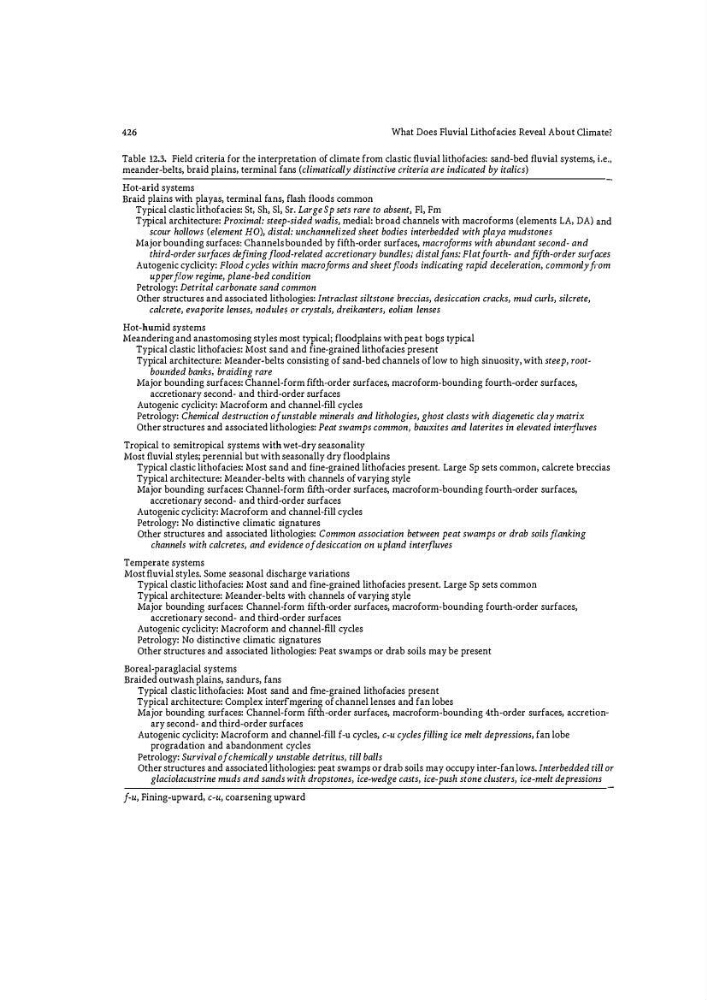
Table 12.3. Field criteria for the interpretation of climate from clastic fluvial lithofacies: sand-bed fluvial systems, i.e,,
meander-belts, braid plains, terminal fans (climatically distinctive criteria are indicated by italics)
Hot-arid systems
Braid plains with playas, terminal fa ns, flash floods common
Typical clastic lithofacies: St, Sh, Sl, Sr. Large Sp sets rare to absent, Fl, Fm
Typical architecture: Proximal: steep-sided wadis, medial: broad channels with macroforms (elements LA, DA) and
scour hollows (element HO), distal: unchannelized sheet bodies interbedded with playa mudstones
Major bounding surfaces: Channels bounded by fifth-order surfaces, macro fo rms with abundant second- and
third-order surfa ces defining flood-related accretionary bundles; distal fa ns: Flat fo urth- and fifth -order swfaces
Autogenic cyclicity: Flood cycles within macroforms and sheet floods indicating rapid deceleration, commonly from
upper flow regime, plane-bed condition
Petrology: Detrital carbonate sand common
Other structures and associated lithologies: Intraclast siltstone breccias, desiccation cracks, mud curls, silcrete,
calcrete, evaporite lenses, nodule$ or crystals, dreikanters, eolian lenses
Hot-humid systems
Meandering and anastomosing styles most typical; floodplains with peat bogs typical
Typical clastic lithofacies: Most sand and fine-grained lithofacies present
Typical architecture: Meander-belts consisting of sand-bed channels of low to high sinuosity, with steep, rootbounded banks; braiding rare
Major bounding surfaces: Channel-form fifth-order surfaces, macroform-bounding fo urth-order surfaces,
accretionary second- and third-order surfaces
Autogenic cyclicity: Macroform and channel-fill cycles
Petrology: Chemical destruction of unstable minerals and lithologies, ghost clasts with diagenetic clay matrix
Other structures and associated lithologies: Peat swamps common, bauxites and laterites in elevated interfluves
Tropical to semitropical systems with wet-dry seasonality
Most fluvial styles; perennial but with seasonally dry floodplains
Typical clastic lithofacies: Most sand and fine-grained lithofacies present. Large Sp sets common, calcrete breccias
Typical architecture: Meander-belts 'With channels of varying style
Major bounding surfaces: Channel-form fJ.fth-order surfaces, macroform�bounding fourth-order surfaces,
accretionary second- and third-order surfaces
Autogenic cyclicity: Macroform and channelwfill cycles
Petrology: No distinctive climatic signatures
Other structures and associated lithologies: Common association between peat swamps or drab soils flanking
channels with calcretes, and evidence of desiccation on upland interfluves
Temperate systems
Most fluvial styles. Some seasonal discharge variations
Typical clastic lithofacies: Most sand and fine-grained lithofacies present. Large Sp sets common
Typical architecture: Meander-belts with channels of varying style
Major bounding surfaces: Channel-form fifth-order surfaces, macroform�bounding fourthworder surfaces,
accretionary second- and third-order surfaces
Autogenic cyclicity: Macroform and channelwfill cycles
Petrology: No distinctive climatic signatures
Other structures and associated lithologies: Peat swamps or drab soils may be present
Boreal-paraglacial systems
Braided outwash plains, sandurs, fans
Typical clastic lithofacies: Most sand and fm e-grained lithofacies present
Typical architecture: Complex interfmgering of channel lenses and fan lobes
Major bounding surfaces: Channel-form fifth -order surfaces, macroform-bounding 4th warder surfaces, accretionary second- and third-order surfaces
Autogenic cyclicity: Macroform and channel-fill f-u cycles, c-u cycles filling ice melt depressions, fan lobe
progradation and abandonment cycles
Petrology: Survival of chemically unstable detritus, till balls
Other structures and associated lithologies: peat swamps or drab soils may occupy inter-fan lows. Interbedded till or
glaciolacustrine muds and sands with dropstones, ice-wedge casts, ice-push stone clusters, ice-melt depressions
f- u, Fining-upward, c-u, coarsening upward
What Does Fluvial Lithofacies Reveal About Climate?
Table 12.3. Field criteria for the interpretation of climate from clastic fluvial lithofacies: sand-bed fluvial systems, i.e,,
meander-belts, braid plains, terminal fans (climatically distinctive criteria are indicated by italics)
Hot-arid systems
Braid plains with playas, terminal fa ns, flash floods common
Typical clastic lithofacies: St, Sh, Sl, Sr. Large Sp sets rare to absent, Fl, Fm
Typical architecture: Proximal: steep-sided wadis, medial: broad channels with macroforms (elements LA, DA) and
scour hollows (element HO), distal: unchannelized sheet bodies interbedded with playa mudstones
Major bounding surfaces: Channels bounded by fifth-order surfaces, macro fo rms with abundant second- and
third-order surfa ces defining flood-related accretionary bundles; distal fa ns: Flat fo urth- and fifth -order swfaces
Autogenic cyclicity: Flood cycles within macroforms and sheet floods indicating rapid deceleration, commonly from
upper flow regime, plane-bed condition
Petrology: Detrital carbonate sand common
Other structures and associated lithologies: Intraclast siltstone breccias, desiccation cracks, mud curls, silcrete,
calcrete, evaporite lenses, nodule$ or crystals, dreikanters, eolian lenses
Hot-humid systems
Meandering and anastomosing styles most typical; floodplains with peat bogs typical
Typical clastic lithofacies: Most sand and fine-grained lithofacies present
Typical architecture: Meander-belts consisting of sand-bed channels of low to high sinuosity, with steep, rootbounded banks; braiding rare
Major bounding surfaces: Channel-form fifth-order surfaces, macroform-bounding fo urth-order surfaces,
accretionary second- and third-order surfaces
Autogenic cyclicity: Macroform and channel-fill cycles
Petrology: Chemical destruction of unstable minerals and lithologies, ghost clasts with diagenetic clay matrix
Other structures and associated lithologies: Peat swamps common, bauxites and laterites in elevated interfluves
Tropical to semitropical systems with wet-dry seasonality
Most fluvial styles; perennial but with seasonally dry floodplains
Typical clastic lithofacies: Most sand and fine-grained lithofacies present. Large Sp sets common, calcrete breccias
Typical architecture: Meander-belts 'With channels of varying style
Major bounding surfaces: Channel-form fJ.fth-order surfaces, macroform�bounding fourth-order surfaces,
accretionary second- and third-order surfaces
Autogenic cyclicity: Macroform and channelwfill cycles
Petrology: No distinctive climatic signatures
Other structures and associated lithologies: Common association between peat swamps or drab soils flanking
channels with calcretes, and evidence of desiccation on upland interfluves
Temperate systems
Most fluvial styles. Some seasonal discharge variations
Typical clastic lithofacies: Most sand and fine-grained lithofacies present. Large Sp sets common
Typical architecture: Meander-belts with channels of varying style
Major bounding surfaces: Channel-form fifth-order surfaces, macroform�bounding fourthworder surfaces,
accretionary second- and third-order surfaces
Autogenic cyclicity: Macroform and channelwfill cycles
Petrology: No distinctive climatic signatures
Other structures and associated lithologies: Peat swamps or drab soils may be present
Boreal-paraglacial systems
Braided outwash plains, sandurs, fans
Typical clastic lithofacies: Most sand and fm e-grained lithofacies present
Typical architecture: Complex interfmgering of channel lenses and fan lobes
Major bounding surfaces: Channel-form fifth -order surfaces, macroform-bounding 4th warder surfaces, accretionary second- and third-order surfaces
Autogenic cyclicity: Macroform and channel-fill f-u cycles, c-u cycles filling ice melt depressions, fan lobe
progradation and abandonment cycles
Petrology: Survival of chemically unstable detritus, till balls
Other structures and associated lithologies: peat swamps or drab soils may occupy inter-fan lows. Interbedded till or
glaciolacustrine muds and sands with dropstones, ice-wedge casts, ice-push stone clusters, ice-melt depressions
f- u, Fining-upward, c-u, coarsening upward