

cong lomerates: The Significance ofT ex:ture and Petrology
425
12.4 Review of C!imatic Criteria
range of climatic criteria, mostly those preserved in
the overbank environment.
The following sections review the major facies at
tributes of clastic fluvial lithofacies that convey some
cli matic information. For each lithofacies class the
focus is on the most climatically sensitive criteria,
and these are emphasized in the sub headings. The
data are summarized in accompanying tables and
figures, as follows: Table 12.1 classifies some major
recent descriptions of modern and ancient gravel
deposits according to climatic sett ing and according
tO the predominance of mass-flow or stream-flow
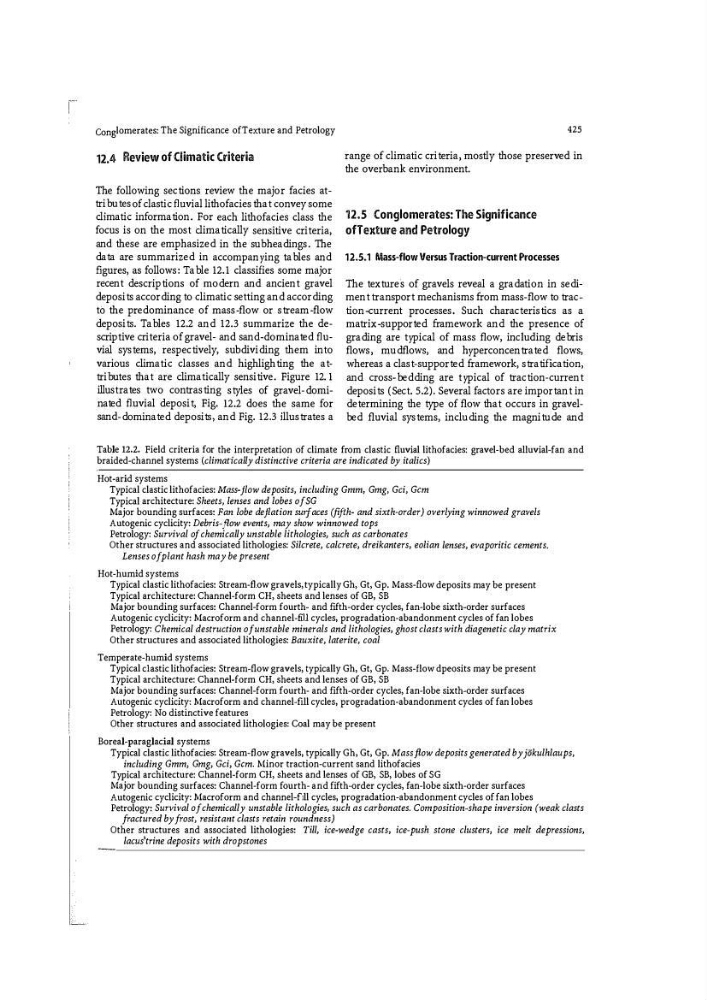
deposits. Tables 12.2 and 12.3 summarize the descript ive criteria of gravel- and sand-dominated fluvial systems, respectively, subdividing them int o
various climatic classes and highlighting the attributes that are climatically sensitive. Figure 12.1
illust rates two contrasting styles of gravel-dominated fluvial deposit, Fig. 12.2 does the same for
sand -dominated deposits, and Fig. 12.3 illustrates a
12.5 Conglomerates: The Significance
ofT enure am! Petrology
12.5.1 Mass�flow Versus Traction-current Processes
The texture's of gravels reveal a gradation in sediment transport mechanisms from mass-flow to traction-current processes. Such characteristics as a
matrix-supported framework and the presence of
grading are typical of mass flow, includ ing debris
flows, mudflows, and hy perconcentrated flows,
whereas a clast-supported framework, stratification,
and cross-bedding are typical of traction-current
deposits (Sect. 5.2). Several factors are important in
determining the type of flow that occurs in gravelbed fluvial systems, including the magnitude and
Table 12.2. Field criteria for the interpretation of climate fro m clastic fluvial lithofacies: gravel-bed alluvial-fan and
braided-channel systems (climatically distinctive criteria are indicated by italics)
Hot-arid systems
Typical clastic lithofacies: Mass-flow deposits, including Gmm, Gmg, Gci, Gem
Typical architecture: Sheets, lenses and lobes ofSG
Major bounding surfaces: Fan lobe deflation surfaces (fift h- and sixth-order) overlying winnowed gravels
Autogenic cyclicity: Debris-flow events, may show winnowed tops
Petrology: Survival of chemically unstable lithologies, such as carbonates
Other structures and associated lithologies: Silcrete, calcrete, dreikanters, eolian lenses, evaporitic cements.
Lenses of plant hash may be present
Hot-humid systems
Typical clastic lithofacies: Stream-flow gravels, typically Gh, Gt, Gp. Mass-flow deposits may be present
Typical architecture: Channel-form CH, sheets and lenses of GB, SB
Major bounding surfaces: Channel-form fourth- and fifth-order cycles, fan-lobe sixth-order surfaces
Autogenic cyclicity: Macroform and channel-f ill cycles, progradation-abandonment cycles of fan lobes
Petrology: Chemical destruction of unstable minerals and lithologies, gh ost clasts with diagenetic clay matrix
Other structures and associated lithologies: Bauxite, laterite, coal
Temperate-humid systems
Typical clastic lithofacies: Stream�flow gravels, typically Gh, Gt, Gp. Mass-flow dpeosits may be present
Typical architecture: Channel�form CH, sheets and lenses of GB, SB
Major bounding surfaces: Channel-form fourth- and fifth�order cycles, fan-lobe sixth�order surfaces
Autogenic cyclicity: Macroform and channel�fill cycles, progradation-abandonment cycles of fan lobes
Petrology: No distinctive features
Other structures and associated lithologies: Coal may be present
Boreal-paraglacial systems
Typical clastic lithofacies: Stream-flow gravels, typically Gh, Gt, Gp. Mass flow deposits generated by jOkulhlaups,
including Gmm, Gmg, Gci, Gem. Minor traction-current sand lithofacies
Typical architecture: Channel-form CH, sheets and lenses of GB, SB, lobes of SG
Major bounding surfaces: Channel-form fourth- and fifth"order cycles, fan-lobe sixth-order surfaces
Autogenic cyclicity: Macroform and channel-fill cycles, progradation-abandonment cycles of fan lobes
Petrology: Survival of chemically unstable lithologies, such as carbonates. Composition-shape inversion (weak clasts
fractured by fr ost, resistant clasts retain roundness)
Other structures and associated lithologies: Till, ice-wedge casts, ice-push stone clusters, ice melt depressions,
lacus'trine deposits with dropstones
425
12.4 Review of C!imatic Criteria
range of climatic criteria, mostly those preserved in
the overbank environment.
The following sections review the major facies at
tributes of clastic fluvial lithofacies that convey some
cli matic information. For each lithofacies class the
focus is on the most climatically sensitive criteria,
and these are emphasized in the sub headings. The
data are summarized in accompanying tables and
figures, as follows: Table 12.1 classifies some major
recent descriptions of modern and ancient gravel
deposits according to climatic sett ing and according
tO the predominance of mass-flow or stream-flow
deposits. Tables 12.2 and 12.3 summarize the descript ive criteria of gravel- and sand-dominated fluvial systems, respectively, subdividing them int o
various climatic classes and highlighting the attributes that are climatically sensitive. Figure 12.1
illust rates two contrasting styles of gravel-dominated fluvial deposit, Fig. 12.2 does the same for
sand -dominated deposits, and Fig. 12.3 illustrates a
12.5 Conglomerates: The Significance
ofT enure am! Petrology
12.5.1 Mass�flow Versus Traction-current Processes
The texture's of gravels reveal a gradation in sediment transport mechanisms from mass-flow to traction-current processes. Such characteristics as a
matrix-supported framework and the presence of
grading are typical of mass flow, includ ing debris
flows, mudflows, and hy perconcentrated flows,
whereas a clast-supported framework, stratification,
and cross-bedding are typical of traction-current
deposits (Sect. 5.2). Several factors are important in
determining the type of flow that occurs in gravelbed fluvial systems, including the magnitude and
Table 12.2. Field criteria for the interpretation of climate fro m clastic fluvial lithofacies: gravel-bed alluvial-fan and
braided-channel systems (climatically distinctive criteria are indicated by italics)
Hot-arid systems
Typical clastic lithofacies: Mass-flow deposits, including Gmm, Gmg, Gci, Gem
Typical architecture: Sheets, lenses and lobes ofSG
Major bounding surfaces: Fan lobe deflation surfaces (fift h- and sixth-order) overlying winnowed gravels
Autogenic cyclicity: Debris-flow events, may show winnowed tops
Petrology: Survival of chemically unstable lithologies, such as carbonates
Other structures and associated lithologies: Silcrete, calcrete, dreikanters, eolian lenses, evaporitic cements.
Lenses of plant hash may be present
Hot-humid systems
Typical clastic lithofacies: Stream-flow gravels, typically Gh, Gt, Gp. Mass-flow deposits may be present
Typical architecture: Channel-form CH, sheets and lenses of GB, SB
Major bounding surfaces: Channel-form fourth- and fifth-order cycles, fan-lobe sixth-order surfaces
Autogenic cyclicity: Macroform and channel-f ill cycles, progradation-abandonment cycles of fan lobes
Petrology: Chemical destruction of unstable minerals and lithologies, gh ost clasts with diagenetic clay matrix
Other structures and associated lithologies: Bauxite, laterite, coal
Temperate-humid systems
Typical clastic lithofacies: Stream�flow gravels, typically Gh, Gt, Gp. Mass-flow dpeosits may be present
Typical architecture: Channel�form CH, sheets and lenses of GB, SB
Major bounding surfaces: Channel-form fourth- and fifth�order cycles, fan-lobe sixth�order surfaces
Autogenic cyclicity: Macroform and channel�fill cycles, progradation-abandonment cycles of fan lobes
Petrology: No distinctive features
Other structures and associated lithologies: Coal may be present
Boreal-paraglacial systems
Typical clastic lithofacies: Stream-flow gravels, typically Gh, Gt, Gp. Mass flow deposits generated by jOkulhlaups,
including Gmm, Gmg, Gci, Gem. Minor traction-current sand lithofacies
Typical architecture: Channel-form CH, sheets and lenses of GB, SB, lobes of SG
Major bounding surfaces: Channel-form fourth- and fifth"order cycles, fan-lobe sixth-order surfaces
Autogenic cyclicity: Macroform and channel-fill cycles, progradation-abandonment cycles of fan lobes
Petrology: Survival of chemically unstable lithologies, such as carbonates. Composition-shape inversion (weak clasts
fractured by fr ost, resistant clasts retain roundness)
Other structures and associated lithologies: Till, ice-wedge casts, ice-push stone clusters, ice melt depressions,
lacus'trine deposits with dropstones