

424
runoff is more flashy and therefore more competent
in the wet season (Walling and Webb 1983). This
effect is particularly marked in monsoonal climates.
Cooling is induced by uplift, as well as by climate
change, and the sedimentological effects are the
same in both cases - changes in fauna and flora, and
typically an increase in sediment caliber and quantity as a result of a reduction in the density of vegetation cover. What sedimentological criteria can be
used to distinguish climatic from tectonic controls
in the generation of these kinds of changes in detrital
caliber and volume?
In their study of the fan gravels fl anking the Dead
Sea rift, Frostick and Reid (1989) noted a sharp
interbedding of coarse and fine deposits, with no
upward coarsening or fining. This they interpreted
to indicate an absence of progradation or retrogradation, which are the typical alluvial responses to
tectonic adjustments (Heward 1978a). They suggested that the coarse units indicate periods of increased rainfall.
De Boer et al. (1991) studied a complex interfingering of marine and nonmarine deposits in a
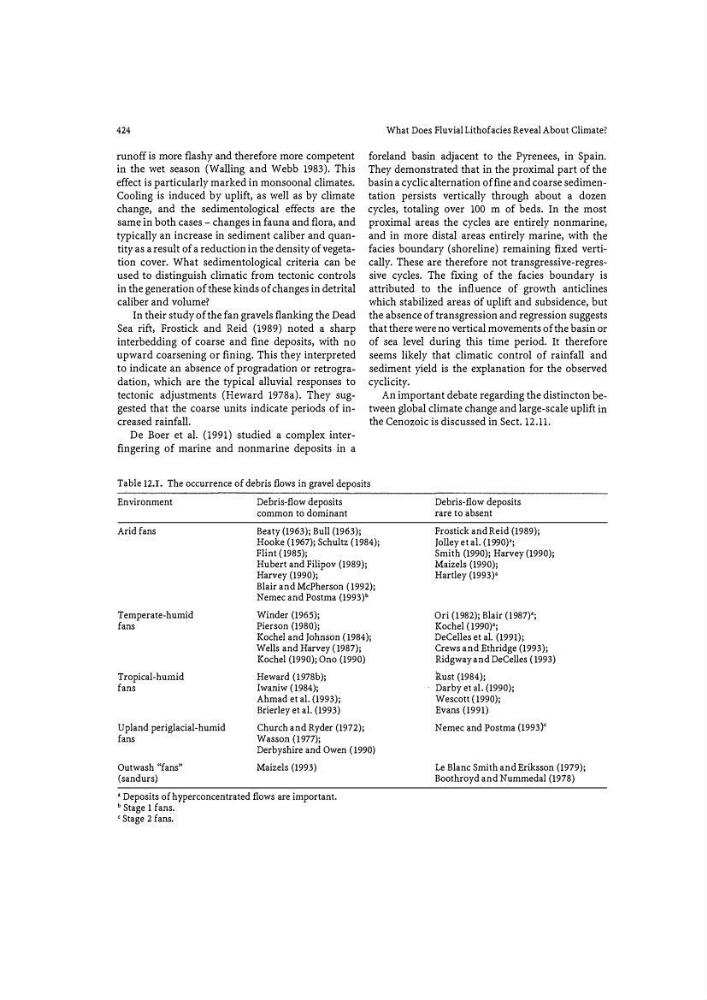
Table 12.I. The occurrence of debris flows in gravel
Environment
Debris� flow deposits
common to dominant
What Does Fluvial Lithofacies Reveal About Climate?
foreland basin adjacent to the Pyrenees, in Spain.
They demonstrated that in the proximal part of the
basin a cyclic alternation of fine and coarse sedimentation persists vertically through about a dozen
cycles, totaling over 100 m of beds. In the most
proximal areas the cycles are entirely nonmarine,
and in more distal areas entirely marine, with the
facies boundary (shoreline) remaining fi Xed vertically. These are therefore not transgressive-regressive cycles. The fixing of the facies boundary is
attributed to the influence of growth anticlines
which stabilized areas of uplift and subsidence, but
the absence of transgression and regression suggests
that there were no vertical movements of the basin or
of sea level during this time period. It therefore
seems likely that climatic control of rainfall and
sediment yield is the explanation for the observed
cyclicity.
An important debate regarding the distincton between global climate change and large-scale uplift in
the Cenozoic is discussed in Sect. 12.11.
Debris-flow deposits
rare to absent
Arid fans
Beaty (1963); Bull (1963);
Hooke (1967); Schultz (1984);
Flint (1985);
Frostick and Reid (1989);
Jolley et al. (1990)';
Smith (1990); Harvey (1990);
Maizels (1990);
Temperate-humid
fans
Tropical-humid
fans
Upland periglacial-humid
fans
Outwash "fans"
(sandurs)
Hubert and Filipov (1989);
Harvey (1990);
Blair and McPherson (1992);
Nemec and Postma (1993)b
Winder (1965);
Pierson (1980);
Kochel and Johnson (1984);
Wells and Harvey (1987);
Kochel (1990); Ono (1990)
Heward (1978b);
!waniw (1984);
Ahmad et al. (1993);
Brierley et al. (1993)
Church and Ryder (1972);
Wasson (1977);
Derbyshire and Owen (1990)
Maize1s (1993)
• Deposits of hyperconcentrated flows are important.
b Stage 1 fans.
c Stage 2 fans.
Hartley (1993)'
Ori (1982); Blair (1987)';
Kochel (1990)';
DeCelles et al. (1991);
Crews and Ethridge (1993);
Ridgway and DeCelles (1993)
R ust (1984);
Darby et al. (1990);
Wescott (1990);
Evans (1991)
Nemec and Postma (1993Y
Le Blanc Smith and Eriksson (1979);
Boothroyd and Nummedal (1978)
runoff is more flashy and therefore more competent
in the wet season (Walling and Webb 1983). This
effect is particularly marked in monsoonal climates.
Cooling is induced by uplift, as well as by climate
change, and the sedimentological effects are the
same in both cases - changes in fauna and flora, and
typically an increase in sediment caliber and quantity as a result of a reduction in the density of vegetation cover. What sedimentological criteria can be
used to distinguish climatic from tectonic controls
in the generation of these kinds of changes in detrital
caliber and volume?
In their study of the fan gravels fl anking the Dead
Sea rift, Frostick and Reid (1989) noted a sharp
interbedding of coarse and fine deposits, with no
upward coarsening or fining. This they interpreted
to indicate an absence of progradation or retrogradation, which are the typical alluvial responses to
tectonic adjustments (Heward 1978a). They suggested that the coarse units indicate periods of increased rainfall.
De Boer et al. (1991) studied a complex interfingering of marine and nonmarine deposits in a
Table 12.I. The occurrence of debris flows in gravel
Environment
Debris� flow deposits
common to dominant
What Does Fluvial Lithofacies Reveal About Climate?
foreland basin adjacent to the Pyrenees, in Spain.
They demonstrated that in the proximal part of the
basin a cyclic alternation of fine and coarse sedimentation persists vertically through about a dozen
cycles, totaling over 100 m of beds. In the most
proximal areas the cycles are entirely nonmarine,
and in more distal areas entirely marine, with the
facies boundary (shoreline) remaining fi Xed vertically. These are therefore not transgressive-regressive cycles. The fixing of the facies boundary is
attributed to the influence of growth anticlines
which stabilized areas of uplift and subsidence, but
the absence of transgression and regression suggests
that there were no vertical movements of the basin or
of sea level during this time period. It therefore
seems likely that climatic control of rainfall and
sediment yield is the explanation for the observed
cyclicity.
An important debate regarding the distincton between global climate change and large-scale uplift in
the Cenozoic is discussed in Sect. 12.11.
Debris-flow deposits
rare to absent
Arid fans
Beaty (1963); Bull (1963);
Hooke (1967); Schultz (1984);
Flint (1985);
Frostick and Reid (1989);
Jolley et al. (1990)';
Smith (1990); Harvey (1990);
Maizels (1990);
Temperate-humid
fans
Tropical-humid
fans
Upland periglacial-humid
fans
Outwash "fans"
(sandurs)
Hubert and Filipov (1989);
Harvey (1990);
Blair and McPherson (1992);
Nemec and Postma (1993)b
Winder (1965);
Pierson (1980);
Kochel and Johnson (1984);
Wells and Harvey (1987);
Kochel (1990); Ono (1990)
Heward (1978b);
!waniw (1984);
Ahmad et al. (1993);
Brierley et al. (1993)
Church and Ryder (1972);
Wasson (1977);
Derbyshire and Owen (1990)
Maize1s (1993)
• Deposits of hyperconcentrated flows are important.
b Stage 1 fans.
c Stage 2 fans.
Hartley (1993)'
Ori (1982); Blair (1987)';
Kochel (1990)';
DeCelles et al. (1991);
Crews and Ethridge (1993);
Ridgway and DeCelles (1993)
R ust (1984);
Darby et al. (1990);
Wescott (1990);
Evans (1991)
Nemec and Postma (1993Y
Le Blanc Smith and Eriksson (1979);
Boothroyd and Nummedal (1978)