

408
th rust-sheet loading may be responsible for stratigraphic cyclicity on time scales between 10 4 and 10 6
years.
Mc Lean and )erzykiewicz (1 978) ex amined th e
up permost of th e major nonmarine clastic wedges in
th e Alberta Bas in, the Brazeau-Paskapoo formations, and showed th at this succession) up to 3600 m
th ic k, encompasses at least four crudely upwardfining cycles, ranging from 400 to 1600 mi n th ickness. Age control on these cycles is poor, but
dep osition of th e entire wedge spanned about 20
million years , and so each cycle represents an aver
age of about 5 million years. In the Karoo Basin of
southern Afr ic a, which is als o a forelan d basin , th e
Beaufort Group comprises th ree basin- wide upward-fining cycles ranging from 160 to 500 m in
thickness (V isser and Dukas 1979), whereas th e
overlying Molteno Formation consists of six up
ward-finin g cycles th at reach maximum th ic knesses
of 140 m (T urner 1983). Tectonic control of th ese
foreland basin cycles in Alberta and southern Mr ica
is in dicated by sedimentological evidence for shiftin g source terranes (Rah mani and Lerbekmo 1975;
Visser and Dukas 1979).
Tectonic Control of Fluvial Sedimentation
Tight correlation between individual tectonic and
str atigraphic events is now available for some
foreland bas ins , such as parts of th e Himalayan
foredeep . There, Burbank and Raynolds (1 984, 1988)
used magnetostratigraphic techn iques to date th e
fluvial dep osits of the Himalayan foredeep of Paid
stan. The technique permits a precision of dating to
within th e nearest 10 5 years. These results show th at,
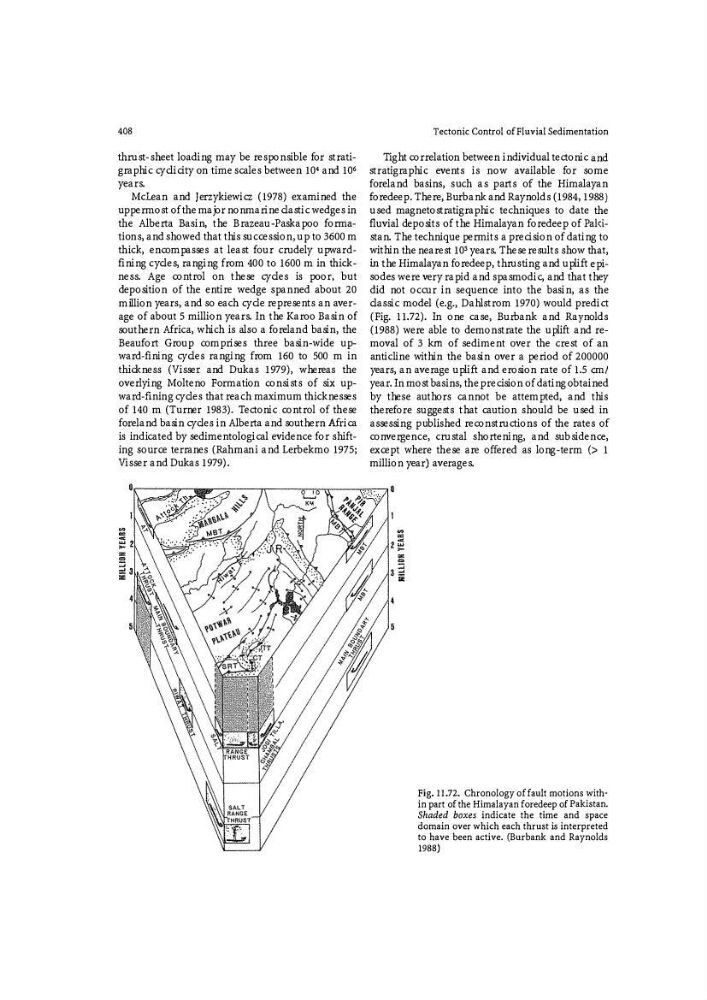
in the Himalayan foredeep, thrus tin g and uplift episodes were ver y rapid and spasmodic, and th at they
did not occur in sequence in to th e basin, as th e
classic model (e.g. , Dahlstrom 1970) would predict
(Fig. 11.72). In one case, Burban k and Raynolds
(1 988) were able to demonstrate th e uplift and removal of 3 km of sediment over th e crest of an
an tic line within th e basin over a period of 200000
years, an average uplift and erosion rate of 1.5 em/
year. In most bas ins, th e precision of dating obtained
by thes e authors cannot be attempted, and this
th erefore suggests that caution should be used in
assessing published reconstructions of th e rates of
convergenc e, crustal shortening, and subsidence,
except wh er e th ese are offer ed as long- ter m (> 1
million year} averages.
Fig. 11.72. Chronology of fault motions within part of the Himalayan foredeep of Pakistan.
Shaded boxes indicate the time and space
domain over which each thrust is interpreted
to have been active. (Burbank and Raynolds
1988)
th rust-sheet loading may be responsible for stratigraphic cyclicity on time scales between 10 4 and 10 6
years.
Mc Lean and )erzykiewicz (1 978) ex amined th e
up permost of th e major nonmarine clastic wedges in
th e Alberta Bas in, the Brazeau-Paskapoo formations, and showed th at this succession) up to 3600 m
th ic k, encompasses at least four crudely upwardfining cycles, ranging from 400 to 1600 mi n th ickness. Age control on these cycles is poor, but
dep osition of th e entire wedge spanned about 20
million years , and so each cycle represents an aver
age of about 5 million years. In the Karoo Basin of
southern Afr ic a, which is als o a forelan d basin , th e
Beaufort Group comprises th ree basin- wide upward-fining cycles ranging from 160 to 500 m in
thickness (V isser and Dukas 1979), whereas th e
overlying Molteno Formation consists of six up
ward-finin g cycles th at reach maximum th ic knesses
of 140 m (T urner 1983). Tectonic control of th ese
foreland basin cycles in Alberta and southern Mr ica
is in dicated by sedimentological evidence for shiftin g source terranes (Rah mani and Lerbekmo 1975;
Visser and Dukas 1979).
Tectonic Control of Fluvial Sedimentation
Tight correlation between individual tectonic and
str atigraphic events is now available for some
foreland bas ins , such as parts of th e Himalayan
foredeep . There, Burbank and Raynolds (1 984, 1988)
used magnetostratigraphic techn iques to date th e
fluvial dep osits of the Himalayan foredeep of Paid
stan. The technique permits a precision of dating to
within th e nearest 10 5 years. These results show th at,
in the Himalayan foredeep, thrus tin g and uplift episodes were ver y rapid and spasmodic, and th at they
did not occur in sequence in to th e basin, as th e
classic model (e.g. , Dahlstrom 1970) would predict
(Fig. 11.72). In one case, Burban k and Raynolds
(1 988) were able to demonstrate th e uplift and removal of 3 km of sediment over th e crest of an
an tic line within th e basin over a period of 200000
years, an average uplift and erosion rate of 1.5 em/
year. In most bas ins, th e precision of dating obtained
by thes e authors cannot be attempted, and this
th erefore suggests that caution should be used in
assessing published reconstructions of th e rates of
convergenc e, crustal shortening, and subsidence,
except wh er e th ese are offer ed as long- ter m (> 1
million year} averages.
Fig. 11.72. Chronology of fault motions within part of the Himalayan foredeep of Pakistan.
Shaded boxes indicate the time and space
domain over which each thrust is interpreted
to have been active. (Burbank and Raynolds
1988)