

plate- Tectonic Setting of Alluvial Basins
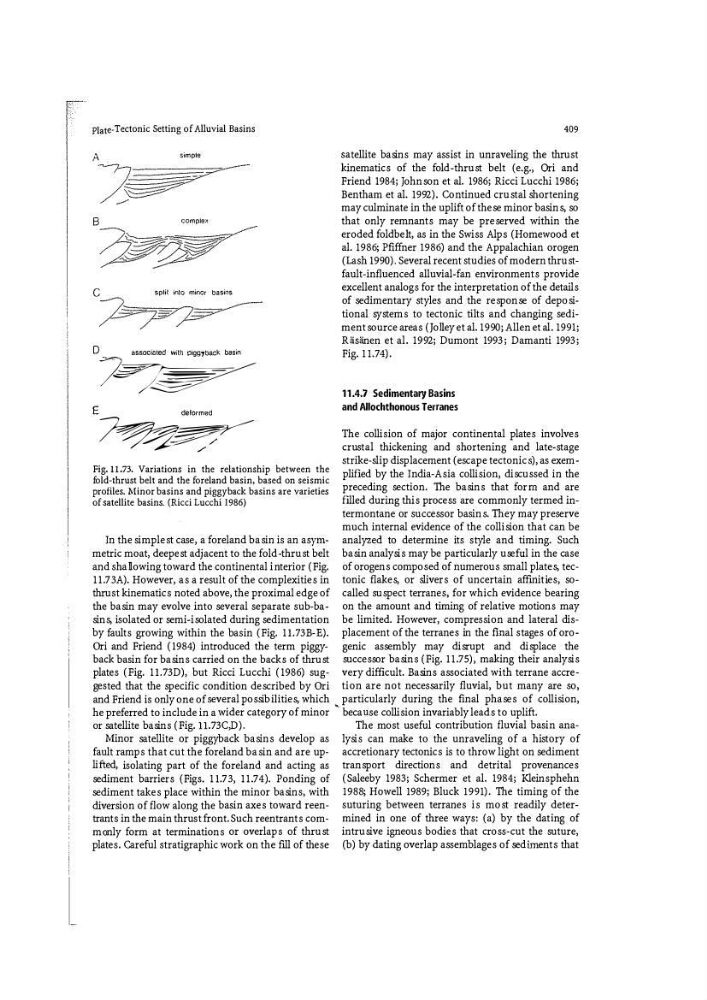
A
simple
/�-B
complex
c
split into minor basins
___. .. .. .._
D��
E��
Fig.l l.73. Variations in the relationship between the
fo ld-thrust belt and the fo reland basin, based on seismic
profiles. Minor basins and piggyback basins are varieties
of satellite basins. (Ricci Lucchi 1986)
409
satellite basins may assist in unraveling the thrus t
kinematics of the fold- thrust belt (e.g., Ori and
Friend 1984; johnson et al. 1986; Ricci Lucchi 1986;
Bentham et al. 1992). Continued crustal shortening
may culminate in the uplift of these minor basins, so
that only remnants may be preserved within the
eroded foldbelt, as in the Swiss Alps (Homewood et
al. 1986; Pfiffner 1986) and the Appalachian orogen
(Las h 1990). Several recent studies of modern thrustfault-influenced alluvial-fan environments provide
excellent analogs for the interpretation of the details
of sedimentary styles and the response of depositional systems to tectonic ti lts and changing sediment source areas (Joll ey et al. 1990; Allen et al. 1991;
Rasanen et al. 1992; Dumont 1993; Damanti 1993;
Fig. 11.74).
11.4.7 Sedimentary Basins
and Allochthonous Te.,anes
The collis ion of major continental plates involves
crustal thickening and shortening and late-stage
strike-slip displacement (escape tectonics), as exemplified by the India-As ia collision, discuss ed in the
preceding section. The basins that form and are
filled during this process are commonly termed intermontane or success or basins. They may preserve
much internal evidence of the collision that can be
In the simplest case, a foreland basin is an asyrn- analyzed to determine its style and timing. Such
metric moat, deepest adjacent to the fold-thrust belt basin analysis may be particularly usefu l in the cas e
and shallowing toward the continental interior (Fig. of orogens compos ed of numerous small plates, tec11.73A). However, as a result of the complexities in tonic flakes, or slivers of uncertain affinities , sothrus t kinematics noted above, the proximal edge of called suspect terranes , for which evidence bearing
the basin may evolve into several separate sub-ba- on the amount and timing of relative motions may
sins, is olated or semi-isolated during sedimentation be limited. However, compression and lateral dis
by faults growing within the bas in (Fig. 1!.73B-E ). placement of the terranes in the fm al stages of oroOri and Friend (1984) introduced the term piggy- genic as sembly may disrupt and displace the
back basin for basins carried on the backs of thrust successor basins (Fig. 11.75 ), making their analysis
plates (Fig. 1!.7 3D), but Ricci Lucchi (1986) sug- very difficult. Basins ass ociated with terrane accreges ted that the specific condition described by Ori tion are not necessarily fluvial, but many are so,
and Friend is only one of several possibil ities, which particularly during the final phases of collision,
he preferred to include in a wider category of minor
" becaUs e collision invariably leads to uplift.
or satellite basins (Fig. ll.73C ,D).
The mos t us eful contribution fluvial basin anaMinor satellite or piggyback basins develop as lysis can make to the unraveling of a history of
fault ramps that cut the foreland basin and are up- accretionary tectonics is to throw light on sediment
lifted, is olating part of the foreland and acting as transport directions and detrital provenances
sediment barriers (Figs . 1!.73, 11.74 ). Ponding of (Saleeby 1983; Schermer et al. 1984; Kleins phehn
sediment takes place within the minor basins , with 1988; Howell 1989; Bluck 1991). The timing of the
diversion of flow along the basin axes toward reen- suturing between terranes is most readily detertrants in the main thrustfront.Such reentrants com- mined in one of three ways: (a) by the dating of
manly form at terminations or overlaps of thrust intrusive igneous bodies that cross -cut the suture,
plates . Careful stratigraphic work on the fill of thes e (b) by dating overlap ass emblages of sediments that
A
simple
/�-B
complex
c
split into minor basins
___. .. .. .._
D��
E��
Fig.l l.73. Variations in the relationship between the
fo ld-thrust belt and the fo reland basin, based on seismic
profiles. Minor basins and piggyback basins are varieties
of satellite basins. (Ricci Lucchi 1986)
409
satellite basins may assist in unraveling the thrus t
kinematics of the fold- thrust belt (e.g., Ori and
Friend 1984; johnson et al. 1986; Ricci Lucchi 1986;
Bentham et al. 1992). Continued crustal shortening
may culminate in the uplift of these minor basins, so
that only remnants may be preserved within the
eroded foldbelt, as in the Swiss Alps (Homewood et
al. 1986; Pfiffner 1986) and the Appalachian orogen
(Las h 1990). Several recent studies of modern thrustfault-influenced alluvial-fan environments provide
excellent analogs for the interpretation of the details
of sedimentary styles and the response of depositional systems to tectonic ti lts and changing sediment source areas (Joll ey et al. 1990; Allen et al. 1991;
Rasanen et al. 1992; Dumont 1993; Damanti 1993;
Fig. 11.74).
11.4.7 Sedimentary Basins
and Allochthonous Te.,anes
The collis ion of major continental plates involves
crustal thickening and shortening and late-stage
strike-slip displacement (escape tectonics), as exemplified by the India-As ia collision, discuss ed in the
preceding section. The basins that form and are
filled during this process are commonly termed intermontane or success or basins. They may preserve
much internal evidence of the collision that can be
In the simplest case, a foreland basin is an asyrn- analyzed to determine its style and timing. Such
metric moat, deepest adjacent to the fold-thrust belt basin analysis may be particularly usefu l in the cas e
and shallowing toward the continental interior (Fig. of orogens compos ed of numerous small plates, tec11.73A). However, as a result of the complexities in tonic flakes, or slivers of uncertain affinities , sothrus t kinematics noted above, the proximal edge of called suspect terranes , for which evidence bearing
the basin may evolve into several separate sub-ba- on the amount and timing of relative motions may
sins, is olated or semi-isolated during sedimentation be limited. However, compression and lateral dis
by faults growing within the bas in (Fig. 1!.73B-E ). placement of the terranes in the fm al stages of oroOri and Friend (1984) introduced the term piggy- genic as sembly may disrupt and displace the
back basin for basins carried on the backs of thrust successor basins (Fig. 11.75 ), making their analysis
plates (Fig. 1!.7 3D), but Ricci Lucchi (1986) sug- very difficult. Basins ass ociated with terrane accreges ted that the specific condition described by Ori tion are not necessarily fluvial, but many are so,
and Friend is only one of several possibil ities, which particularly during the final phases of collision,
he preferred to include in a wider category of minor
" becaUs e collision invariably leads to uplift.
or satellite basins (Fig. ll.73C ,D).
The mos t us eful contribution fluvial basin anaMinor satellite or piggyback basins develop as lysis can make to the unraveling of a history of
fault ramps that cut the foreland basin and are up- accretionary tectonics is to throw light on sediment
lifted, is olating part of the foreland and acting as transport directions and detrital provenances
sediment barriers (Figs . 1!.73, 11.74 ). Ponding of (Saleeby 1983; Schermer et al. 1984; Kleins phehn
sediment takes place within the minor basins , with 1988; Howell 1989; Bluck 1991). The timing of the
diversion of flow along the basin axes toward reen- suturing between terranes is most readily detertrants in the main thrustfront.Such reentrants com- mined in one of three ways: (a) by the dating of
manly form at terminations or overlaps of thrust intrusive igneous bodies that cross -cut the suture,
plates . Careful stratigraphic work on the fill of thes e (b) by dating overlap ass emblages of sediments that