

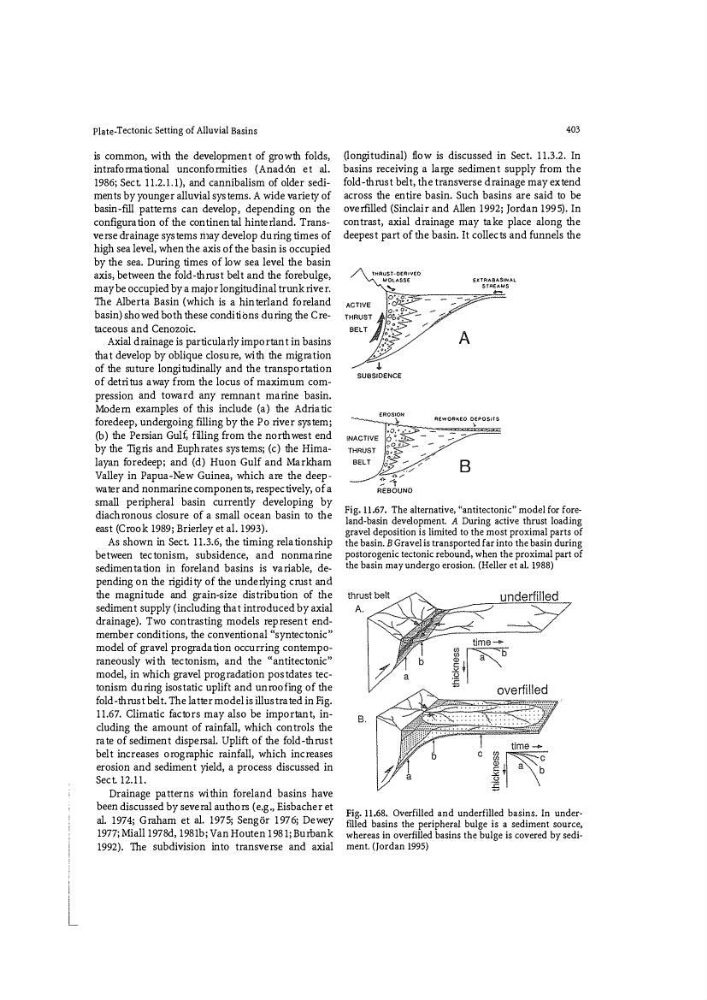
I
I
L
Plate� Tectonic Setting of Alluvial Basins
is common, with the development of gr owth folds,
intraformational unconformities (AnadOn et al.
1986; Sect. 11.2.! .1), and cannibalism of older sediment s by younger alluvial systems. A wide var iety of
basin- fill patterns can develop, depending on the
configuration of the cont inental hinterland. Transverse dr ainage systems :rilay develop during times of
high sea level, when the axis of the basin is occupied
by the sea. During times of low sea level the basin
axis, between the fold-thrust belt and the forebulge,
may be occupied by a major longitudinal tr unk river.
The Albert a Basin (which is a hinterland foreland
basin) showed bot h these conditio ns during the Cretaceous and Cenozoic.
Axial drainage is particularly important in basins
that develop by oblique closure, with the migrat ion
of the sut ur e longitudinally and the transportation
of detritus away from the locus of maximum compr ession and towar d any remnant marine basin.
Modern examples of this include (a) the Adriatic
foredeep, undergoing filling by the Po river system;
(b) the Persian Gul£ filling fr om the northwest end
by the Tigris and Euphrates systems; (c) the Himalayan for edeep; and (d) Huon Gulf and Markham
Valley in Papua-New Guinea, which are the deepwater and nonmarine components, respectively, of a
small peripheral basin curr ently developing by
diachronous closure of a small ocean basin to the
east (Crook 1989; Br ierley et al. 1993 ).
As shown in Sect. 11.3.6 , the timing relationship
between tectonism, subsidence, and nonmarine
sedimentation in foreland basins is variable, depending on the rigidity of the underl ying crust and
the magnitude and gr ain-size distribution of the
sediment supply (including that introduced by axial
dr ainage). Two contrast ing models represent endmember condit ions, the conventional "syntectonic"
model of gr avel pr ogradation occurr ing contemporaneously with tectonism, and the "ant it ectonic"
model, in which gr avel pr ogradation postdates tectonism during isost atic uplift and unroofing of the
fold-thrust belt . The latter model is illustrated in Fig.
11.67. Climatic factor s may also be important, including the amount of rainfall, which controls the
rate of sediment dispersal. Uplift of the fold-thrust
belt incr eases orographic rainfall, which increases
er osion and sediment yield, a pr ocess discussed in
Sect. 12.1 1.
Dr ainage patt er ns within foreland basins have
been discussed by several authors (e.g., Eisbacher et
al. 19 74; Graham et al. 19 75; Sengor 19 76; Dewey
19 77; Miall 19 78d, 19 81b; Van Houten 19 81; Burbank
1992). The subdivision int o transverse and axial
403
(longit udinal) flow is discussed in Sect . 11.3.2. In
basins receiving a large sediment supply fr om the
fold-thrust belt , the transverse drainage may extend
acr oss the ent ir e basin. Such basins ar e said to be
overfilled (Sinclair and Allen 1992; Jordan 1995). In
contrast , axial drainage may take place along the
deepest part of the basin. It collects and funnels the
IHAUST·OERIVEO
MOLASSE
,.
SUBSIDENCE
� � ?
- "'
REBOUND
A
�XTRA8A$1NAL
STREAMS
-
REWORI
B
Fig. 11.67. The alternative, "antitectonic" model for fore�
land-basin development. A During active thrust loading
gravel deposition is limited to the most proximal parts of
the basin. B Gravel is transported far into the basin during
postorogenic tectonic rebound, when the proximal part of
the basin may undergo erosion. (Heller et al. 1988)
Fig. 11.68. Overfilled and underfilled basins. In under�
fi lled basins the peripheral bulge is a sediment source,
whereas in overfilled basins the bulge is covered by sediM
ment. (Jordan 1995)
I
L
Plate� Tectonic Setting of Alluvial Basins
is common, with the development of gr owth folds,
intraformational unconformities (AnadOn et al.
1986; Sect. 11.2.! .1), and cannibalism of older sediment s by younger alluvial systems. A wide var iety of
basin- fill patterns can develop, depending on the
configuration of the cont inental hinterland. Transverse dr ainage systems :rilay develop during times of
high sea level, when the axis of the basin is occupied
by the sea. During times of low sea level the basin
axis, between the fold-thrust belt and the forebulge,
may be occupied by a major longitudinal tr unk river.
The Albert a Basin (which is a hinterland foreland
basin) showed bot h these conditio ns during the Cretaceous and Cenozoic.
Axial drainage is particularly important in basins
that develop by oblique closure, with the migrat ion
of the sut ur e longitudinally and the transportation
of detritus away from the locus of maximum compr ession and towar d any remnant marine basin.
Modern examples of this include (a) the Adriatic
foredeep, undergoing filling by the Po river system;
(b) the Persian Gul£ filling fr om the northwest end
by the Tigris and Euphrates systems; (c) the Himalayan for edeep; and (d) Huon Gulf and Markham
Valley in Papua-New Guinea, which are the deepwater and nonmarine components, respectively, of a
small peripheral basin curr ently developing by
diachronous closure of a small ocean basin to the
east (Crook 1989; Br ierley et al. 1993 ).
As shown in Sect. 11.3.6 , the timing relationship
between tectonism, subsidence, and nonmarine
sedimentation in foreland basins is variable, depending on the rigidity of the underl ying crust and
the magnitude and gr ain-size distribution of the
sediment supply (including that introduced by axial
dr ainage). Two contrast ing models represent endmember condit ions, the conventional "syntectonic"
model of gr avel pr ogradation occurr ing contemporaneously with tectonism, and the "ant it ectonic"
model, in which gr avel pr ogradation postdates tectonism during isost atic uplift and unroofing of the
fold-thrust belt . The latter model is illustrated in Fig.
11.67. Climatic factor s may also be important, including the amount of rainfall, which controls the
rate of sediment dispersal. Uplift of the fold-thrust
belt incr eases orographic rainfall, which increases
er osion and sediment yield, a pr ocess discussed in
Sect. 12.1 1.
Dr ainage patt er ns within foreland basins have
been discussed by several authors (e.g., Eisbacher et
al. 19 74; Graham et al. 19 75; Sengor 19 76; Dewey
19 77; Miall 19 78d, 19 81b; Van Houten 19 81; Burbank
1992). The subdivision int o transverse and axial
403
(longit udinal) flow is discussed in Sect . 11.3.2. In
basins receiving a large sediment supply fr om the
fold-thrust belt , the transverse drainage may extend
acr oss the ent ir e basin. Such basins ar e said to be
overfilled (Sinclair and Allen 1992; Jordan 1995). In
contrast , axial drainage may take place along the
deepest part of the basin. It collects and funnels the
IHAUST·OERIVEO
MOLASSE
,.
SUBSIDENCE
� � ?
- "'
REBOUND
A
�XTRA8A$1NAL
STREAMS
-
REWORI
B
Fig. 11.67. The alternative, "antitectonic" model for fore�
land-basin development. A During active thrust loading
gravel deposition is limited to the most proximal parts of
the basin. B Gravel is transported far into the basin during
postorogenic tectonic rebound, when the proximal part of
the basin may undergo erosion. (Heller et al. 1988)
Fig. 11.68. Overfilled and underfilled basins. In under�
fi lled basins the peripheral bulge is a sediment source,
whereas in overfilled basins the bulge is covered by sediM
ment. (Jordan 1995)