

402
.. .
Tectonic Control of Fluvial Sedimentation
�
l.:..;_:j
FAULT
THRUST
WRENCH INFERRED FOLD
BASIN
FAULT
FAULT
FAULT
AXIS
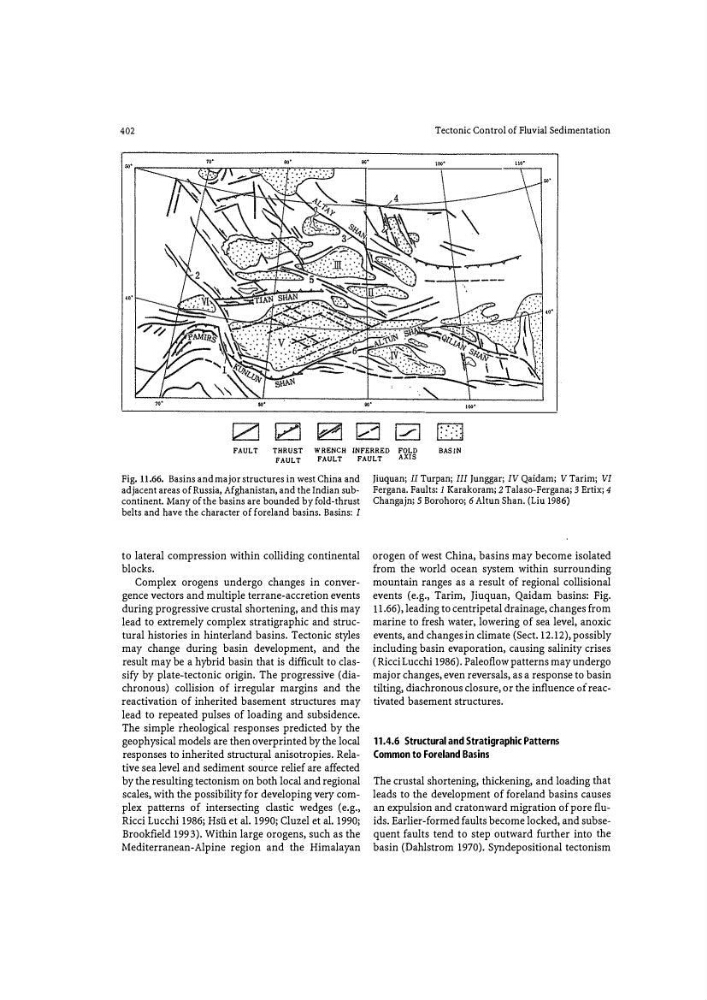
Fig. 11.66. Basins and major structures in west China and
adjacent areas of Russia, Afghanistan, and the Indian sub�
continent. Many of the basins are bounded by fold-thrust
belts and have the character of foreland basins. Basins: I
to lateral compression within colliding continental
blocks.
Complex orogens undergo changes in convergence vectors and multiple terrane-accretion events
during progressive crustal shortening, and this may
lead to extremely complex stratigraphic and structural histories in hinterland basins. Tectonic styles
may change during basin development, and the
result may be a hybrid basin that is difficult to classify by platectectonic origin. The progressive (diachronous) collision of irregular margins and the
reactivation of inherited basement structures may
lead to repeated pulses of loading and subsidence.
The simple rheological responses predicted by the
geophysical models are then overprinted by the local
responses to inherited structu�al anisotropies. Relative sea level and sediment source relief are affected
by the resulting tectonism on both local and regional
scales, with the possibility for developing very complex patterns of intersecting clastic wedges (e.g.,
Ricci Lucchi 1986; Hsu et al. 1990; Cluzel et al. 1990;
Brookfield 1993). Within large orogens, such as the
Mediterranean-Alpine region and the Himalayan
Jiuquan; II Turpan; III Junggar; IV Qaidam; V Tarim; VI
Fergana. Faults: 1 Karakoram; 2 Talaso-Fergana; 3 Ertix; 4
Changajn; 5 Borohoro; 6 Altun Shan. (Liu 1986)
orogen of west China, basins may become isolated
from the world ocean system within surrounding
mountain ranges as a result of regional collisional
events (e.g., Tarim, Jiuquan, Qaidam basins: Fig.
1 1.66), leading to centripetal drainage, changes from
marine to fresh water, lowering of sea level, anoxic
events, and changes in climate (S ect. 12.12), possibly
including basin evaporation, causing salinity crises
(Ricci Lucchi 1986). Paleoflow patterns may undergo
major changes, even reversals, as a response to basin
tilting, diachronous closure, or the influence of reactivated basement structures.
11.4.6 Structural and Stratigraphic Patterns
Common to Foreland Basins
The crustal shortening, thickening, and loading that
leads to the development of foreland basins causes
an expulsion and cratonward migration of pore fluids. Earlier-formed faults become locked, and subsequent faults tend to step outward further into the
basin (Dahlstrom 1970). Syndepositional tectonism
.. .
Tectonic Control of Fluvial Sedimentation
�
l.:..;_:j
FAULT
THRUST
WRENCH INFERRED FOLD
BASIN
FAULT
FAULT
FAULT
AXIS
Fig. 11.66. Basins and major structures in west China and
adjacent areas of Russia, Afghanistan, and the Indian sub�
continent. Many of the basins are bounded by fold-thrust
belts and have the character of foreland basins. Basins: I
to lateral compression within colliding continental
blocks.
Complex orogens undergo changes in convergence vectors and multiple terrane-accretion events
during progressive crustal shortening, and this may
lead to extremely complex stratigraphic and structural histories in hinterland basins. Tectonic styles
may change during basin development, and the
result may be a hybrid basin that is difficult to classify by platectectonic origin. The progressive (diachronous) collision of irregular margins and the
reactivation of inherited basement structures may
lead to repeated pulses of loading and subsidence.
The simple rheological responses predicted by the
geophysical models are then overprinted by the local
responses to inherited structu�al anisotropies. Relative sea level and sediment source relief are affected
by the resulting tectonism on both local and regional
scales, with the possibility for developing very complex patterns of intersecting clastic wedges (e.g.,
Ricci Lucchi 1986; Hsu et al. 1990; Cluzel et al. 1990;
Brookfield 1993). Within large orogens, such as the
Mediterranean-Alpine region and the Himalayan
Jiuquan; II Turpan; III Junggar; IV Qaidam; V Tarim; VI
Fergana. Faults: 1 Karakoram; 2 Talaso-Fergana; 3 Ertix; 4
Changajn; 5 Borohoro; 6 Altun Shan. (Liu 1986)
orogen of west China, basins may become isolated
from the world ocean system within surrounding
mountain ranges as a result of regional collisional
events (e.g., Tarim, Jiuquan, Qaidam basins: Fig.
1 1.66), leading to centripetal drainage, changes from
marine to fresh water, lowering of sea level, anoxic
events, and changes in climate (S ect. 12.12), possibly
including basin evaporation, causing salinity crises
(Ricci Lucchi 1986). Paleoflow patterns may undergo
major changes, even reversals, as a response to basin
tilting, diachronous closure, or the influence of reactivated basement structures.
11.4.6 Structural and Stratigraphic Patterns
Common to Foreland Basins
The crustal shortening, thickening, and loading that
leads to the development of foreland basins causes
an expulsion and cratonward migration of pore fluids. Earlier-formed faults become locked, and subsequent faults tend to step outward further into the
basin (Dahlstrom 1970). Syndepositional tectonism