

I
!
Plate- Tectonic Setting of Alluvial Basins
Oct�enle cruet
o! S<:>Uih Chlnll Sen
11nd Andamnn So a
\
\
s
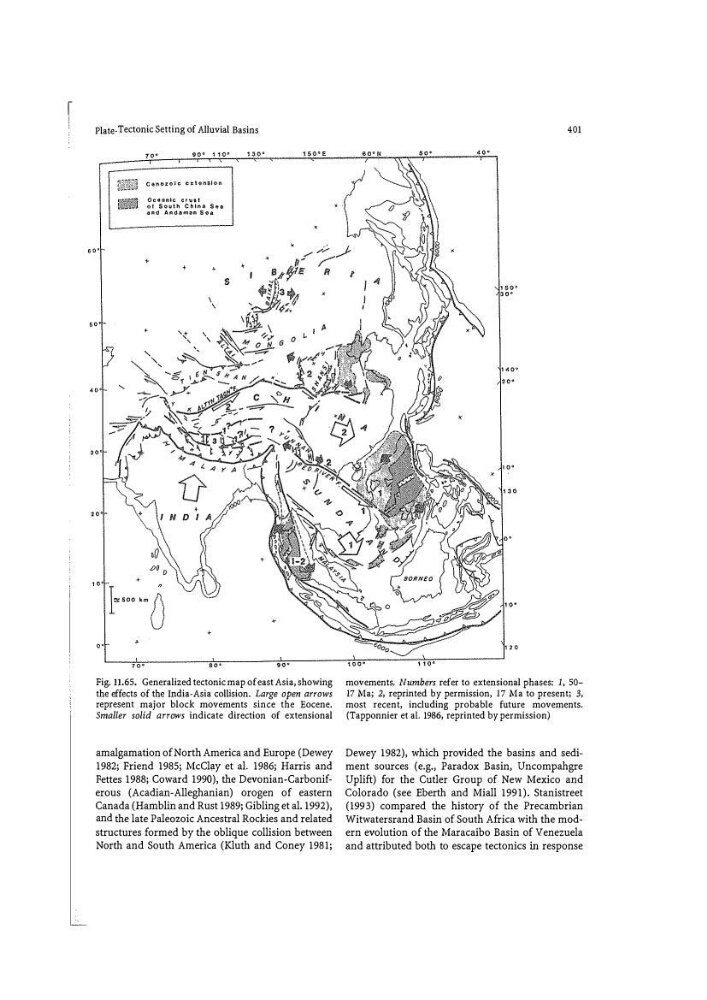
Fig. 11.65. Generalized tectonic map of east Asia, showing
the effects o' f the India-Asia collision. Large open arrows
represent major block movements since the Eocene.
Smaller solid arrows indicate direction of extensional
amalgamation ofNorth America and Europe (Dewey
1982; Friend 1985; McCl�y et al. 1986; Harris and
Fettes 1988; Coward 1990), the Devonian-Carboniferous (Acadian-Alleghanian) orogen of eastern
Canada (Hamblin and Rust 1989; Gibling et al.1992),
and the late Paleozoic Ancestral Rockies and related
structures formed by the oblique collision between
North and South America (Kluth and Coney 1981;
401
,.
,.
movements. Numbers refer to extensional phases: l, 5017 Ma; 2, reprinted by permission, 17 Ma to present; 3,
most recent, including probable future movements.
(Tapponnier et aL 1986, reprinted by permission)
Dewey 1982), which provided the basins and sediment sources (e.g., Paradox Basin, Uncompahgre
Uplift) for the Cutler Group of New Mexico and
Colorado (see Eberth and Miall 1991). Stanistreet
(1993) compared the history of the Precambrian
Witwatersrand Basin of South Africa with the modern evolution of the Maracaibo Basin of Venezuela
and attributed both to escape tectonics in response
!
Plate- Tectonic Setting of Alluvial Basins
Oct�enle cruet
o! S<:>Uih Chlnll Sen
11nd Andamnn So a
\
\
s
Fig. 11.65. Generalized tectonic map of east Asia, showing
the effects o' f the India-Asia collision. Large open arrows
represent major block movements since the Eocene.
Smaller solid arrows indicate direction of extensional
amalgamation ofNorth America and Europe (Dewey
1982; Friend 1985; McCl�y et al. 1986; Harris and
Fettes 1988; Coward 1990), the Devonian-Carboniferous (Acadian-Alleghanian) orogen of eastern
Canada (Hamblin and Rust 1989; Gibling et al.1992),
and the late Paleozoic Ancestral Rockies and related
structures formed by the oblique collision between
North and South America (Kluth and Coney 1981;
401
,.
,.
movements. Numbers refer to extensional phases: l, 5017 Ma; 2, reprinted by permission, 17 Ma to present; 3,
most recent, including probable future movements.
(Tapponnier et aL 1986, reprinted by permission)
Dewey 1982), which provided the basins and sediment sources (e.g., Paradox Basin, Uncompahgre
Uplift) for the Cutler Group of New Mexico and
Colorado (see Eberth and Miall 1991). Stanistreet
(1993) compared the history of the Precambrian
Witwatersrand Basin of South Africa with the modern evolution of the Maracaibo Basin of Venezuela
and attributed both to escape tectonics in response