

400
s
?
Subsidence
m
?
Tectonic Control of Fluvial Sedimentation
Fan
deltas
••
N
o
km
!0
ffi7'.01 A!tuvial fan body
ti!2J
rn:m:m Main river sand body
Eilll li!l
Downwarping
E] Tributary river sand body
Q
Fine grained sediments
.... .., ..._,_ Upper limit of marine inlluence.o?
'
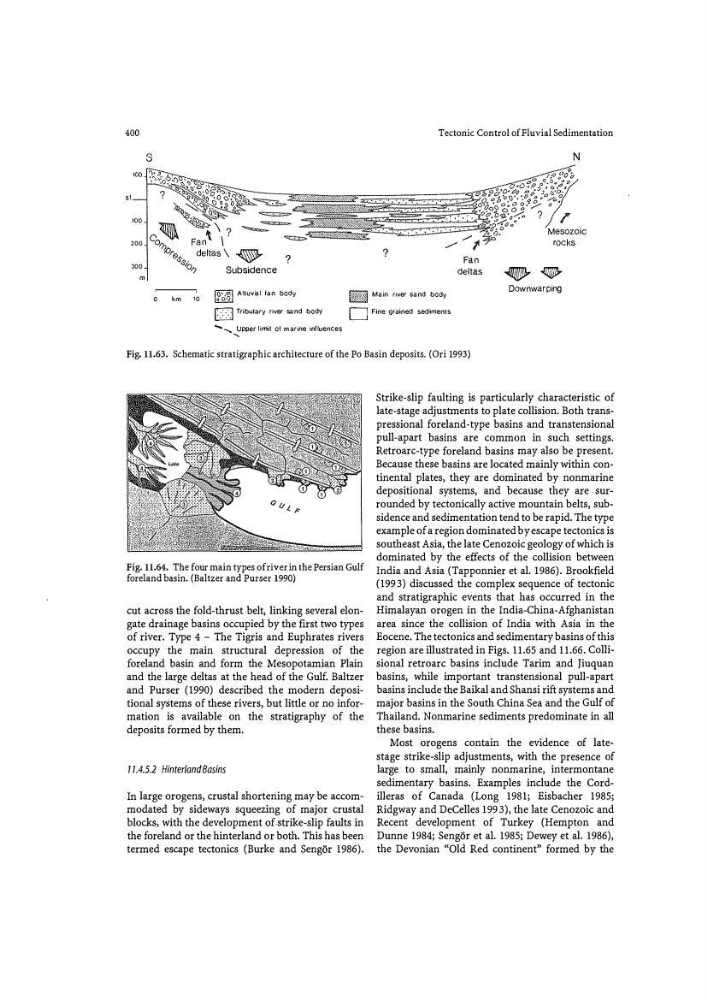
Fig. 11.63. Schematic stratigraphic architecture of the Po Basin deposits. (Ori 1993)
Fig. 11.64. The four main types of river in the Persian Gulf
fo reland basin. (Baltzer and Purser 1990)
cut across the fold-thrust belt, linking several elongate drainage basins occupied by the first two types
of river. Type 4 - The Tigris and Euphrates rivers
occupy the main structural depression of the
foreland basin and form the Mesopotamian Plain
and the large deltas at the head of the Gulf. Baltzer
and Purser (1990) described the modern depositional syStems of these rivers, but little or no information is available on the stratigraphy of the
deposits formed by them.
11.4.5.2 Hinterland Basins
In large orogens, crustal shortening may be accom�
modated by sideways squeezing of major crustal
blocks, with the development of.strike-slip faults in
the foreland or the hinterland or both. This has been
termed escape tectonics (Burke and Sengor 1986).
Strike-slip faulting is particularly characteristic of
late-stage adjustments to plate collision. Both transpressional foreland-type basins and transtensional
pull-apart basins are common in such settings.
Retroarc-type foreland basins may also be present.
Because these basins are located mainly within continental plates, they are dominated by nonmarine
depositional systems, and because they are surrounded by tectonically active mountain belts, subsidence and sedimentation tend to be rapid. The type
example of a region dominated by escape tectonics is
southeast Asia, the late Cenozoic geology of which is
dominated by the effects of the collision between
India and Asia (Tapponnier et al. 1986). Brookfield
(1993) discussed the complex sequence of tectonic
and stratigraphic events that has occurred in the
Himalayan orogen in the India-China-Afghanistan
area since the collision of India with Asia in the
Eocene. The tectonics and sedimentary basins of this
region are illustrated in Figs. 1!.65 and 1!.66. Collisional retroarc basins include Tarim and Jiuquan
basins, while important transtensional pull-apart
basins include the· Baikal and Shansi rift systems and
major basins in the South China Sea and the Gulf of
Thailand. Nonmarine sediments predominate in all
these basins.
Most orogens contain the evidence of latestage strike-slip adjustments, with the presence of
large to small, mainly nonmarine, intermontane
sedimentary basins. Examples include the Cordilleras of Canada (Long 1981; Eisbacher 1985;
Ridgway and DeCelles 1993), the late Cenozoic and
Recent development of Turkey (Hempton and
Dunne 1984; Sengor et a!. 1985; Dewey et al. 1986),
the Devonian "Old Red continent" formed by the
s
?
Subsidence
m
?
Tectonic Control of Fluvial Sedimentation
Fan
deltas
••
N
o
km
!0
ffi7'.01 A!tuvial fan body
ti!2J
rn:m:m Main river sand body
Eilll li!l
Downwarping
E] Tributary river sand body
Q
Fine grained sediments
.... .., ..._,_ Upper limit of marine inlluence.o?
'
Fig. 11.63. Schematic stratigraphic architecture of the Po Basin deposits. (Ori 1993)
Fig. 11.64. The four main types of river in the Persian Gulf
fo reland basin. (Baltzer and Purser 1990)
cut across the fold-thrust belt, linking several elongate drainage basins occupied by the first two types
of river. Type 4 - The Tigris and Euphrates rivers
occupy the main structural depression of the
foreland basin and form the Mesopotamian Plain
and the large deltas at the head of the Gulf. Baltzer
and Purser (1990) described the modern depositional syStems of these rivers, but little or no information is available on the stratigraphy of the
deposits formed by them.
11.4.5.2 Hinterland Basins
In large orogens, crustal shortening may be accom�
modated by sideways squeezing of major crustal
blocks, with the development of.strike-slip faults in
the foreland or the hinterland or both. This has been
termed escape tectonics (Burke and Sengor 1986).
Strike-slip faulting is particularly characteristic of
late-stage adjustments to plate collision. Both transpressional foreland-type basins and transtensional
pull-apart basins are common in such settings.
Retroarc-type foreland basins may also be present.
Because these basins are located mainly within continental plates, they are dominated by nonmarine
depositional systems, and because they are surrounded by tectonically active mountain belts, subsidence and sedimentation tend to be rapid. The type
example of a region dominated by escape tectonics is
southeast Asia, the late Cenozoic geology of which is
dominated by the effects of the collision between
India and Asia (Tapponnier et al. 1986). Brookfield
(1993) discussed the complex sequence of tectonic
and stratigraphic events that has occurred in the
Himalayan orogen in the India-China-Afghanistan
area since the collision of India with Asia in the
Eocene. The tectonics and sedimentary basins of this
region are illustrated in Figs. 1!.65 and 1!.66. Collisional retroarc basins include Tarim and Jiuquan
basins, while important transtensional pull-apart
basins include the· Baikal and Shansi rift systems and
major basins in the South China Sea and the Gulf of
Thailand. Nonmarine sediments predominate in all
these basins.
Most orogens contain the evidence of latestage strike-slip adjustments, with the presence of
large to small, mainly nonmarine, intermontane
sedimentary basins. Examples include the Cordilleras of Canada (Long 1981; Eisbacher 1985;
Ridgway and DeCelles 1993), the late Cenozoic and
Recent development of Turkey (Hempton and
Dunne 1984; Sengor et a!. 1985; Dewey et al. 1986),
the Devonian "Old Red continent" formed by the