

I
1
plate� Tectonic Setting of Alluvial Basins
the trough. The Siwaliks are folded and faulted near
the Main Boundary Fault but pass out into flat-lying
beds overlain conformably by modern alluvium. The
allu vium itself is tilted near the mountain front, and
Landsat images indicate active folds in parts of the
trough. Petrographic studies of light and heavy minerals and of the conglomerate clasts document the
progressive and rapid unroofing of Tethyan rocks
that were metamorphosed deep in the collision zone
(Cer. veny et a!. 1988).
The Swiss molasse basin was initiated as a peripheral basin, extending from France to Austria. Its
strongly deformed basin fill is exposed in the western Alps of Switzerland and France (Van Houten
1981; Homewood et al. 1986; Crumeyrolle et al. 1991;
Sinclair and Allen 1992; Fig. 11.60). The molasse is
subdivisible into several marine and freshwater
units reflecting the regional tectonic history. In the
Digne Basin of France more than 2 km of molasse
deposits are preserved. In Switzerland the basin fill
reaches at least 5 km. The nonmarine part of the
Molasse is dominated by thick conglomerate units,
termed the Wigelfluh. As noted in Sect. I 1.3.2, axial
drainage developed during two distinct phases of
basin evolution, separated by marine transgression.
The axial rivers showed opposite drainage directions
during the two phases of basin development, reflecting variations in basin subsidence patterns (Fig.
11.24).
The Adriatic foredeep of northern Italy and the
Adriatic Sea developed as a result of collision between the Apennines (a spur of Africa) and the Alps)
DeQositlona! sy:stems
50 Km
399
beginning in the Oligocene and not yet completed
(Ricci Lucchi 1986). The basin is asymmetric in cross
section, with the deepest part of the basin located
adjacent to the Apennine thrusts, in the south. The
basin has been suplied with terrigenous sediment
from the northeast, northwest, and southwest sides,
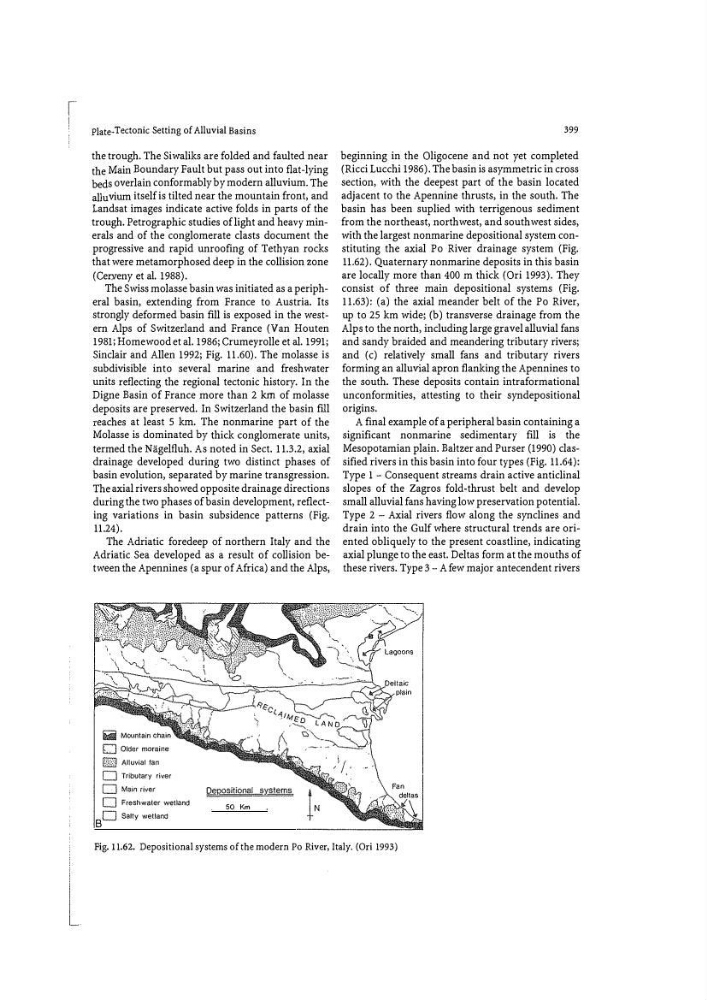
with the largest nonmarine depositional system constituting the axial Po River drainage system (Fig.
11.62). Quaternary nonmarine deposits in this basin
are locally more than 400 m thick (Ori 1993). They
consist of three main depositional systems (Fig.
I 1.63): (a) the axial meander belt of the Po River,
up to 25 km wide; (b) transverse drainage from the
Alps to the north, including large gravel alluvial fans
and sandy braided and meandering tributary rivers;
and (c) relatively small fans and tributary rivers
forming an alluvial apron fl anking the Apennines to
the south. These deposits contain intraformational
unconformities, attesting to their syndepositional
origins.
A final example of a peripheral basin containing a
significant nonmarine sedimentary fill is the
Mesopotamian plain. Baltzer and Purser (1990) classified rivers in this basin into four types (Fig. 11.64):
Type 1 - Consequent streams drain active anticlinal
slopes of the Zagros fold-thrust belt and develop
small alluvial fans having low preservation potential.
Type 2 Axial rivers flow along the synclines and
drain into the Gulf where structural trends are oriented obliquely to the present coastline, indicating
axial plunge to the east. Deltas form at the mouths of
these rivers. Type 3- A few major antecendent rivers
Fig.l1.62. Depositional systems of the modern Po River, Italy. (Ori 1993)
1
plate� Tectonic Setting of Alluvial Basins
the trough. The Siwaliks are folded and faulted near
the Main Boundary Fault but pass out into flat-lying
beds overlain conformably by modern alluvium. The
allu vium itself is tilted near the mountain front, and
Landsat images indicate active folds in parts of the
trough. Petrographic studies of light and heavy minerals and of the conglomerate clasts document the
progressive and rapid unroofing of Tethyan rocks
that were metamorphosed deep in the collision zone
(Cer. veny et a!. 1988).
The Swiss molasse basin was initiated as a peripheral basin, extending from France to Austria. Its
strongly deformed basin fill is exposed in the western Alps of Switzerland and France (Van Houten
1981; Homewood et al. 1986; Crumeyrolle et al. 1991;
Sinclair and Allen 1992; Fig. 11.60). The molasse is
subdivisible into several marine and freshwater
units reflecting the regional tectonic history. In the
Digne Basin of France more than 2 km of molasse
deposits are preserved. In Switzerland the basin fill
reaches at least 5 km. The nonmarine part of the
Molasse is dominated by thick conglomerate units,
termed the Wigelfluh. As noted in Sect. I 1.3.2, axial
drainage developed during two distinct phases of
basin evolution, separated by marine transgression.
The axial rivers showed opposite drainage directions
during the two phases of basin development, reflecting variations in basin subsidence patterns (Fig.
11.24).
The Adriatic foredeep of northern Italy and the
Adriatic Sea developed as a result of collision between the Apennines (a spur of Africa) and the Alps)
DeQositlona! sy:stems
50 Km
399
beginning in the Oligocene and not yet completed
(Ricci Lucchi 1986). The basin is asymmetric in cross
section, with the deepest part of the basin located
adjacent to the Apennine thrusts, in the south. The
basin has been suplied with terrigenous sediment
from the northeast, northwest, and southwest sides,
with the largest nonmarine depositional system constituting the axial Po River drainage system (Fig.
11.62). Quaternary nonmarine deposits in this basin
are locally more than 400 m thick (Ori 1993). They
consist of three main depositional systems (Fig.
I 1.63): (a) the axial meander belt of the Po River,
up to 25 km wide; (b) transverse drainage from the
Alps to the north, including large gravel alluvial fans
and sandy braided and meandering tributary rivers;
and (c) relatively small fans and tributary rivers
forming an alluvial apron fl anking the Apennines to
the south. These deposits contain intraformational
unconformities, attesting to their syndepositional
origins.
A final example of a peripheral basin containing a
significant nonmarine sedimentary fill is the
Mesopotamian plain. Baltzer and Purser (1990) classified rivers in this basin into four types (Fig. 11.64):
Type 1 - Consequent streams drain active anticlinal
slopes of the Zagros fold-thrust belt and develop
small alluvial fans having low preservation potential.
Type 2 Axial rivers flow along the synclines and
drain into the Gulf where structural trends are oriented obliquely to the present coastline, indicating
axial plunge to the east. Deltas form at the mouths of
these rivers. Type 3- A few major antecendent rivers
Fig.l1.62. Depositional systems of the modern Po River, Italy. (Ori 1993)