

398
continent collision. Typically, these basins form
above, and rest on, the extensional continental margin of the downgoing plate that developed during the
preceding cycle of continental rifting and sea-floor
spreading. For example, the Himalayan foredeep
basin is formed above the Paleozoic through early
Cenozoic Tethyan continental margin of the Indian
subcontinent (Gansser 1964). Development of the
peripheral basin may involve several distinct but
diachronous phases, as first the arc on the overriding
plate undergoes compression, and later the main
mass of continental crust reaches the subduction
zone. Typically, the basins become shallower with
time, as the colliding arc climbs the ramp formed by
the 'Subducting continent, and the basin fills with
sediment (Cant and Stockmal 1989; Stockmal et al.
1986, 1992; Stockmal and Beaumont 1987; Sinclair
and Allen 1992). Nonmarine deposits, the typical
«molasse'' (Van Houten 1981), constitute the terminal basin fiJI (Figs. 11.24, 11.60).
The Indus-Ganges trough of India and Pakistan
is an excellent modern example of a peripheral
foredeep basin. It is underlain by the Siwalik Group,
a molasse-type deposit of Miocene-Pliocene age accumulated in conditions apparently identical to
those of the present day (Johnson and Vondra 1972;
Parkash et a!. 1983). The Siwaliks have been much
studied in recent years for the information they yield
on rates and styles of sedimentary and tectonic processes, information that can be obtained from the
rocks because of the excellent chronostratigraphic
Tectonic Control of Fluvial Sedimentation
control provided by magnetostratigraphy (e.g., see
Sects. 11.2.1, 11.3.2, 11.3.6).
The early ((collisional facies )) , the marine Murree
Formation (Cretaceous-Eocene) passes gradationally up into the Siwaliks, an entirely nonmarine unit
locally more than 6 km thick (Burbank et a!. 1986;
Burbank and Raynolds 1988; Burbank and Beck
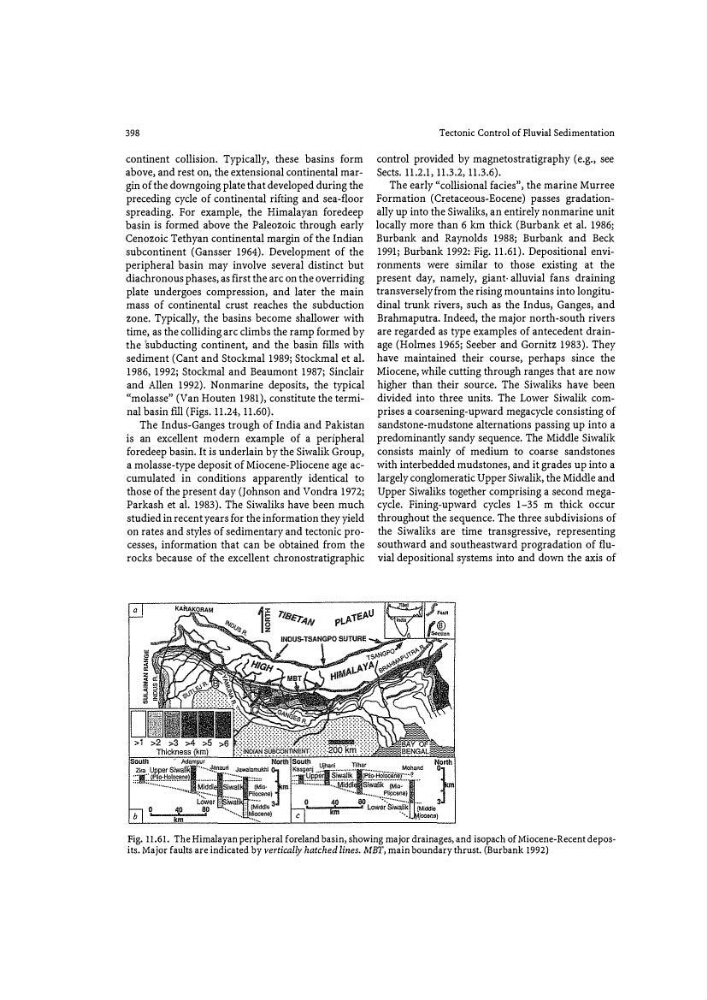
1991; Burbank 1992: Fig. 11.61). Depositional environments were similar to those existing at the
present day, namely, giant· alluvial fans draining
transversely from the rising mountains into longitudinal trunk rivers, such as the Indus, Ganges, and
Brahmaputra. Indeed, the major north-south rivers
are regarded as type examples of antecedent drainage (Holmes 1965; Seeber and Gornitz 1983). They
have maintained their course, perhaps since the
Miocene, while cutting through ranges that are now
higher than their source. The Siwaliks have been
divided into three units. The Lower Siwalik comprises a coarsening-upward megacycle consisting of
sandstone-mudstone alternations passing up into a
predominantly sandy sequence. The Middle Siwalik
consists mainly of medium to coarse sandstones
with interbedded mudstones, and it grades up into a
largely conglomeratic Upper Siwalik, the Middle and
Upper Siwaliks together comprising a second megacycle. Fining-upward cycles 1-35 m thick occur
throughout the sequence. The three subdivisions of
the Siwaliks are time transgressive, representing
southward and southeastward progradation of fluvial depositional systems into and down the axis of
Fig. 11.61. The Himalayan peripheral foreland basin, showing major drainages, and isopach of Miocene-Recent deposits. Major faults are indicated by verticall y hatched lines. MBT, main boundary thrust. (Burbank 1992)
continent collision. Typically, these basins form
above, and rest on, the extensional continental margin of the downgoing plate that developed during the
preceding cycle of continental rifting and sea-floor
spreading. For example, the Himalayan foredeep
basin is formed above the Paleozoic through early
Cenozoic Tethyan continental margin of the Indian
subcontinent (Gansser 1964). Development of the
peripheral basin may involve several distinct but
diachronous phases, as first the arc on the overriding
plate undergoes compression, and later the main
mass of continental crust reaches the subduction
zone. Typically, the basins become shallower with
time, as the colliding arc climbs the ramp formed by
the 'Subducting continent, and the basin fills with
sediment (Cant and Stockmal 1989; Stockmal et al.
1986, 1992; Stockmal and Beaumont 1987; Sinclair
and Allen 1992). Nonmarine deposits, the typical
«molasse'' (Van Houten 1981), constitute the terminal basin fiJI (Figs. 11.24, 11.60).
The Indus-Ganges trough of India and Pakistan
is an excellent modern example of a peripheral
foredeep basin. It is underlain by the Siwalik Group,
a molasse-type deposit of Miocene-Pliocene age accumulated in conditions apparently identical to
those of the present day (Johnson and Vondra 1972;
Parkash et a!. 1983). The Siwaliks have been much
studied in recent years for the information they yield
on rates and styles of sedimentary and tectonic processes, information that can be obtained from the
rocks because of the excellent chronostratigraphic
Tectonic Control of Fluvial Sedimentation
control provided by magnetostratigraphy (e.g., see
Sects. 11.2.1, 11.3.2, 11.3.6).
The early ((collisional facies )) , the marine Murree
Formation (Cretaceous-Eocene) passes gradationally up into the Siwaliks, an entirely nonmarine unit
locally more than 6 km thick (Burbank et a!. 1986;
Burbank and Raynolds 1988; Burbank and Beck
1991; Burbank 1992: Fig. 11.61). Depositional environments were similar to those existing at the
present day, namely, giant· alluvial fans draining
transversely from the rising mountains into longitudinal trunk rivers, such as the Indus, Ganges, and
Brahmaputra. Indeed, the major north-south rivers
are regarded as type examples of antecedent drainage (Holmes 1965; Seeber and Gornitz 1983). They
have maintained their course, perhaps since the
Miocene, while cutting through ranges that are now
higher than their source. The Siwaliks have been
divided into three units. The Lower Siwalik comprises a coarsening-upward megacycle consisting of
sandstone-mudstone alternations passing up into a
predominantly sandy sequence. The Middle Siwalik
consists mainly of medium to coarse sandstones
with interbedded mudstones, and it grades up into a
largely conglomeratic Upper Siwalik, the Middle and
Upper Siwaliks together comprising a second megacycle. Fining-upward cycles 1-35 m thick occur
throughout the sequence. The three subdivisions of
the Siwaliks are time transgressive, representing
southward and southeastward progradation of fluvial depositional systems into and down the axis of
Fig. 11.61. The Himalayan peripheral foreland basin, showing major drainages, and isopach of Miocene-Recent deposits. Major faults are indicated by verticall y hatched lines. MBT, main boundary thrust. (Burbank 1992)