

396
Tectonic Control of Fluvial Sedimentation
(I)
��� . ,.... .,. .
, ,' -::- -c
, "2 ' .
,...- -. .._ _:! · �
, I
/ '- l , , I
1
0
km
100
�
Conglomerate, subordinate sandstone,
.
s•Ustone, and mudstone lenses
D
Sands! one, W!lh lenses of conglomerate
Siltstone
�
Mudstone , shale
-
Mor•ne mvertebmle foss1ls, 1<'1Ciud1ng
ommomtes, bwalves, gastropods
,£
Logs, fotioqe
I
Oirechon ol oecreosmg qrom Slle
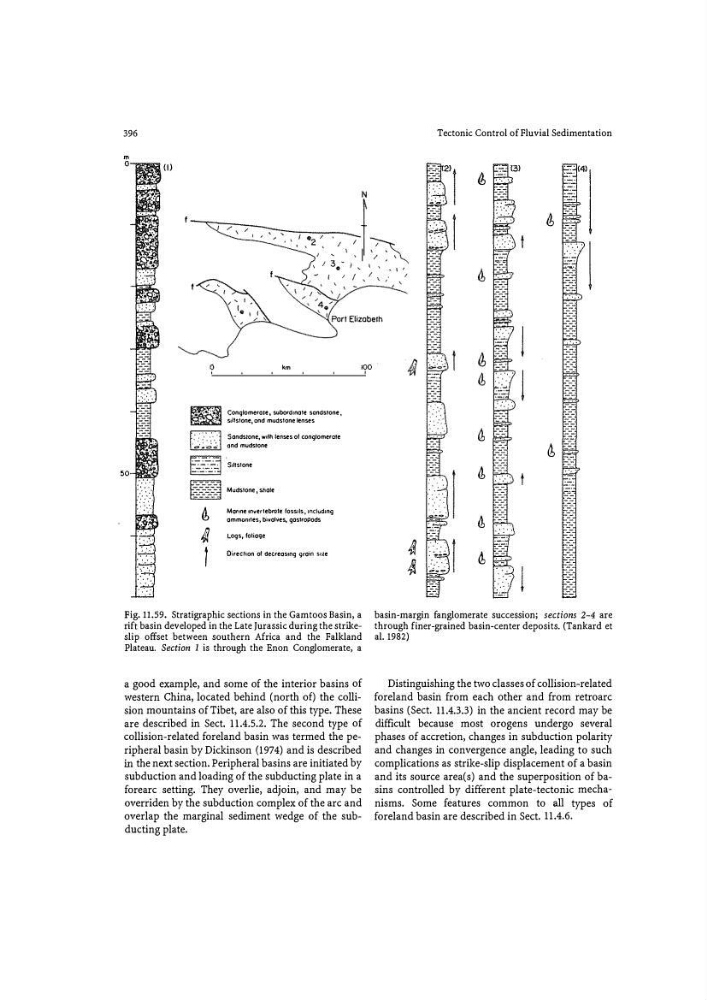
Fig. 11.59. Stratigraphic sections in the Gamtoos Basin, a
rift basin developed in the Late Jurassic during the stril
a good example, and some of the interior basins of
western China, located behind (north of) the collision mountains of Tibet, are also of this type. These
are described in Sect. I 1.4.5.2. The second type of
collision-related foreland basin was termed the peripheral basin by Dickinson (1974) and is described
in the next section. Peripheral basins are initiated by
subduction and loading of the subducting plate in a
forearc setting. They overlie, adjoin, and may be
overriden by the subduction complex of the arc and
overlap the marginal sediment wedge of the subducting plate,
'
.f)
basin-margin fa nglomerate succession; sections 2-4 are
through finer-grained basin-center deposits. (Tankard et
al. 1982)
Distinguishing the two classes of collision-related
foreland basin from each other and from retroarc
basins (Sect. 11.4.3.3) in the ancient record may be
difficult because most orogens undergo several
phases of accretion, changes in subduction polarity
and changes in convergence angle, leading to such
complications as strike-slip displacement of a basin
and its source area(s) and the superposition of basins controlled by different plate-tectonic mechanisms. Some features common to all types of
foreland basin are described in Sect, 11.4.6.
Tectonic Control of Fluvial Sedimentation
(I)
��� . ,.... .,. .
, ,' -::- -c
, "2 ' .
,...- -. .._ _:! · �
, I
/ '- l , , I
1
0
km
100
�
Conglomerate, subordinate sandstone,
.
s•Ustone, and mudstone lenses
D
Sands! one, W!lh lenses of conglomerate
Siltstone
�
Mudstone , shale
-
Mor•ne mvertebmle foss1ls, 1<'1Ciud1ng
ommomtes, bwalves, gastropods
,£
Logs, fotioqe
I
Oirechon ol oecreosmg qrom Slle
Fig. 11.59. Stratigraphic sections in the Gamtoos Basin, a
rift basin developed in the Late Jurassic during the stril
a good example, and some of the interior basins of
western China, located behind (north of) the collision mountains of Tibet, are also of this type. These
are described in Sect. I 1.4.5.2. The second type of
collision-related foreland basin was termed the peripheral basin by Dickinson (1974) and is described
in the next section. Peripheral basins are initiated by
subduction and loading of the subducting plate in a
forearc setting. They overlie, adjoin, and may be
overriden by the subduction complex of the arc and
overlap the marginal sediment wedge of the subducting plate,
'
.f)
basin-margin fa nglomerate succession; sections 2-4 are
through finer-grained basin-center deposits. (Tankard et
al. 1982)
Distinguishing the two classes of collision-related
foreland basin from each other and from retroarc
basins (Sect. 11.4.3.3) in the ancient record may be
difficult because most orogens undergo several
phases of accretion, changes in subduction polarity
and changes in convergence angle, leading to such
complications as strike-slip displacement of a basin
and its source area(s) and the superposition of basins controlled by different plate-tectonic mechanisms. Some features common to all types of
foreland basin are described in Sect, 11.4.6.