

Plate� Tectonic Setting of Alluvial Basins
HORNELEN
RIDGE
EXPLANATION
�
Talus, landslide, and debris�
0
flow-dominBted alluvial fans
�
m
Streamflow-domina ted
�
.
alluvial fans
�
Lacustrine deposits
-
-
E_]
Alluvial plain '"'
1:
fan-delta deposits
§
Marine turbidites
! �
.
�
Approximate strike
+
Axis and plunge of syncllna
__ ,
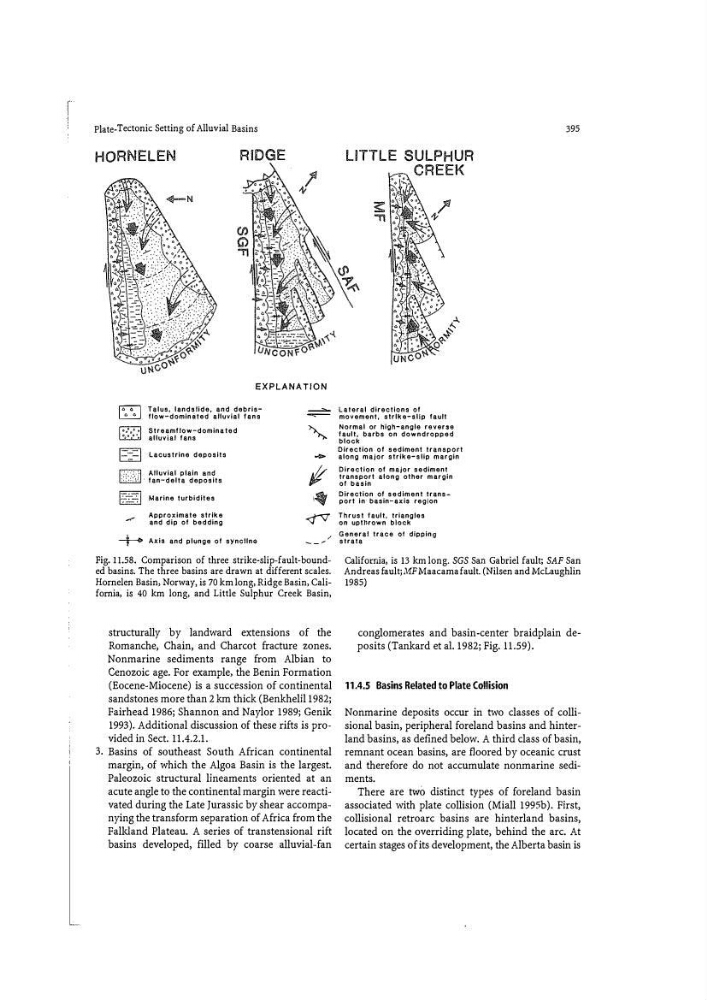
Fig. 11.58. Comparison of three strike�slip�fault�bound�
ed basins. The three basins are drawn at different scales.
Hornelen Basin) Norway, is 70 km long, Ridge Basin, California, is 40 km long, and Little Sulphur Creek Basin,
structurally by landward extensions of the
Romanche, Chain, and Charcot fracture zones.
Nonmarine sediments range from Albian to
Cenozoic age. For example> the Benin Formation
(Eocene-Miocene) is a succession of continental
sandstones more than 2 km thick (Benkhelil 1982;
Fairhead 1986; Shannon and Naylor 1989; Genik
1993). Additional discussion of these rifts is pro·
vided in Sect. 11.4.2.1.
3. Basins of southeast South African continental
margin, of which the Algoa Basin is the largest.
Paleozoic structural lineaments oriented at an
acute angle to the continental margin were reactivated during the Late Jurassic by shear accompanying the transform separation of Africa from the
Falldand Plateau. A series of transtensional rift
basins developed, filled by coarse alluvial-fan
UTTLE SULPHUR
CREEK
Lateral directions of
movement, strlke-sllp fault
Normal or high-angle reverse
fault, barbs on downdropped
block
Direction of sediment transport
along major strike-slip margin
Direction of major sediment
transport along other margin
of basin
Direction of sediment transport in basin-axis region
Thrust fault, triangles
on uptllrown block
General trace ol dipping
strata
395
California, is 13 km long. SGS San Gabriel fault; SAP San
Andreas fa ult;MF Maacama fault. (Nilsen and McLaughlin
1985)
conglomerates and basin�center braidplain deposits (Tankard et a!. 1982; Fig. 11.59).
11.4.5 Basins Related to Plate Collision
Nonmarine deposits occur in two classes of collisional basin, peripheral foreland basins and hinterland basins, as defi ned below. A third class of basin,
remnant ocean basins, are fl oored by oceanic crust
and therefore do not accumulate nonmarine sediments.
There are tvv O distinct types of foreland basin
associated with plate collision (Miall 199Sb). First,
collisional retroarc basins are hinterland basins,
located on the overriding plate, behind the arc. At
certain stages of its development, the Alberta basin is
HORNELEN
RIDGE
EXPLANATION
�
Talus, landslide, and debris�
0
flow-dominBted alluvial fans
�
m
Streamflow-domina ted
�
.
alluvial fans
�
Lacustrine deposits
-
-
E_]
Alluvial plain '"'
1:
fan-delta deposits
§
Marine turbidites
! �
.
�
Approximate strike
+
Axis and plunge of syncllna
__ ,
Fig. 11.58. Comparison of three strike�slip�fault�bound�
ed basins. The three basins are drawn at different scales.
Hornelen Basin) Norway, is 70 km long, Ridge Basin, California, is 40 km long, and Little Sulphur Creek Basin,
structurally by landward extensions of the
Romanche, Chain, and Charcot fracture zones.
Nonmarine sediments range from Albian to
Cenozoic age. For example> the Benin Formation
(Eocene-Miocene) is a succession of continental
sandstones more than 2 km thick (Benkhelil 1982;
Fairhead 1986; Shannon and Naylor 1989; Genik
1993). Additional discussion of these rifts is pro·
vided in Sect. 11.4.2.1.
3. Basins of southeast South African continental
margin, of which the Algoa Basin is the largest.
Paleozoic structural lineaments oriented at an
acute angle to the continental margin were reactivated during the Late Jurassic by shear accompanying the transform separation of Africa from the
Falldand Plateau. A series of transtensional rift
basins developed, filled by coarse alluvial-fan
UTTLE SULPHUR
CREEK
Lateral directions of
movement, strlke-sllp fault
Normal or high-angle reverse
fault, barbs on downdropped
block
Direction of sediment transport
along major strike-slip margin
Direction of major sediment
transport along other margin
of basin
Direction of sediment transport in basin-axis region
Thrust fault, triangles
on uptllrown block
General trace ol dipping
strata
395
California, is 13 km long. SGS San Gabriel fault; SAP San
Andreas fa ult;MF Maacama fault. (Nilsen and McLaughlin
1985)
conglomerates and basin�center braidplain deposits (Tankard et a!. 1982; Fig. 11.59).
11.4.5 Basins Related to Plate Collision
Nonmarine deposits occur in two classes of collisional basin, peripheral foreland basins and hinterland basins, as defi ned below. A third class of basin,
remnant ocean basins, are fl oored by oceanic crust
and therefore do not accumulate nonmarine sediments.
There are tvv O distinct types of foreland basin
associated with plate collision (Miall 199Sb). First,
collisional retroarc basins are hinterland basins,
located on the overriding plate, behind the arc. At
certain stages of its development, the Alberta basin is