

394
Tectonic Control of Fluvial Sedimentation
NE
EXPLANATION
� Breccia
0 Conglomerate
CJ
'
Sandstone
§
-
Siltstone
IIII I Shale (Mudstone)
b!l
'
Basement Rocks
THICKNESS
0
2 Miles
Horizontal Scale
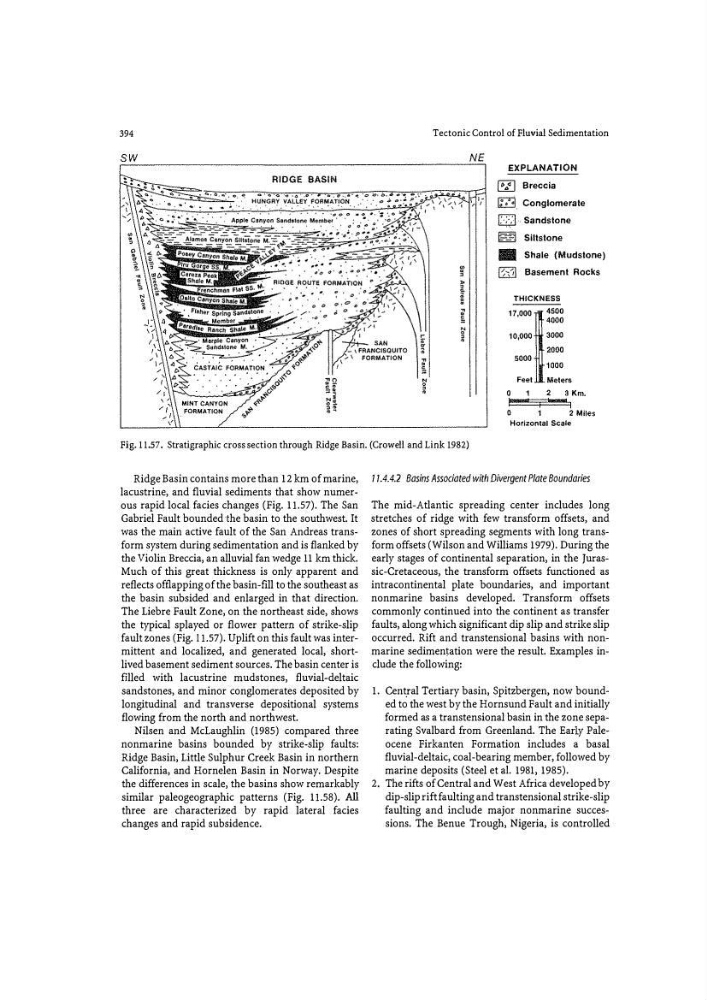
Fig. 11.57. Stratigraphic cross section through Ridge Basin. (Crowell and Link 1982)
Ridge Basin contains more than 12 km of marine,
lacustrine, and fluvial sediments that show numer�
ous rapid local facies changes (Fig, 1 L57), The San
Gabriel Fault bounded the basin to the southwest, It
was the main active fault of the San Andreas trans�
form system during sedimentation and is fl anked by
the Violin Breccia, an alluvial fan wedge 11 km thick.
Much of this great thickness is only apparent and
reflects offlapping of the basin-fill to the southeast as
the basin subsided and enlarged in that direction,
The Liebre Fault Zone, on the northeast side, shows
the typical splayed or fl ower pattern of strike-slip
fault zones (Fig. l L57), Uplift on this fault was intermittent and localized, and generated local, shortlived basement sediment sources. The basin center is
filled with lacustrine mudstones, fl uvial-deltaic
sandstones, and minor conglomerates deposited by
longitudinal and transverse depositional systems
flowing from the north and northwest.
Nilsen and McLaughlin (1985) compared three
nonmarine basins bounded by strike-slip faults:
Ridge Basin, Little Sulphur Creek Basin in northern
California, and Hornelen Basin in Norway. Despite
the differences in scale, the basins show remarkably
similar paleogeographic patterns (Fig, 1 L58), All
three are characterized by rapid lateral facies
changes and rapid subsidence.
11.4.42 Basins Associated with Divergent Plate Boundaries
The mid-Atlantic spreading center includes long
stretches of ridge with few transform offsets, and
zones of short spreading segments with long transform offsets (Wilson and Williams 1979). During the
early stages of continental separation, in the Jurassic-Cretaceous, the transform offsets functioned as
intracontinental plate boundaries, and important
nonmarine basins developed. Transform offsets
commonly continued into the continent as transfer
faults, along which significant dip slip and strike slip
occurred. Rift and transtensional basins with nonmarine sedimentation were the result. Examples include the following:
1. Cent_ral Tertiary basin, Spitzbergen, now bounded to the west by the Hornsund Fault and initially
formed as a transtensional basin in the zone separating Svalbard from Greenland. The Early Paleocene Firkanten Formation includes a basal
fluvial-deltaic, coal-bearing member, followed by
marine deposits (Steel et aL 1981, 1985).
2, The rifts of Central and West Africa developed by
dip-slip rift faulting and transtensional strike-slip
faulting and include major nonmarine successions. The Benue Trough, Nigeria, is controlled
Tectonic Control of Fluvial Sedimentation
NE
EXPLANATION
� Breccia
0 Conglomerate
CJ
'
Sandstone
§
-
Siltstone
IIII I Shale (Mudstone)
b!l
'
Basement Rocks
THICKNESS
0
2 Miles
Horizontal Scale
Fig. 11.57. Stratigraphic cross section through Ridge Basin. (Crowell and Link 1982)
Ridge Basin contains more than 12 km of marine,
lacustrine, and fluvial sediments that show numer�
ous rapid local facies changes (Fig, 1 L57), The San
Gabriel Fault bounded the basin to the southwest, It
was the main active fault of the San Andreas trans�
form system during sedimentation and is fl anked by
the Violin Breccia, an alluvial fan wedge 11 km thick.
Much of this great thickness is only apparent and
reflects offlapping of the basin-fill to the southeast as
the basin subsided and enlarged in that direction,
The Liebre Fault Zone, on the northeast side, shows
the typical splayed or fl ower pattern of strike-slip
fault zones (Fig. l L57), Uplift on this fault was intermittent and localized, and generated local, shortlived basement sediment sources. The basin center is
filled with lacustrine mudstones, fl uvial-deltaic
sandstones, and minor conglomerates deposited by
longitudinal and transverse depositional systems
flowing from the north and northwest.
Nilsen and McLaughlin (1985) compared three
nonmarine basins bounded by strike-slip faults:
Ridge Basin, Little Sulphur Creek Basin in northern
California, and Hornelen Basin in Norway. Despite
the differences in scale, the basins show remarkably
similar paleogeographic patterns (Fig, 1 L58), All
three are characterized by rapid lateral facies
changes and rapid subsidence.
11.4.42 Basins Associated with Divergent Plate Boundaries
The mid-Atlantic spreading center includes long
stretches of ridge with few transform offsets, and
zones of short spreading segments with long transform offsets (Wilson and Williams 1979). During the
early stages of continental separation, in the Jurassic-Cretaceous, the transform offsets functioned as
intracontinental plate boundaries, and important
nonmarine basins developed. Transform offsets
commonly continued into the continent as transfer
faults, along which significant dip slip and strike slip
occurred. Rift and transtensional basins with nonmarine sedimentation were the result. Examples include the following:
1. Cent_ral Tertiary basin, Spitzbergen, now bounded to the west by the Hornsund Fault and initially
formed as a transtensional basin in the zone separating Svalbard from Greenland. The Early Paleocene Firkanten Formation includes a basal
fluvial-deltaic, coal-bearing member, followed by
marine deposits (Steel et aL 1981, 1985).
2, The rifts of Central and West Africa developed by
dip-slip rift faulting and transtensional strike-slip
faulting and include major nonmarine successions. The Benue Trough, Nigeria, is controlled