

Plate� Tectonic Setting of Alluvial Basins
up to 2 km of fluvial sandstones overlain by marine
or lacustrine deposits. Miocene-Holocene sediments
constitute a post-rift assemblage and consist of a few
tens of meters of fluvial deposits along the basin
margins, with much thicker lacustrine assemblages
in the center. All the fluvial deposits in these basins
appear to have accumulated within systems of internal drainage (Genik 1993).
17 .4.2.2 Continental-margin Basins
Extensional continental margins that develop once
oceanic crust has evolved along the rift axis are commonly not characterized by significant thicknesses
of nonmarine deposits, except where major rivers
cross the continental . margin. As noted in Sect.
11.3.1, many of the world's major rivers enter the sea
at divergent plate margins, and their fluvial deltaic
systems form part of the continental-margin basin
stratigraphy. Away from such fluvial axes, however,
flexural subsidence leads to the development of
gently dipping continental shelves which are transgressed ' by the sea, with alluvial coastal plains typically occupying only the fringes of the basin. As
discussed in Chap. 13, alluvial deposits on these shelf
areas may become significant only during times of
low sea level, and their stratigraphy may yield much
useful information regarding local sea-level history.
The jurassic-Tertiary section flanking the Gulf
Coast of the United States is probably the thickest
and most extensive suite of alluvial deposits on a
divergent continental margin (Fisher and McGowen
1967; Galloway 1981; Worrall and Snelson 1989).
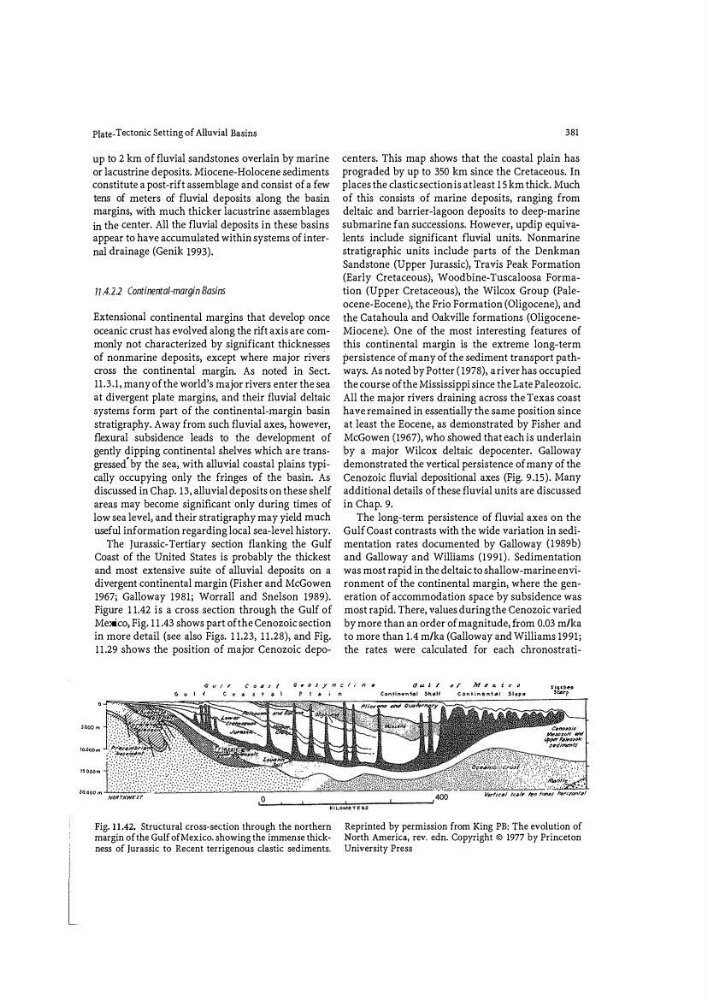
Figure 11.42 is a cross section through the Gulf of
Mexico, Fig. 11.43 shows part of the Cenozoic section
in more detail (see also Figs. 11.23, 11.28), and Fig.
11.29 shows the position of major Cenozoic depo381
centers. This map shows that the coastal plain has
prograded by up to 350 km since the Cretaceous. In
places the clastic section is at least 15 km thick. Much
of this consists of marine deposits, ranging from
deltaic and barrier-lagoon deposits to deep-marine
submarine fan successions. However, updip equivalents include significant fluvial units. Nonmarine
stratigraphic units include parts of the Denkman
Sandstone (Upper Jurassic), Travis Peak Formation
(Early Cretaceous), Woodbine-Tuscaloosa Formation (Upper Cretaceous), the Wilcox Group (Paleocene-Eocene), the Frio Formation (Oligocene), and
the Catahoula and Oakville formations (OligoceneMiocene). One of the most interesting features of
this continental margin is the extreme long-term
persistence of many of the sediment transport pathways. As noted by Potter (1978), a river has occupied
the course of the Mississippi since the Late Paleozoic.
All the major rivers draining across the Texas coast
have remained in essentially the same position since
at least the Eocene, as demonstrated by Fisher and
McGowen (1967), who showed that each is underlain
by a major Wilcox deltaic depocenter. Galloway
demonstrated the vertical persistence of many of the
Cenozoic fluvial depositional axes (Fig. 9.15). Many
additional details of these fluvial units are discussed
in Chap. 9.
The long-term persistence of fluvial axes on the
Gulf Coast contrasts with the wide variation in sedimentation rates documented by Galloway (1989b)
and Galloway and Williams (1991). Sedimentation
was most rapid in the deltaic to shallow-marine environment of the continental margin, where the generation of accommodation space by subsidence was
most rapid. There, values during the Cenozoic varied
by more than an order of magnitude, from 0.03 m/ka
to more than 1.4 m/ka (Galloway and Williams 1991;
the rates were calculated for each chronostratic;.,OJ)' '7Cii '7tt
Ou lf
uJ'
Mex ico
G u 1 (
c " .a � t ;o 1
P J " ; n
Cont!n<>n1<1l Sholf
Contlnent"'l Slop<�
�::r
Fig. 11.42. Structural cross-section through the northern
margin of the Gulf of Mexico. showing the immense thickness of Jurassic to Recent terrigenous clastic sediments.
Reprinted by permission from King PB: The evolution of
North America, rev. edn. Copyright © 1977 by Princeton
University Press
up to 2 km of fluvial sandstones overlain by marine
or lacustrine deposits. Miocene-Holocene sediments
constitute a post-rift assemblage and consist of a few
tens of meters of fluvial deposits along the basin
margins, with much thicker lacustrine assemblages
in the center. All the fluvial deposits in these basins
appear to have accumulated within systems of internal drainage (Genik 1993).
17 .4.2.2 Continental-margin Basins
Extensional continental margins that develop once
oceanic crust has evolved along the rift axis are commonly not characterized by significant thicknesses
of nonmarine deposits, except where major rivers
cross the continental . margin. As noted in Sect.
11.3.1, many of the world's major rivers enter the sea
at divergent plate margins, and their fluvial deltaic
systems form part of the continental-margin basin
stratigraphy. Away from such fluvial axes, however,
flexural subsidence leads to the development of
gently dipping continental shelves which are transgressed ' by the sea, with alluvial coastal plains typically occupying only the fringes of the basin. As
discussed in Chap. 13, alluvial deposits on these shelf
areas may become significant only during times of
low sea level, and their stratigraphy may yield much
useful information regarding local sea-level history.
The jurassic-Tertiary section flanking the Gulf
Coast of the United States is probably the thickest
and most extensive suite of alluvial deposits on a
divergent continental margin (Fisher and McGowen
1967; Galloway 1981; Worrall and Snelson 1989).
Figure 11.42 is a cross section through the Gulf of
Mexico, Fig. 11.43 shows part of the Cenozoic section
in more detail (see also Figs. 11.23, 11.28), and Fig.
11.29 shows the position of major Cenozoic depo381
centers. This map shows that the coastal plain has
prograded by up to 350 km since the Cretaceous. In
places the clastic section is at least 15 km thick. Much
of this consists of marine deposits, ranging from
deltaic and barrier-lagoon deposits to deep-marine
submarine fan successions. However, updip equivalents include significant fluvial units. Nonmarine
stratigraphic units include parts of the Denkman
Sandstone (Upper Jurassic), Travis Peak Formation
(Early Cretaceous), Woodbine-Tuscaloosa Formation (Upper Cretaceous), the Wilcox Group (Paleocene-Eocene), the Frio Formation (Oligocene), and
the Catahoula and Oakville formations (OligoceneMiocene). One of the most interesting features of
this continental margin is the extreme long-term
persistence of many of the sediment transport pathways. As noted by Potter (1978), a river has occupied
the course of the Mississippi since the Late Paleozoic.
All the major rivers draining across the Texas coast
have remained in essentially the same position since
at least the Eocene, as demonstrated by Fisher and
McGowen (1967), who showed that each is underlain
by a major Wilcox deltaic depocenter. Galloway
demonstrated the vertical persistence of many of the
Cenozoic fluvial depositional axes (Fig. 9.15). Many
additional details of these fluvial units are discussed
in Chap. 9.
The long-term persistence of fluvial axes on the
Gulf Coast contrasts with the wide variation in sedimentation rates documented by Galloway (1989b)
and Galloway and Williams (1991). Sedimentation
was most rapid in the deltaic to shallow-marine environment of the continental margin, where the generation of accommodation space by subsidence was
most rapid. There, values during the Cenozoic varied
by more than an order of magnitude, from 0.03 m/ka
to more than 1.4 m/ka (Galloway and Williams 1991;
the rates were calculated for each chronostratic;.,OJ)' '7Cii '7tt
Ou lf
uJ'
Mex ico
G u 1 (
c " .a � t ;o 1
P J " ; n
Cont!n<>n1<1l Sholf
Contlnent"'l Slop<�
�::r
Fig. 11.42. Structural cross-section through the northern
margin of the Gulf of Mexico. showing the immense thickness of Jurassic to Recent terrigenous clastic sediments.
Reprinted by permission from King PB: The evolution of
North America, rev. edn. Copyright © 1977 by Princeton
University Press