

380
the same sense of dip that represent reactivated
Paleozoic compressional faults1 and in this way
they differ from the East African rift system, which
consists of segments of opposite-facing border faults
(P.E. Olsen 1990). Newark basins show two different
depositional patterns: one is fl uvial dominated, consisting of basin-wide channel systems, commonly
including axial trunk rivers; the other is lacustrine
Newark
Supergroup Rift
Basins
CULPEPER
TAYLORSVILL�
111!1 11 11 1 Exposed
Inferred
km
0 100 200 300 400
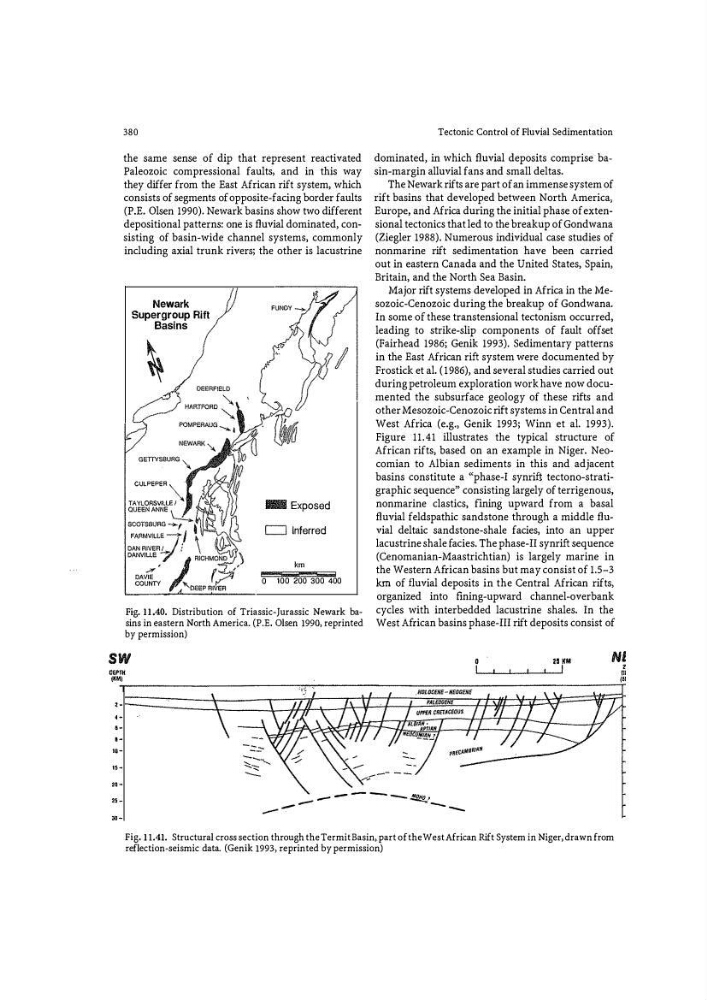
Fig. 11.40. Distribution of Triassic-Jurassic Newark basins in eastern North America. (P.E. Olsen 1990, reprinted
by permission)
sw
Tectonic Control of Fluvial Sedimentation
dominated, in which fl uvial deposits comprise basin-margin alluvial fans and small deltas.
The Newark rifts are part of an immense system of
rift basins that developed between North America,
Europe, and Africa during the initial phase of extensional tectonics that led to the breakup of Gondwana
(Ziegler 1988). Numerous individual case studies of
nonmarine rift sedimentation have been carried
out in eastern Canada and the United States, Spain,
Britain, and the North Sea Basin.
Major rift systems developed in Africa in the Mesozoic-Cenozoic during the breakup of Gondwana.
In some of these transtensional tectonism occurred,
leading to strike-slip components of fault offset
(Fairhead 1986; Genik 1993). Sedimentary patterns
in the East African rift system were documented by
Frostick et a!. (1986), and several studies carried out
during petroleum exploration work have now documented the subsurface geology of these rifts and
other Mesozoic-Cenozoic rift systems in Central and
West Africa (e.g., Genik 1993; Winn et a!. 1993).
Figure 11.41 illustrates the typical structure of
African rifts, based on an example in Niger. Neocomian to Albian sediments in this and adjacent
basins constitute a "phase-I synrift tectono-stratigraphic sequence" consisting largely of terrigenous,
nonmarine clastics, fining upward from a basal
fl uvial feldspathic sandstone through a middle fl uvial deltaic sandstone-shale facies, into an upper
lacustrine shale facies. The phase-II synrift sequence
(Cenomanian-Maastrichtian) is largely marine in
the Western African basins but may consist of 1.5-3
km of fluvial deposits in the Central African rifts,
organized into fining-upward channel-overbank
cycles with interbedded lacustrine shales. In the
West African basins phase-III rift deposits consist of
2liKM
Ni
'
OEf>TH
W
··� '-- --------------------------��---------------- -=��==== ------------------------ cr "'
.H O LOCENE- NEOGENE
"
"
"
"
;--- -_.. ----�·
....- ....--�
-
Fig. 11.41. Structural cross section through the Termit Basin, part of the West African Rift System in Niger, drawn from
reflection-seismic data. (Genik 1993, reprinted by permission)
the same sense of dip that represent reactivated
Paleozoic compressional faults1 and in this way
they differ from the East African rift system, which
consists of segments of opposite-facing border faults
(P.E. Olsen 1990). Newark basins show two different
depositional patterns: one is fl uvial dominated, consisting of basin-wide channel systems, commonly
including axial trunk rivers; the other is lacustrine
Newark
Supergroup Rift
Basins
CULPEPER
TAYLORSVILL�
111!1 11 11 1 Exposed
Inferred
km
0 100 200 300 400
Fig. 11.40. Distribution of Triassic-Jurassic Newark basins in eastern North America. (P.E. Olsen 1990, reprinted
by permission)
sw
Tectonic Control of Fluvial Sedimentation
dominated, in which fl uvial deposits comprise basin-margin alluvial fans and small deltas.
The Newark rifts are part of an immense system of
rift basins that developed between North America,
Europe, and Africa during the initial phase of extensional tectonics that led to the breakup of Gondwana
(Ziegler 1988). Numerous individual case studies of
nonmarine rift sedimentation have been carried
out in eastern Canada and the United States, Spain,
Britain, and the North Sea Basin.
Major rift systems developed in Africa in the Mesozoic-Cenozoic during the breakup of Gondwana.
In some of these transtensional tectonism occurred,
leading to strike-slip components of fault offset
(Fairhead 1986; Genik 1993). Sedimentary patterns
in the East African rift system were documented by
Frostick et a!. (1986), and several studies carried out
during petroleum exploration work have now documented the subsurface geology of these rifts and
other Mesozoic-Cenozoic rift systems in Central and
West Africa (e.g., Genik 1993; Winn et a!. 1993).
Figure 11.41 illustrates the typical structure of
African rifts, based on an example in Niger. Neocomian to Albian sediments in this and adjacent
basins constitute a "phase-I synrift tectono-stratigraphic sequence" consisting largely of terrigenous,
nonmarine clastics, fining upward from a basal
fl uvial feldspathic sandstone through a middle fl uvial deltaic sandstone-shale facies, into an upper
lacustrine shale facies. The phase-II synrift sequence
(Cenomanian-Maastrichtian) is largely marine in
the Western African basins but may consist of 1.5-3
km of fluvial deposits in the Central African rifts,
organized into fining-upward channel-overbank
cycles with interbedded lacustrine shales. In the
West African basins phase-III rift deposits consist of
2liKM
Ni
'
OEf>TH
W
··� '-- --------------------------��---------------- -=��==== ------------------------ cr "'
.H O LOCENE- NEOGENE
"
"
"
"
;--- -_.. ----�·
....- ....--�
-
Fig. 11.41. Structural cross section through the Termit Basin, part of the West African Rift System in Niger, drawn from
reflection-seismic data. (Genik 1993, reprinted by permission)