

Plate· Tectonic Setting of Alluvial Basins
abandom�d meander belt
HANGING WALL
<::: :: :. ..
CONES
LARGE CONES SOURCED
IN EN-ECHELON
FOOTWALL ZONE·
CONTINENTAL
HALF-GRABEN WITH
AXIAL THROUGH DRAINAGE
379
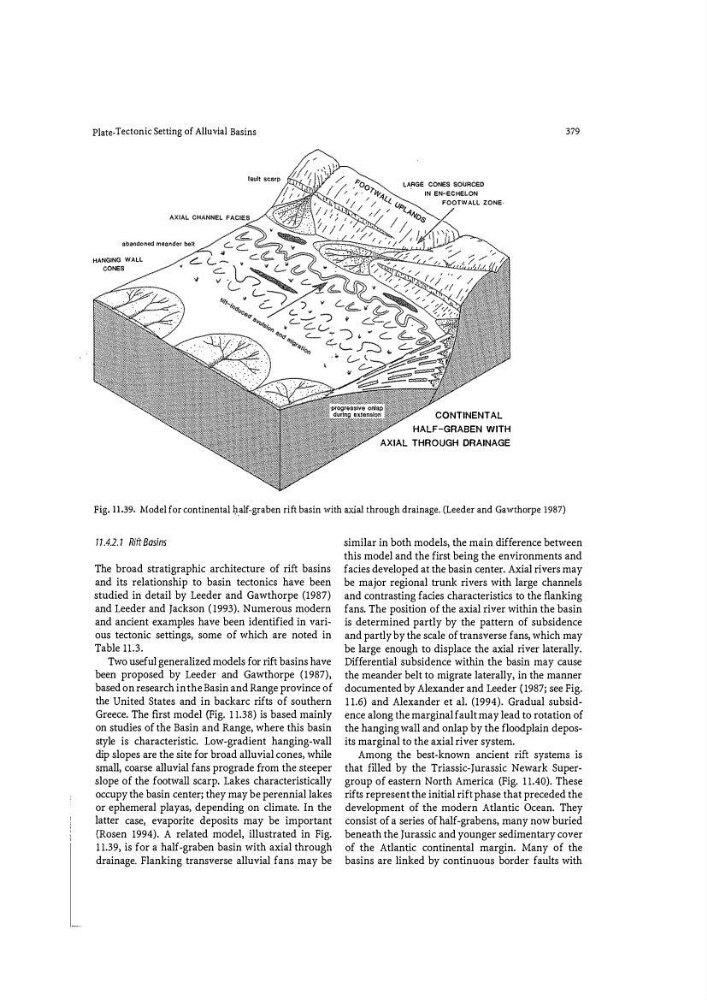
Fig. 11.39. Model for continental l:J. , alf-graben rift basin with axial through drainage. (Leeder and Gawthorpe 1987)
11.4.2. 1 Rift Basins
The broad stratigraphic architecture of rift basins
and its relationship to basin tectonics have been
studied in detail by Leeder and Gawthorpe (1987)
and Leeder and jackson (1993). Numerous modern
and ancient examples have been identified in various tectonic settings, some of which are noted in
Table 1!.3.
Two useful generalized models for rift basins have
been proposed by Leeder and Gawthorpe (1987),
based on research in the Basin and Range province of
the United States and in backarc rifts of southern
Greece. The first model (Fig. 1 !.38) is based mainly
on studies of the Basin and Range, where this basin
style is characteristic. Low-gradient hanging-wall
dip slopes are the site for broad alluvial cones, while
small, coarse alluvial fans prograde from the steeper
slope of the footwall scarp. Lakes characteristically
occupy the basin center; they may be perennial lakes
or ephemeral playas, depending on climate. In the
latter case, evaporite deposits may be important
(Rosen 1994). A related model, illustrated in Fig.
1 !.39, is for a half-graben basin with axial through
drainage. Flanking transverse alluvial fans may be
similar in both models, the main difference between
this model and the first being the environments and
fades developed at the basin center. Axial rivers may
be major regional trunk rivers with large channels
and contrasting facies characteristics to the flanking
fans. The position of the axial river within the basin
is determined partly by the pattern of subsidence
and partly by the scale of transverse fans, which may
be large enough to displace the axial river laterally.
Differential subsidence within the basin may cause
the meander belt to migrate laterally, in the manner
documented by Alexander and Leeder ( 1987; see Fig.
11.6) and Alexander et al. (1994). Gradual subsidence along the marginal fault may lead to rotation of
the hanging wall and onlap by the floodplain deposits marginal to the axial river system.
Among the best-known ancient rift systems is
that filled by the Triassic-Jurassic Newark Supergroup of eastern North America (Fig. 1!.40). These
rifts represent the initial rift phase that preceded the
development of the modern Atlantic Ocean. They
consist of a series of half-grabens) many now buried
beneath the Jurassic and younger sedimentary cover
of the Atlantic continental margin. Many of the
basins are linked by continuous border faults with
abandom�d meander belt
HANGING WALL
<::: :: :. ..
CONES
LARGE CONES SOURCED
IN EN-ECHELON
FOOTWALL ZONE·
CONTINENTAL
HALF-GRABEN WITH
AXIAL THROUGH DRAINAGE
379
Fig. 11.39. Model for continental l:J. , alf-graben rift basin with axial through drainage. (Leeder and Gawthorpe 1987)
11.4.2. 1 Rift Basins
The broad stratigraphic architecture of rift basins
and its relationship to basin tectonics have been
studied in detail by Leeder and Gawthorpe (1987)
and Leeder and jackson (1993). Numerous modern
and ancient examples have been identified in various tectonic settings, some of which are noted in
Table 1!.3.
Two useful generalized models for rift basins have
been proposed by Leeder and Gawthorpe (1987),
based on research in the Basin and Range province of
the United States and in backarc rifts of southern
Greece. The first model (Fig. 1 !.38) is based mainly
on studies of the Basin and Range, where this basin
style is characteristic. Low-gradient hanging-wall
dip slopes are the site for broad alluvial cones, while
small, coarse alluvial fans prograde from the steeper
slope of the footwall scarp. Lakes characteristically
occupy the basin center; they may be perennial lakes
or ephemeral playas, depending on climate. In the
latter case, evaporite deposits may be important
(Rosen 1994). A related model, illustrated in Fig.
1 !.39, is for a half-graben basin with axial through
drainage. Flanking transverse alluvial fans may be
similar in both models, the main difference between
this model and the first being the environments and
fades developed at the basin center. Axial rivers may
be major regional trunk rivers with large channels
and contrasting facies characteristics to the flanking
fans. The position of the axial river within the basin
is determined partly by the pattern of subsidence
and partly by the scale of transverse fans, which may
be large enough to displace the axial river laterally.
Differential subsidence within the basin may cause
the meander belt to migrate laterally, in the manner
documented by Alexander and Leeder ( 1987; see Fig.
11.6) and Alexander et al. (1994). Gradual subsidence along the marginal fault may lead to rotation of
the hanging wall and onlap by the floodplain deposits marginal to the axial river system.
Among the best-known ancient rift systems is
that filled by the Triassic-Jurassic Newark Supergroup of eastern North America (Fig. 1!.40). These
rifts represent the initial rift phase that preceded the
development of the modern Atlantic Ocean. They
consist of a series of half-grabens) many now buried
beneath the Jurassic and younger sedimentary cover
of the Atlantic continental margin. Many of the
basins are linked by continuous border faults with