

376
complications that may have confused the simple
picture painted by Gordon and Heller ( 1993 ), but, in
a reply to this discussion) the authors maintained
that these are essentially small-scale details which do
not obscure the broad patterns predicted by the
basin-scale model (Heller and Gordon 1994). Lang
(1993) attempted to apply the new basin models to a
Devonian alluvial complex in northeast Australia
and suggested that examples of both syntectonic and
antitectonic progradation are present. In a study of a
modern syntectonic fan system in Argentina,
Damanti (1993) suggested that thrust-proximal fan
systems fed by large sediment source areas (large
drainage basins for individual fans) are able to respond rapidly to thrust-fault activity by renewed
basinward progradation) especially where there is
adequate rainfall to maintain high rates of sediment
transport. G.A. Smith (1994) warned of the ability of
rapid climate change to generate stratigraphic effects (such as changes in grain size and channel style)
very similar to those traditionally thought to be controlled by tectonism. It is clear that a variety oflocal
factors influence the relationship between tectonics
and sedimentation, and that in each case the nature
of this relationship needs to be determined by detailed local studies.
11.4 Plate-Tectonic Setting of Alluvial Basins
The purpose of this section is to illustrate the broad
stratigraphic architecture of alluvial depositional
systems and their relationship to the structural style
and tectonic processes dependent on plate-tectonic
setting.
11.4.1 Basin Classification
Basin-forming mechanisms and the classification
of sedimentary basins according to plate-tectonic
principles are subjects that have been discussed
by numerous authors (Dickinson 1974; Bally and
Snelson 1980; Bally 1984; Klein 1987; lngersoll 1988;
Miall 1990; Allen and Allen 1990; Busby and
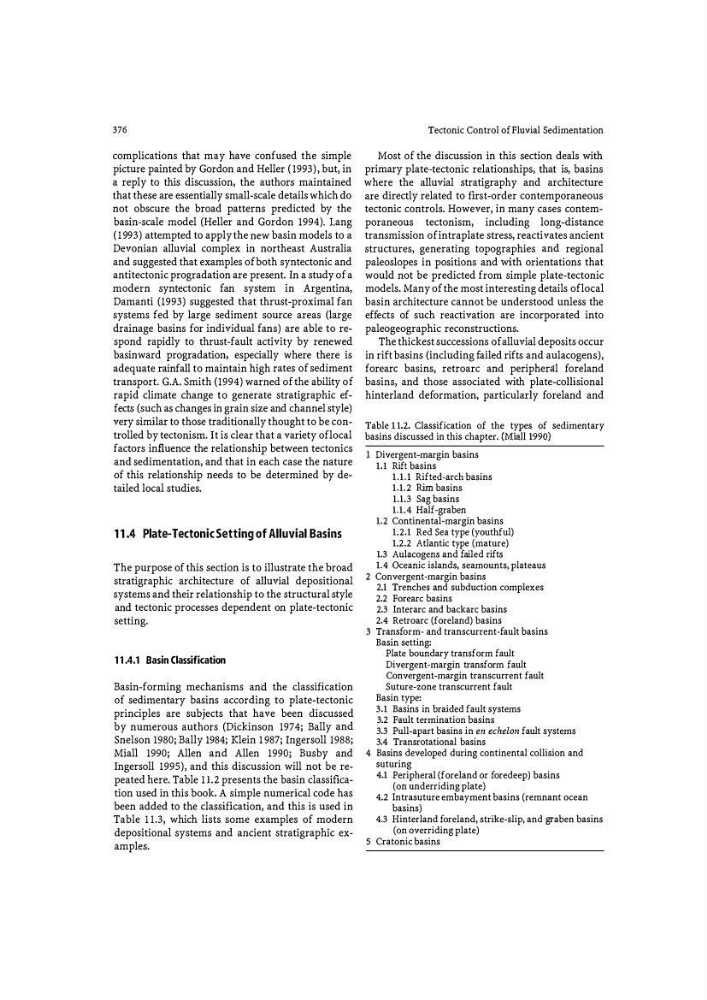
Ingersoll 1995), and this discussion will not be repeated here. Table 1 !.2 presents the basin classification used in this book. A simple numerical code has
been added to the classification, and this is used in
Table 11.3, which lists some examples of modern
depositional systems and ancient stratigraphic examples.
Tectonic Control of Fluvial Sedimentation
Most of the discussion in this section deals with
primary plate-tectonic relationships, that is, basins
where the alluvial stratigraphy and architecture
are directly related to first-order contemporaneous
tectonic controls. However, in many cases contemporaneous tectonism, including long-distance
transmission of intraplate stress, reactivates ancient
structures, generating topographies and regional
paleoslopes in positions and with orientations that
would not be predicted from simple plate-tectonic
models. Many of the most interesting details oflocal
basin architecture cannot be understood unless the
effects of such reactivation are incorporated into
paleogeographic reconstructions.
The thickest successions of alluvial deposits occur
in rift basins (including fa iled rifts and aulacogens),
forearc basins, retroarc and peripheral fo reland
basins, and those associated with plate-collisional
hinterland deformation, particularly fo reland and
Table 11.2. Classification of the types of sedimentary
basins discussed in this chapter. (Mia11 1990)
Divergent-margin basins
1.1 Rift basins
1.1.1 Rifted-arch basins
1.1.2 Rim basins
1.1.3 Sag basins
1.1.4 Half-graben
1.2 Continental-margin basins
1.2.1 Red Sea type (youthful)
1.2.2 Atlantic type (mature)
1.3 Aulacogens and failed rifts
1.4 Oceanic islands, seamounts, plateaus
2 Convergent-margin basins
2.1 Trenches and subduction complexes
2.2 Forearc basins
2.3 Interarc and backarc basins
2.4 Retroarc (foreland) basins
3 Transform- and transcurrent-fault basins
Basin setting:
Plate boundary transform fault
Divergent-margin transform fault
Convergent-margin transcurrent fault
Suture-zone transcurrent fault
Basin type:
3.1 Basins in braided fault systems
3.2 Fault termination basins
3.3 Pull-apart basins in en echelon fault systems
3.4 Transrotational basins
4 Basins developed during continental collision and
suturing
4.1 Peripheral (foreland or foredeep) basins
(on underriding plate)
4.2 Intrasuture embayment basins (remnant ocean
basins)
4.3 Hinterland foreland, strike-slip, and graben basins
(on overriding plate)
5 Cratonic basins
complications that may have confused the simple
picture painted by Gordon and Heller ( 1993 ), but, in
a reply to this discussion) the authors maintained
that these are essentially small-scale details which do
not obscure the broad patterns predicted by the
basin-scale model (Heller and Gordon 1994). Lang
(1993) attempted to apply the new basin models to a
Devonian alluvial complex in northeast Australia
and suggested that examples of both syntectonic and
antitectonic progradation are present. In a study of a
modern syntectonic fan system in Argentina,
Damanti (1993) suggested that thrust-proximal fan
systems fed by large sediment source areas (large
drainage basins for individual fans) are able to respond rapidly to thrust-fault activity by renewed
basinward progradation) especially where there is
adequate rainfall to maintain high rates of sediment
transport. G.A. Smith (1994) warned of the ability of
rapid climate change to generate stratigraphic effects (such as changes in grain size and channel style)
very similar to those traditionally thought to be controlled by tectonism. It is clear that a variety oflocal
factors influence the relationship between tectonics
and sedimentation, and that in each case the nature
of this relationship needs to be determined by detailed local studies.
11.4 Plate-Tectonic Setting of Alluvial Basins
The purpose of this section is to illustrate the broad
stratigraphic architecture of alluvial depositional
systems and their relationship to the structural style
and tectonic processes dependent on plate-tectonic
setting.
11.4.1 Basin Classification
Basin-forming mechanisms and the classification
of sedimentary basins according to plate-tectonic
principles are subjects that have been discussed
by numerous authors (Dickinson 1974; Bally and
Snelson 1980; Bally 1984; Klein 1987; lngersoll 1988;
Miall 1990; Allen and Allen 1990; Busby and
Ingersoll 1995), and this discussion will not be repeated here. Table 1 !.2 presents the basin classification used in this book. A simple numerical code has
been added to the classification, and this is used in
Table 11.3, which lists some examples of modern
depositional systems and ancient stratigraphic examples.
Tectonic Control of Fluvial Sedimentation
Most of the discussion in this section deals with
primary plate-tectonic relationships, that is, basins
where the alluvial stratigraphy and architecture
are directly related to first-order contemporaneous
tectonic controls. However, in many cases contemporaneous tectonism, including long-distance
transmission of intraplate stress, reactivates ancient
structures, generating topographies and regional
paleoslopes in positions and with orientations that
would not be predicted from simple plate-tectonic
models. Many of the most interesting details oflocal
basin architecture cannot be understood unless the
effects of such reactivation are incorporated into
paleogeographic reconstructions.
The thickest successions of alluvial deposits occur
in rift basins (including fa iled rifts and aulacogens),
forearc basins, retroarc and peripheral fo reland
basins, and those associated with plate-collisional
hinterland deformation, particularly fo reland and
Table 11.2. Classification of the types of sedimentary
basins discussed in this chapter. (Mia11 1990)
Divergent-margin basins
1.1 Rift basins
1.1.1 Rifted-arch basins
1.1.2 Rim basins
1.1.3 Sag basins
1.1.4 Half-graben
1.2 Continental-margin basins
1.2.1 Red Sea type (youthful)
1.2.2 Atlantic type (mature)
1.3 Aulacogens and failed rifts
1.4 Oceanic islands, seamounts, plateaus
2 Convergent-margin basins
2.1 Trenches and subduction complexes
2.2 Forearc basins
2.3 Interarc and backarc basins
2.4 Retroarc (foreland) basins
3 Transform- and transcurrent-fault basins
Basin setting:
Plate boundary transform fault
Divergent-margin transform fault
Convergent-margin transcurrent fault
Suture-zone transcurrent fault
Basin type:
3.1 Basins in braided fault systems
3.2 Fault termination basins
3.3 Pull-apart basins in en echelon fault systems
3.4 Transrotational basins
4 Basins developed during continental collision and
suturing
4.1 Peripheral (foreland or foredeep) basins
(on underriding plate)
4.2 Intrasuture embayment basins (remnant ocean
basins)
4.3 Hinterland foreland, strike-slip, and graben basins
(on overriding plate)
5 Cratonic basins