

Tectonic Control of Basin Style and Basin� Scale Fluvial Patterns
375
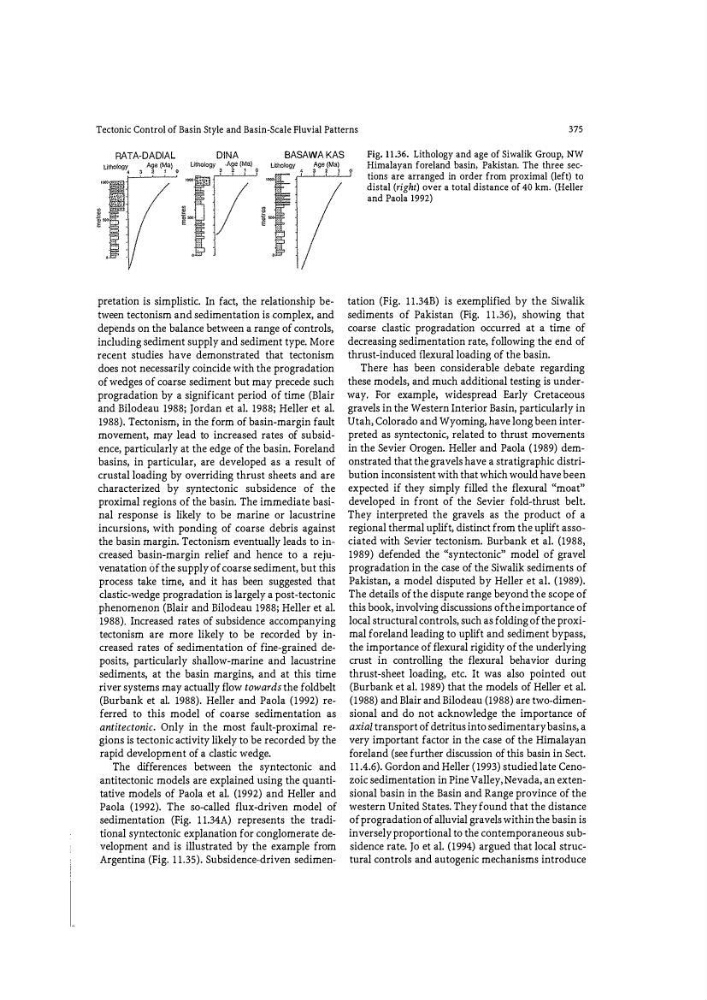
RATA-DADIAL
I
DINA
BASAWA KAS
pretation is simplistic. In fact, the relationship between tectonism and sedimentation is complex, and
depends on the balance between a range of controls,
including sediment supply and sediment type. More
recent studies have demonstrated that tectonism
does not necessarily coincide with the prOgradation
of wedges of coarse sediment but may precede such
progradation by a significant period of time (Blair
and Bilodeau 1988; Jordan et a!. 1988; Heller et a!.
1988). Tectonism, in the form of basin-margin fault
movement, may lead to increased rates of subsidence, particularly at the edge of the basin. Foreland
basins, in particular, are developed as a result of
crustal loading by overriding thrust sheets and are
characterized by syntectonic subsidence of the
proximal regions of the basin. The immediate basinal response is likely to be marine or lacustrine
incursions, with pending of coarse debris against
the basin margin. Tectonism eventually leads to increased basin-margin relief and hence to a reju�
venatation Of the supply of coarse sediment, but this
process take time, and it has been suggested that
clastic-wedge progradation is largely a post-tectonic
phenomenon (Blair and Bilodeau 1988; Heller et a!.
1988). Increased rates of subsidence accompanying
tectonism are more likely to be recorded by in�
creased rates of sedimentation of fine-grained deposits, particularly shallow-marine and lacustrine
sediments, at the basin margins, and at this time
river systems may actually flow towards the foldbelt
(Burbank et a!. 1988). Heller and Paola (1992) referred to this model of coarse sedimentation as
antitectonic. Only in the most fault-proximal regions is tectonic activity likely to be recorded by the
rapid development of a clastic wedge.
The differences between the syntectonic and
antitectonic models are explained using the quantitative models of Paola et al. (1992) and Heller and
Paola (1992). The so-called flux-driven model of
sedimentation (Fig. 11.34A) represents the traditional syntectonic explanation for conglomerate development and is illustrated by the example from
Argentina (Fig. 11.35). Subsidence-driven sedimenFig. 11.36. Lithology and age of Siwalik Group, NW
Himalayan foreland basin, Pakistan. The three sections are arranged in order from proximal (left) to
distal (right) over a total distance of 40 km. (Heller
and Paola 1992)
tation (Fig. 1!.34B) is exemplified by the Siwalik
sediments of Pakistan (Fig. 1!.36), showing that
coarse clastic progradation occurred at a time of
decreasing sedimentation rate, following the end of
thrust-induced flexural loading of the basin.
There has been considerable debate regarding
these models, and much additional testing is underway. For example, widespread Early Cretaceous
gravels in the Western Interior Basin, particularly in
Utah, Colorado and Wyoming, have long been interpreted as syntectonic, related to thrust movements
in the Sevier Orogen. Heller and Paola (1989) demonstrated that the gravels have a stratigraphic distribution inconsistent with that which would have been
expected if they simply filled the flexural "moat"
developed in front of the Sevier fold-thrust belt.
They interpreted the gravels as the product of a
regional thermal uplift, distinct from the uplift associated with Sevier tectonism. Burbank et al. (1988,
1989) defended the "syntectonic" model of gravel
progradation in the case of the Siwalik sediments of
Pakistan, a model disputed by Heller et al. (1989).
The details of the dispute range beyond the scope of
this book, involving discussions of the importance of
local structural controls, such as folding of the proximal foreland leading to uplift and sediment bypass,
the importance of flexural rigidity of the underlying
crust in controlling the flexural behavior during
thrust-sheet loading, etc. It was also pointed out
(Burbank et a!. 1989) that the models of Heller et al.
(1988) and Blair and Bilodeau (1988) are two-dimensional and do not acknowledge the importance of
axial transport of detritus into sedimentary basins, a
very important factor in the case of the Himalayan
foreland (see further discussion of this basin in Sect.
11.4.6). Gordon and Heller ( 1993) studied late Cenozoic sedimentation in Pine Valley) Nevada, an extensional basin in the Basin and Range province of the
western United States. They found that the distance
of progradation of alluvial gravels within the basin is
inversely proportional to the contemporaneous subsidence rate. Jo et al. (1994) argued that local structural controls and autogenic mechanisms introduce
375
RATA-DADIAL
I
DINA
BASAWA KAS
pretation is simplistic. In fact, the relationship between tectonism and sedimentation is complex, and
depends on the balance between a range of controls,
including sediment supply and sediment type. More
recent studies have demonstrated that tectonism
does not necessarily coincide with the prOgradation
of wedges of coarse sediment but may precede such
progradation by a significant period of time (Blair
and Bilodeau 1988; Jordan et a!. 1988; Heller et a!.
1988). Tectonism, in the form of basin-margin fault
movement, may lead to increased rates of subsidence, particularly at the edge of the basin. Foreland
basins, in particular, are developed as a result of
crustal loading by overriding thrust sheets and are
characterized by syntectonic subsidence of the
proximal regions of the basin. The immediate basinal response is likely to be marine or lacustrine
incursions, with pending of coarse debris against
the basin margin. Tectonism eventually leads to increased basin-margin relief and hence to a reju�
venatation Of the supply of coarse sediment, but this
process take time, and it has been suggested that
clastic-wedge progradation is largely a post-tectonic
phenomenon (Blair and Bilodeau 1988; Heller et a!.
1988). Increased rates of subsidence accompanying
tectonism are more likely to be recorded by in�
creased rates of sedimentation of fine-grained deposits, particularly shallow-marine and lacustrine
sediments, at the basin margins, and at this time
river systems may actually flow towards the foldbelt
(Burbank et a!. 1988). Heller and Paola (1992) referred to this model of coarse sedimentation as
antitectonic. Only in the most fault-proximal regions is tectonic activity likely to be recorded by the
rapid development of a clastic wedge.
The differences between the syntectonic and
antitectonic models are explained using the quantitative models of Paola et al. (1992) and Heller and
Paola (1992). The so-called flux-driven model of
sedimentation (Fig. 11.34A) represents the traditional syntectonic explanation for conglomerate development and is illustrated by the example from
Argentina (Fig. 11.35). Subsidence-driven sedimenFig. 11.36. Lithology and age of Siwalik Group, NW
Himalayan foreland basin, Pakistan. The three sections are arranged in order from proximal (left) to
distal (right) over a total distance of 40 km. (Heller
and Paola 1992)
tation (Fig. 1!.34B) is exemplified by the Siwalik
sediments of Pakistan (Fig. 1!.36), showing that
coarse clastic progradation occurred at a time of
decreasing sedimentation rate, following the end of
thrust-induced flexural loading of the basin.
There has been considerable debate regarding
these models, and much additional testing is underway. For example, widespread Early Cretaceous
gravels in the Western Interior Basin, particularly in
Utah, Colorado and Wyoming, have long been interpreted as syntectonic, related to thrust movements
in the Sevier Orogen. Heller and Paola (1989) demonstrated that the gravels have a stratigraphic distribution inconsistent with that which would have been
expected if they simply filled the flexural "moat"
developed in front of the Sevier fold-thrust belt.
They interpreted the gravels as the product of a
regional thermal uplift, distinct from the uplift associated with Sevier tectonism. Burbank et al. (1988,
1989) defended the "syntectonic" model of gravel
progradation in the case of the Siwalik sediments of
Pakistan, a model disputed by Heller et al. (1989).
The details of the dispute range beyond the scope of
this book, involving discussions of the importance of
local structural controls, such as folding of the proximal foreland leading to uplift and sediment bypass,
the importance of flexural rigidity of the underlying
crust in controlling the flexural behavior during
thrust-sheet loading, etc. It was also pointed out
(Burbank et a!. 1989) that the models of Heller et al.
(1988) and Blair and Bilodeau (1988) are two-dimensional and do not acknowledge the importance of
axial transport of detritus into sedimentary basins, a
very important factor in the case of the Himalayan
foreland (see further discussion of this basin in Sect.
11.4.6). Gordon and Heller ( 1993) studied late Cenozoic sedimentation in Pine Valley) Nevada, an extensional basin in the Basin and Range province of the
western United States. They found that the distance
of progradation of alluvial gravels within the basin is
inversely proportional to the contemporaneous subsidence rate. Jo et al. (1994) argued that local structural controls and autogenic mechanisms introduce