

'
I
Tectonic Control of Alluvial Stratigraphy
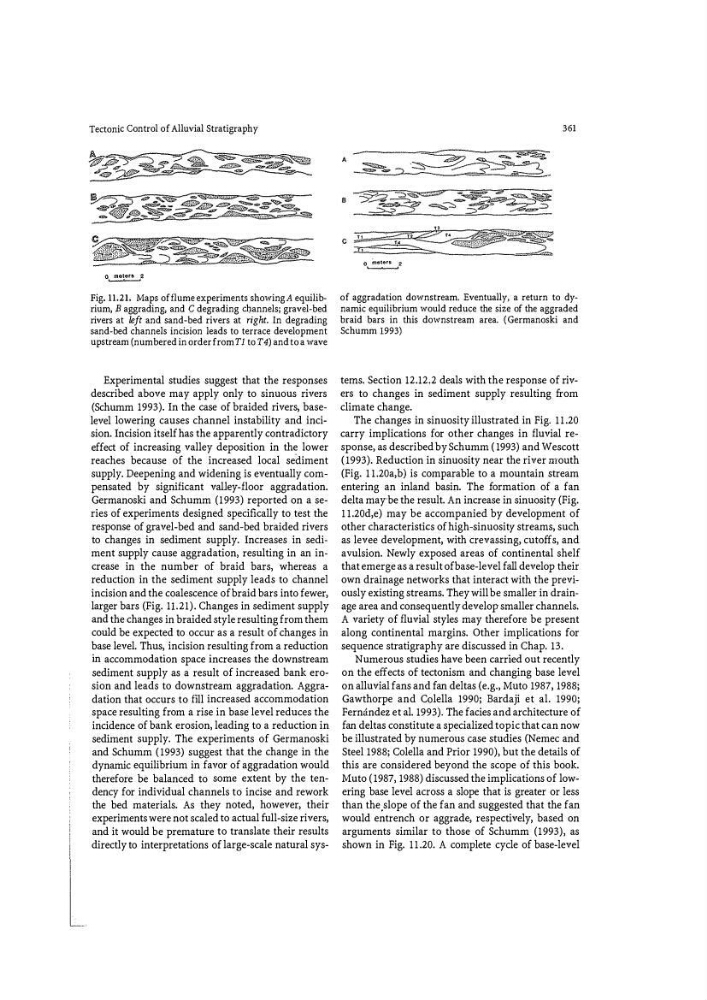
Fig. 11.21. Maps of flume experiments showing A equilibrium, B aggrading, and C degrading d;J-annels; gravel-bed
rivers at left and sand-bed rivers at right. In degrading
sand-bed channels incision leads to terrace development
upstream (numbered in order from Tl to T4) and to a wave
Experimental studies suggest that the responses
described above may apply only to sinuous rivers
(Schumm 1993). In the case of braided rivers, baselevel lowering causes channel instability and incision. Incision itself has the apparently contradictory
effect of increasing valley deposition in the lower
reaches because of the increased local sediment
supply. Deepening and widening is eventually compensated by significant valley-floor aggradation.
Germanoski and Schumm (1993) reported on a series of experiments designed specifically to test the
response of gravel-bed and sand-bed braided rivers
to changes in sediment supply. Increases in sediment supply cause aggradation, resulting in an increase in the number of braid bars, whereas a
reduction in the sediment supply leads to channel
incision and the coalescence of braid bars into fewer,
larger bars (Fig. 1!.21). Changes in sediment supply
and the changes in braided style resulting from them
could be expected to occur as a result of changes in
base level. Thus, incision resulting from a reduction
in accommodation space increases the downstream
sediment supply as a result of increased bank erosion and leads to downstream aggradation. Aggradation that occurs to fill increased accommodation
space resulting from a rise in base level reduces the
incidence of bank erosion, leading to a reduction in
sediment supply. The experiments of Germanoski
and Schumm (1993) suggest that the change in the
dynamic equilibrium in favor of aggradation would
therefore be balanced to some extent by the tendency for individual channels to incise and rework
the bed materials. As they noted, however, their
experiments were not scaled to actual full-size rivers,
and it would be premature to translate their results
directly to interpretations of large-scale natural sys361
of aggradation downstream. Eventually, a return to dynamic equilibrium would reduce the size of the aggraded
braid bars in this downstream area. ( Germanoski and
Schumm 1993)
terns. Section 12.12.2 deals with the response of rivers to changes in sediment supply resulting fr om
climate change.
The changes in sinuosity illustrated in Fig. 11.20
carry implications for other changes in fluvial response, as described by Schumm ( 1993) and Wescott
(1993). Reduction in sinuosity near the river mouth
(Fig. 11.20a,b) is comparable to a mountain stream
entering an inland basin. The fo rmation of a fan
delta may·be the result. An increase in sinuosity (Fig.
11.20d,e) may be accompanied by development of
other characteristics of high-sinuosity streams, such
as levee development, with crevassing, cutoffs, and
avulsion. Newly exposed areas of continental shelf
that emerge as a result ofbase-level fall develop their
own drainage networks that interact with the previously existing streams. They will be smaller in drainage area and consequently develop smaller channels.
A variety of fluvial styles may therefore be present
along continental margins. Other implications for
sequence stratigraphy are discussed in Chap. 13.
Numerous studies have been carried out recently
on the effects of tectonism and changing base level
on alluvial fans and fan deltas (e.g., Muto 1987, 1988;
Gawthorpe and Colella 1990; Bardaji et al. 1990;
Fernandez et al. 1993). The facies and architecture of
fan deltas constitute a specialized topic that can now
be illustrated by numerous case studies (Nemec and
Steel 1988; Colella and Prior 1990), but the details of
this are considered beyond the scope of this book.
Muto (1987, 1988) discussed the implications of lowering base level across a slope that is greater or less
than the slope of the fan and suggested that the fan
would entrench or aggrade, respectively, based on
arguments similar to those of Schumm (1993), as
shown in Fig. 11.20. A complete cycle of base-level
I
Tectonic Control of Alluvial Stratigraphy
Fig. 11.21. Maps of flume experiments showing A equilibrium, B aggrading, and C degrading d;J-annels; gravel-bed
rivers at left and sand-bed rivers at right. In degrading
sand-bed channels incision leads to terrace development
upstream (numbered in order from Tl to T4) and to a wave
Experimental studies suggest that the responses
described above may apply only to sinuous rivers
(Schumm 1993). In the case of braided rivers, baselevel lowering causes channel instability and incision. Incision itself has the apparently contradictory
effect of increasing valley deposition in the lower
reaches because of the increased local sediment
supply. Deepening and widening is eventually compensated by significant valley-floor aggradation.
Germanoski and Schumm (1993) reported on a series of experiments designed specifically to test the
response of gravel-bed and sand-bed braided rivers
to changes in sediment supply. Increases in sediment supply cause aggradation, resulting in an increase in the number of braid bars, whereas a
reduction in the sediment supply leads to channel
incision and the coalescence of braid bars into fewer,
larger bars (Fig. 1!.21). Changes in sediment supply
and the changes in braided style resulting from them
could be expected to occur as a result of changes in
base level. Thus, incision resulting from a reduction
in accommodation space increases the downstream
sediment supply as a result of increased bank erosion and leads to downstream aggradation. Aggradation that occurs to fill increased accommodation
space resulting from a rise in base level reduces the
incidence of bank erosion, leading to a reduction in
sediment supply. The experiments of Germanoski
and Schumm (1993) suggest that the change in the
dynamic equilibrium in favor of aggradation would
therefore be balanced to some extent by the tendency for individual channels to incise and rework
the bed materials. As they noted, however, their
experiments were not scaled to actual full-size rivers,
and it would be premature to translate their results
directly to interpretations of large-scale natural sys361
of aggradation downstream. Eventually, a return to dynamic equilibrium would reduce the size of the aggraded
braid bars in this downstream area. ( Germanoski and
Schumm 1993)
terns. Section 12.12.2 deals with the response of rivers to changes in sediment supply resulting fr om
climate change.
The changes in sinuosity illustrated in Fig. 11.20
carry implications for other changes in fluvial response, as described by Schumm ( 1993) and Wescott
(1993). Reduction in sinuosity near the river mouth
(Fig. 11.20a,b) is comparable to a mountain stream
entering an inland basin. The fo rmation of a fan
delta may·be the result. An increase in sinuosity (Fig.
11.20d,e) may be accompanied by development of
other characteristics of high-sinuosity streams, such
as levee development, with crevassing, cutoffs, and
avulsion. Newly exposed areas of continental shelf
that emerge as a result ofbase-level fall develop their
own drainage networks that interact with the previously existing streams. They will be smaller in drainage area and consequently develop smaller channels.
A variety of fluvial styles may therefore be present
along continental margins. Other implications for
sequence stratigraphy are discussed in Chap. 13.
Numerous studies have been carried out recently
on the effects of tectonism and changing base level
on alluvial fans and fan deltas (e.g., Muto 1987, 1988;
Gawthorpe and Colella 1990; Bardaji et al. 1990;
Fernandez et al. 1993). The facies and architecture of
fan deltas constitute a specialized topic that can now
be illustrated by numerous case studies (Nemec and
Steel 1988; Colella and Prior 1990), but the details of
this are considered beyond the scope of this book.
Muto (1987, 1988) discussed the implications of lowering base level across a slope that is greater or less
than the slope of the fan and suggested that the fan
would entrench or aggrade, respectively, based on
arguments similar to those of Schumm (1993), as
shown in Fig. 11.20. A complete cycle of base-level