

362
Tectonic Control of Fluvial Sedimentation
AGGRADAT ION
•
<>iaaa�a aa aa<><>" "�"""oo<>
Q
p•"�"""""""'"""' """" ....
oo: ooen fan
'--'- -- -'
fv: fan volley
de: dissection channel
cf: confined fan
df: dissection fill
e
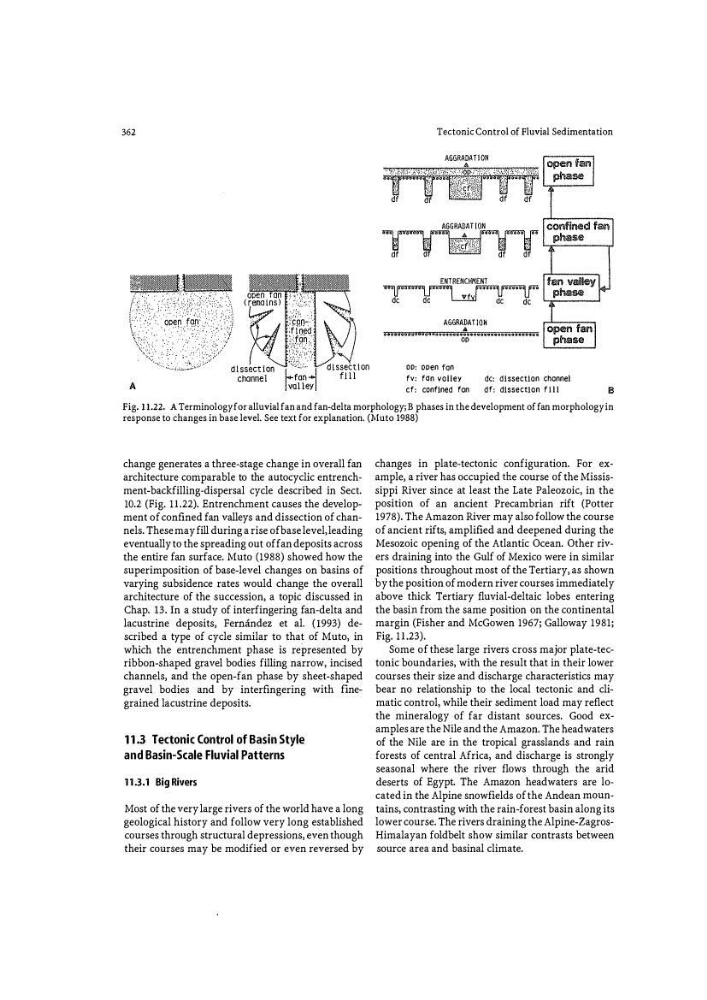
Fig. 11.22. A Terminology for alluvial fan and fan�delta morphology; B phases in the development of fan morphology in
response to changes in base level. See text for explanation. (Muto 1988)
change generates a three�stage change in overall fan
architecture comparable to the autocyclic entrenchment-backfilling-dispersal cycle described in Sect.
10.2 (Fig. 1!.22). Entrenchment causes the development of confined fan valleys and dissection of channels. These may fill during a rise ofbase level, leading
eventually to the spreading out of fan deposits across
the entire fan surface. Muto (1988) showed how the
superimposition of base-level changes on basins of
varying subsidence rates would change the overall
architecture of the succession, a topic discussed in
Chap. !3. In a study of interfingering fan-delta and
lacustrine deposits, Fernandez et al. (!993) described a type of cycle similar to that of Muto, in
which the entrenchment phase is rePresented by
ribbon-shaped gravel bodies filling narrow, incised
channels, and the open-fan phase by sheet-shaped
gravel bodies and by interfingering with finegrained lacustrine deposits.
11.3 Tectonic Control of Basin Style
and Basin-Scale Fluvial Patterns
11.3.1 Big Rivers
Most of the very large rivers of the world have a long
geological history and follow very long established
courses through structural depressions, even though
their courses may be modified or even reversed by
changes in plate-tectonic configuration. For example, a river has occupied t he course of the Mississippi River since at least the Late Paleozoic, in the
position of an ancient Precambrian rift (Potter
1978). The Amazon River may also follow the course
of ancient rifts, amplified and deepened during the
Mesozoic opening of the Atlantic Ocean. Other rivers draining into the Gulf of Mexico were in similar
positions throughout most of the Tertiary, as shown
by the position of modern river courses immediately
above thick Tertiary fluvial-deltaic lobes entering
the basin from the same position on the continental
margin (Fisher and McGowen 1967; Galloway 1981;
Fig. 1!.23).
Some of these large rivers cross major plate-tee�
tonic boundaries, with the result that in their lower
courses their size and discharge characteristics may
bear no relationship to the local tectonic and climatic control, while their sediment load may reflect
the mineralogy of far distant sources. Good examples are the Nile and the Amazon. The headwaters
of the Nile are in the tropical grasslands and rain
forests of central Africa, and discharge is strongly
seasonal where the river flows through the arid
deserts of Egypt. The Amazon headwaters are located in the Alpine snowfields of the Andean mountains, contrasting with the rain�forest basin along its
lower course. The rivers draining the Alpine-ZagrosHimalayan foldbelt show similar contrasts between
source area and basinal climate.
Tectonic Control of Fluvial Sedimentation
AGGRADAT ION
•
<>iaaa�a aa aa<><>" "�"""oo<>
Q
p•"�"""""""'"""' """" ....
oo: ooen fan
'--'- -- -'
fv: fan volley
de: dissection channel
cf: confined fan
df: dissection fill
e
Fig. 11.22. A Terminology for alluvial fan and fan�delta morphology; B phases in the development of fan morphology in
response to changes in base level. See text for explanation. (Muto 1988)
change generates a three�stage change in overall fan
architecture comparable to the autocyclic entrenchment-backfilling-dispersal cycle described in Sect.
10.2 (Fig. 1!.22). Entrenchment causes the development of confined fan valleys and dissection of channels. These may fill during a rise ofbase level, leading
eventually to the spreading out of fan deposits across
the entire fan surface. Muto (1988) showed how the
superimposition of base-level changes on basins of
varying subsidence rates would change the overall
architecture of the succession, a topic discussed in
Chap. !3. In a study of interfingering fan-delta and
lacustrine deposits, Fernandez et al. (!993) described a type of cycle similar to that of Muto, in
which the entrenchment phase is rePresented by
ribbon-shaped gravel bodies filling narrow, incised
channels, and the open-fan phase by sheet-shaped
gravel bodies and by interfingering with finegrained lacustrine deposits.
11.3 Tectonic Control of Basin Style
and Basin-Scale Fluvial Patterns
11.3.1 Big Rivers
Most of the very large rivers of the world have a long
geological history and follow very long established
courses through structural depressions, even though
their courses may be modified or even reversed by
changes in plate-tectonic configuration. For example, a river has occupied t he course of the Mississippi River since at least the Late Paleozoic, in the
position of an ancient Precambrian rift (Potter
1978). The Amazon River may also follow the course
of ancient rifts, amplified and deepened during the
Mesozoic opening of the Atlantic Ocean. Other rivers draining into the Gulf of Mexico were in similar
positions throughout most of the Tertiary, as shown
by the position of modern river courses immediately
above thick Tertiary fluvial-deltaic lobes entering
the basin from the same position on the continental
margin (Fisher and McGowen 1967; Galloway 1981;
Fig. 1!.23).
Some of these large rivers cross major plate-tee�
tonic boundaries, with the result that in their lower
courses their size and discharge characteristics may
bear no relationship to the local tectonic and climatic control, while their sediment load may reflect
the mineralogy of far distant sources. Good examples are the Nile and the Amazon. The headwaters
of the Nile are in the tropical grasslands and rain
forests of central Africa, and discharge is strongly
seasonal where the river flows through the arid
deserts of Egypt. The Amazon headwaters are located in the Alpine snowfields of the Andean mountains, contrasting with the rain�forest basin along its
lower course. The rivers draining the Alpine-ZagrosHimalayan foldbelt show similar contrasts between
source area and basinal climate.