

360
A
,r
Tectonic Control of Fluvial Sedimentation
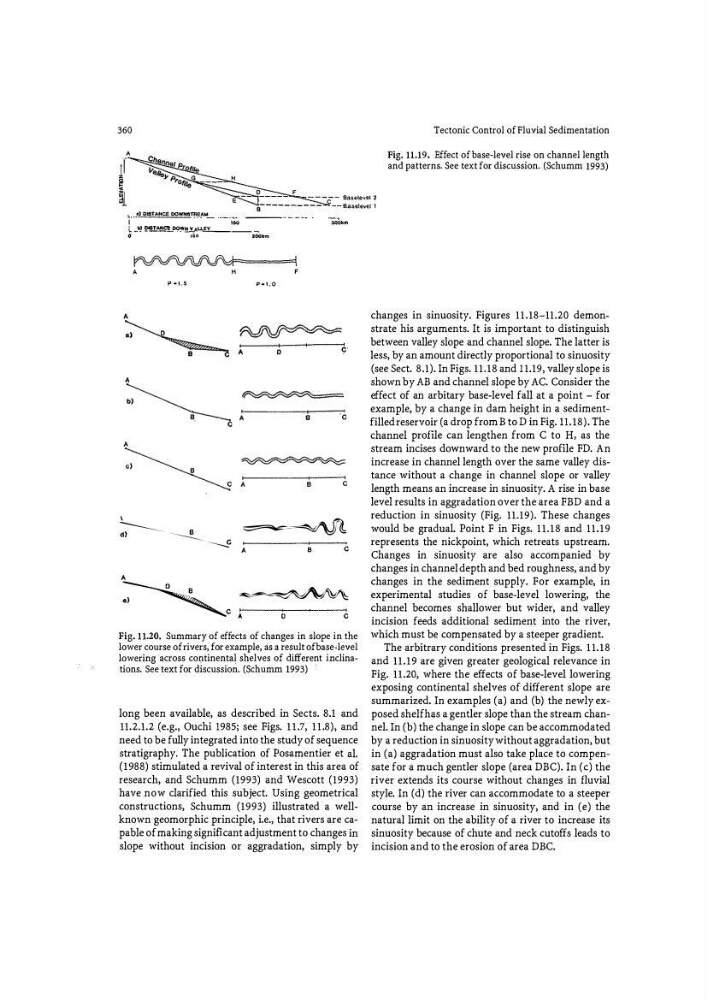
Fig. 11.19. Effect of base-level rise on channel length
and patterns. See text for discussion. (Schumm 1993)
�
�1
------ Saso!evc! 2
9- --------- C-- Baselevel l
.... �!!: �,!lCE OOwm!��f'U_ ·---.-- --- ·
I
•�
L _bl �A!:!.£§_� !!.Y,A I..I£L_ __ �
0
1Un
20011m
A
H
f
p •1.5
p •1.0
�� A
8
C
· � �
)
C A
0
C
Fig. 11.20. Summary of effects of changes in slope in the
lower course of rivers, for example, as a result ofbase�level
lowering · across continental shelves of different inclinations. See text for discussion. (Schumm 1993)
long been available, as described in Sects. 8.1 and
11.2.1.2 (e.g., Ouchi !985; see Figs. 11.7, 11.8), and
need to be fully integrated into the study of sequence
stratigraphy. The publication of Posamentier et al.
(1988) stimulated a revival of interest in this area of
research, and Schumm (1993) and Wescott (1993)
have now clarified this subject. Using geometrical
constructions, Schumm (1993) illustrated a wellknown geomorphic principle, i.e., that rivers are capable of making signifi cant adjustment to changes in
slope without incision or aggradation, simply by
changes in sinuosity. Figures 11.18-11.20 demonstrate his arguments. It is important to distinguish
between valley slope and channel slope. The latter is
less, by an amount directly proportional to sinuosity
(see Sect. 8.1). In Figs. 11.18 and I 1.19, valley slope is
shown by AB and channel slope by AC. Consider the
effe ct of an arbitary base-level fall at a point � for
example, by a change in dam height in a sedimentfilled reservoir (a drop from B to Din Fig. l!.18). The
channel profile can lengthen from C to H, as the
stream incises downward to the new profile FD. An
"increase in channel length over the same valley distance without a change in channel slope or valley
length means an increase in sinuosity. A rise in base
level results in aggradation over the area FBD and a
reduction in sinuosity (Fig. 11.19). These changes
would be gradual. Point Fi n Figs. 11.18 and 11.19
represents the nickpoint, which retreats upstream.
Changes in sinuosity are also accompanied by
changes in channel depth and bed roughness, and by
changes in the sediment supply. For example, in
experimental studies of base-level lowering, the
channel becomes shallower but wider, and valley
incision feeds additional sediment into the river,
which must be compensated by a steeper gradient.
The arbitrary conditions presented in Figs. 11.18
and 11.19 are given greater geological relevance in
Fig. 11.20, where the effects of base-level lowering
exposing continental shelves of different slope are
summarized. In examples (a) and (b) the newly exposed shelfhas a gentler slope than the stream channel. In (b) the change in slope can be accommodated
by a reduction in sinuosity without aggradation, but
in (a) aggradation must also take place to compensate for a much gentler slope (area DBC). In (c) the
river extends its course without changes in fluvial
style. In (d) the river can accommodate to a steeper
course by an increase in sinuosity, and in (e) the
natural limit on the ability of a river to increase its
sinuosity because of chute and neck cutoffs leads to
incision and to the erosion of area D BC.
A
,r
Tectonic Control of Fluvial Sedimentation
Fig. 11.19. Effect of base-level rise on channel length
and patterns. See text for discussion. (Schumm 1993)
�
�1
------ Saso!evc! 2
9- --------- C-- Baselevel l
.... �!!: �,!lCE OOwm!��f'U_ ·---.-- --- ·
I
•�
L _bl �A!:!.£§_� !!.Y,A I..I£L_ __ �
0
1Un
20011m
A
H
f
p •1.5
p •1.0
�� A
8
C
· � �
)
C A
0
C
Fig. 11.20. Summary of effects of changes in slope in the
lower course of rivers, for example, as a result ofbase�level
lowering · across continental shelves of different inclinations. See text for discussion. (Schumm 1993)
long been available, as described in Sects. 8.1 and
11.2.1.2 (e.g., Ouchi !985; see Figs. 11.7, 11.8), and
need to be fully integrated into the study of sequence
stratigraphy. The publication of Posamentier et al.
(1988) stimulated a revival of interest in this area of
research, and Schumm (1993) and Wescott (1993)
have now clarified this subject. Using geometrical
constructions, Schumm (1993) illustrated a wellknown geomorphic principle, i.e., that rivers are capable of making signifi cant adjustment to changes in
slope without incision or aggradation, simply by
changes in sinuosity. Figures 11.18-11.20 demonstrate his arguments. It is important to distinguish
between valley slope and channel slope. The latter is
less, by an amount directly proportional to sinuosity
(see Sect. 8.1). In Figs. 11.18 and I 1.19, valley slope is
shown by AB and channel slope by AC. Consider the
effe ct of an arbitary base-level fall at a point � for
example, by a change in dam height in a sedimentfilled reservoir (a drop from B to Din Fig. l!.18). The
channel profile can lengthen from C to H, as the
stream incises downward to the new profile FD. An
"increase in channel length over the same valley distance without a change in channel slope or valley
length means an increase in sinuosity. A rise in base
level results in aggradation over the area FBD and a
reduction in sinuosity (Fig. 11.19). These changes
would be gradual. Point Fi n Figs. 11.18 and 11.19
represents the nickpoint, which retreats upstream.
Changes in sinuosity are also accompanied by
changes in channel depth and bed roughness, and by
changes in the sediment supply. For example, in
experimental studies of base-level lowering, the
channel becomes shallower but wider, and valley
incision feeds additional sediment into the river,
which must be compensated by a steeper gradient.
The arbitrary conditions presented in Figs. 11.18
and 11.19 are given greater geological relevance in
Fig. 11.20, where the effects of base-level lowering
exposing continental shelves of different slope are
summarized. In examples (a) and (b) the newly exposed shelfhas a gentler slope than the stream channel. In (b) the change in slope can be accommodated
by a reduction in sinuosity without aggradation, but
in (a) aggradation must also take place to compensate for a much gentler slope (area DBC). In (c) the
river extends its course without changes in fluvial
style. In (d) the river can accommodate to a steeper
course by an increase in sinuosity, and in (e) the
natural limit on the ability of a river to increase its
sinuosity because of chute and neck cutoffs leads to
incision and to the erosion of area D BC.