

Tectonic Control of Alluvial Stratigraphy
The basic hydraulic flaw in this argument is that the
deposited sediment is assumed to become finer as
slopes (and thus velocity and shear stress) increase
(from slope AF to DF). Of course, the exact opposite
would happen. An increase in slope results in in�
creased competency and increased grain size. SediM
ments deposited on the fluvial plain represent
temporary sediment storage, with geological preservation typically occurring because of abandonment
of a deposit before it can be remobilized (e.g., lateral
accretion on a point bar, channel avulsion). Therefore, if the pattern of Fig. 11.!1 were actually to
occur, an upward-coarsening profile would result.
In conclusion, the model of Posamentier et al.
(1988) and Posamentier and Vail (1988), suggesting
that significant fluvial sedimentation, coastal-plain
progradation, and coastal onlap occur during times
of rapidly falling sea level (the late-highstand phase,
when eustatic fall outpaces subsidence, and an actual
relative fall occurs: times T4-T6 in Posamentier and
Vail 1988, Fig. 8), seems incorrect. It seems much
more likely that the main coastal-plain fluvial accumulations occur either during relative rises in sea
level or during periods of te�tonism and source-area
uplift (as described earlier in this chapter). These
conclusions were supported by the numerical modeling experiments of Rivenaes (1992), but they need
to be evaluated in each field case, in light of local
variations in subsidence, sediment supply, and marine energy, as demonstrated by the work of Leckie
(1994). The rise in sea level following the last ice age
is a good example of a transgressive situation. Most
river valleys were initially drowned and then became
filled with estuarine and fluvial facies. Suter et al.
(1987) showed that this happened several times on
the Louisiana shelf during the late Quaternary sealevel changes (Chap. 13). Yet because of high sediA
359
ment supply the major river on the Gulf Coast, the
Mississippi, has prograded significantly.
A recent text on sequence stratigraphy by H.W.
Posamentier and G.P. Allen (manuscript in preparation) contains many improvements on the 1988 synthesis. The following lengthy quote provides the
current state of ideas by the acknowledged leading
experts in the field of sequence stratigraphy:
"During the early lowstand phase, relative sea level is
gradually falling and the highstand shelf or coastal plain is
subjected to subaerial exposure and fluvial incision. Sedi�
ments pass through this area with no net deposition. Consequently, in the absence of tectonic tilting, within the
incising river channels there is no net accumulation of
fluvial sediment during this phase. Locally, however, flu¥
vial deposits can be preserved in the form of stranded
fl uvial terraces . ... When relative sea level stops falling,
fluvial incision ceases. At this time, examination of fluvial
systems would reveal a minimum fluvial deposit concentrated along the axes of incised valleys . ... After relative sea�
level fall ends, and stillstand and slow rise ensues, rivers
stabilize and then begin to aggrade as coastal plains en¥
large by normal (in contrast with "forced") shoreline re¥
gression. The total amount of fluvial aggradation during
this late lowstand phase results from the combination of
two mechanisms: 1) tectonically-induced aggradation by a
landward tilting of the fluvial profiles, and 2) aggradation
provoked by the seaward and upward migration of the
fluvial equilibrium prof:tle during normal shoreline regression under the influence of slow relative sea-level rise
or stillstand." (H.W. Posamentier and G.P. Allen, manu¥
script in preparation, p. 51)
The landward tilt referred to in this excerpt applies
in the case of foreland basins in which subsidence is
more rapid iri the proximal part of the basin1 but
would not apply in the case of extensional continental margins. «Early lowstand" corresponds to the late
highstand of Posamentier and Vail (1988).
Experimental work and geomorphological observations on the effects of slope changes on rivers have
l
------Base !evel 1
0 - ----- ---E
----H
-Baselevel 2
It) 01$TAN!;E OOWNSTREAM
"'
I>) OISTAN!;E DOWN VAUEY
200km
p .. 1.5
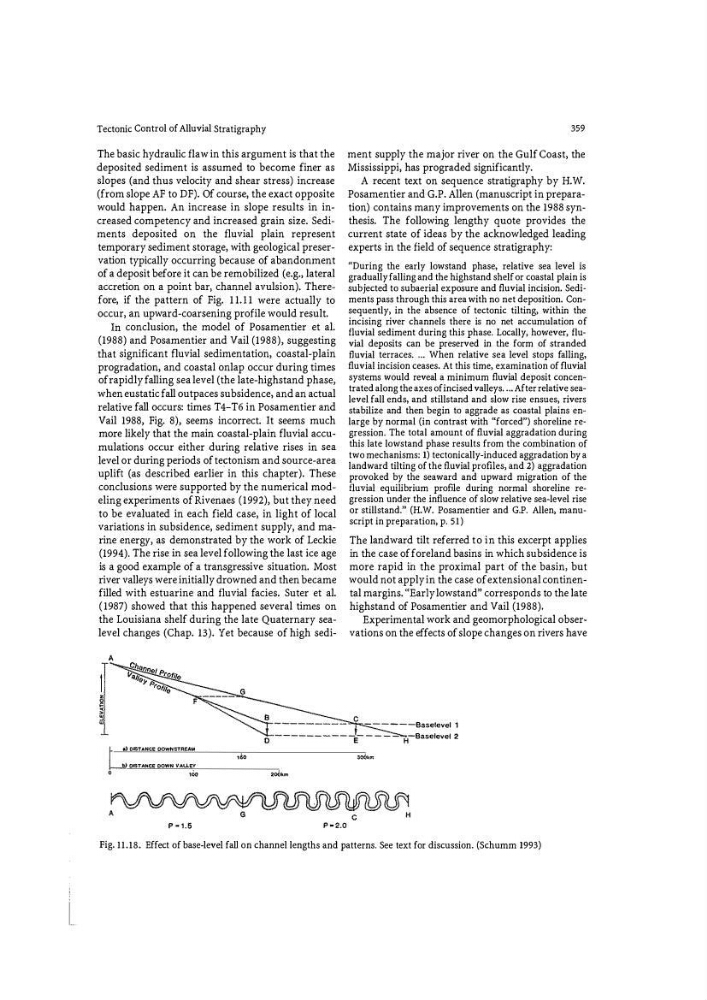
Fig. 11.18. Effect of base�level fall on channel lengths and patterns. See text for discussion. (Schumm 1993)
The basic hydraulic flaw in this argument is that the
deposited sediment is assumed to become finer as
slopes (and thus velocity and shear stress) increase
(from slope AF to DF). Of course, the exact opposite
would happen. An increase in slope results in in�
creased competency and increased grain size. SediM
ments deposited on the fluvial plain represent
temporary sediment storage, with geological preservation typically occurring because of abandonment
of a deposit before it can be remobilized (e.g., lateral
accretion on a point bar, channel avulsion). Therefore, if the pattern of Fig. 11.!1 were actually to
occur, an upward-coarsening profile would result.
In conclusion, the model of Posamentier et al.
(1988) and Posamentier and Vail (1988), suggesting
that significant fluvial sedimentation, coastal-plain
progradation, and coastal onlap occur during times
of rapidly falling sea level (the late-highstand phase,
when eustatic fall outpaces subsidence, and an actual
relative fall occurs: times T4-T6 in Posamentier and
Vail 1988, Fig. 8), seems incorrect. It seems much
more likely that the main coastal-plain fluvial accumulations occur either during relative rises in sea
level or during periods of te�tonism and source-area
uplift (as described earlier in this chapter). These
conclusions were supported by the numerical modeling experiments of Rivenaes (1992), but they need
to be evaluated in each field case, in light of local
variations in subsidence, sediment supply, and marine energy, as demonstrated by the work of Leckie
(1994). The rise in sea level following the last ice age
is a good example of a transgressive situation. Most
river valleys were initially drowned and then became
filled with estuarine and fluvial facies. Suter et al.
(1987) showed that this happened several times on
the Louisiana shelf during the late Quaternary sealevel changes (Chap. 13). Yet because of high sediA
359
ment supply the major river on the Gulf Coast, the
Mississippi, has prograded significantly.
A recent text on sequence stratigraphy by H.W.
Posamentier and G.P. Allen (manuscript in preparation) contains many improvements on the 1988 synthesis. The following lengthy quote provides the
current state of ideas by the acknowledged leading
experts in the field of sequence stratigraphy:
"During the early lowstand phase, relative sea level is
gradually falling and the highstand shelf or coastal plain is
subjected to subaerial exposure and fluvial incision. Sedi�
ments pass through this area with no net deposition. Consequently, in the absence of tectonic tilting, within the
incising river channels there is no net accumulation of
fluvial sediment during this phase. Locally, however, flu¥
vial deposits can be preserved in the form of stranded
fl uvial terraces . ... When relative sea level stops falling,
fluvial incision ceases. At this time, examination of fluvial
systems would reveal a minimum fluvial deposit concentrated along the axes of incised valleys . ... After relative sea�
level fall ends, and stillstand and slow rise ensues, rivers
stabilize and then begin to aggrade as coastal plains en¥
large by normal (in contrast with "forced") shoreline re¥
gression. The total amount of fluvial aggradation during
this late lowstand phase results from the combination of
two mechanisms: 1) tectonically-induced aggradation by a
landward tilting of the fluvial profiles, and 2) aggradation
provoked by the seaward and upward migration of the
fluvial equilibrium prof:tle during normal shoreline regression under the influence of slow relative sea-level rise
or stillstand." (H.W. Posamentier and G.P. Allen, manu¥
script in preparation, p. 51)
The landward tilt referred to in this excerpt applies
in the case of foreland basins in which subsidence is
more rapid iri the proximal part of the basin1 but
would not apply in the case of extensional continental margins. «Early lowstand" corresponds to the late
highstand of Posamentier and Vail (1988).
Experimental work and geomorphological observations on the effects of slope changes on rivers have
l
------Base !evel 1
0 - ----- ---E
----H
-Baselevel 2
It) 01$TAN!;E OOWNSTREAM
"'
I>) OISTAN!;E DOWN VAUEY
200km
p .. 1.5
Fig. 11.18. Effect of base�level fall on channel lengths and patterns. See text for discussion. (Schumm 1993)