

Tectonic Control of Alluvial Stratigraphy
some·of the older sequence literature, in order that a
clearer understanding of the present state of understanding can be reached.
Over geological lengths of time, rivers develop a
dynamic equilibrium in the form of a graded longitudinal proftle (some of the historical steps in the
emergence of this idea are summarized in Sect.
2.3.3). Butcher (1990, p. 376) stated:
"An equilibrium profile, or graded stream, is one in which
slope, velocity, depth, width, roughness, pattern, and
channel morphology delicately and mutually adjust to
provide the power and efficiency necessary to tranport the
load supplied from the drainage basin without aggradation or degradation of the channels (Leopold and Bull
1979). Rivers that are out of equilibrium will aggrade or
incise in an attempt to achieve a graded profile which ... is
a function of tectonic, isostatic, climatic variation ... and
base-level controls.''
Isolating the effects of base-level changes is difficult, because in many naturally occurring cases
changes in base level are linked to other effects. For
example, the major base-level changes that affected
the world's coasts during the late Cenozoic are
glacioeustatic in origin, a:rid the effects on the rivers
and their deposits of actual changes in base level are
difficult to separate from changes in discharge and
sediment load that occurred at the same time
(Butcher 1990; Schumm 1993; Leckie 1994). Experiments by Begin et al. (1980) and Begin (1981) in
modeling base-level changes in a flume have been
useful in clarifying geomorphic concepts. Recent
work by Blum (1994) and Blum and Price (1994) has
demonstrated that Climate change may be much
more important than base-level change in affecting
the balance between aggradation and degradation,
because of the effects of climate change on discharge
and sediment yield. This topic is dicussed at greater
length in Sect. 12.12.2.
Posamentier et al. (1988, p. 135) stated:
"The fundamental principle which governs sedimentation
in fluvial environments (assuming constant sediment supply) is that a stream will aggrade if its equilibrium proflle
shifts basinward or upward and incise if its equilibrium
profile shifts downward ... subaerial accommodation
occurs by basinward shifts of the stream equilibrium profile."
This statement is quite correct, but there has been
debate regarding the causes and controls on the shift
in fluvial profiles (Miall 1991c; Schumm 1993). The
book in which the statement appears (Society of
Economic Paleontologists and Mineralogists Special
Publication 42) is still regarded as an authoritative source, containing two landmark papers. by
Posamentier et al. (1988) and Posamentier and Vail
353
( 1988). For this reason, it is important that the earlier
models be described briefly and the problems with
them mentioned. As noted below, H. Posamentier
and his co-workers do not now use the part of the
earlier work that is now described.
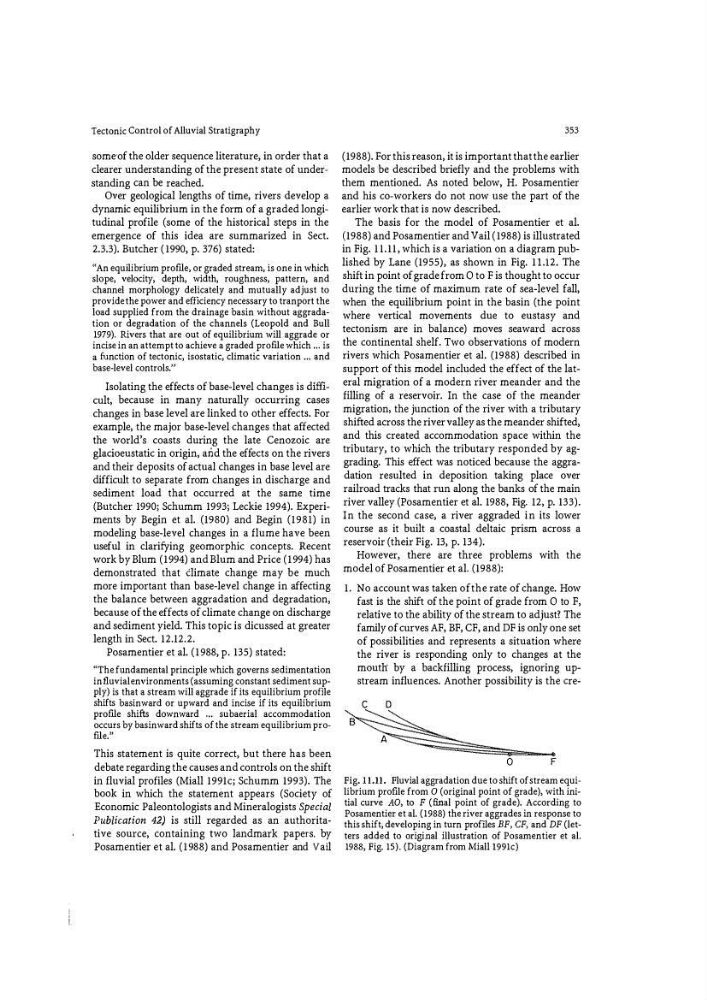
The basis for the model of Posamentier et al.
{1988) and Posamentier and Vail ( 1988) is illustrated
in Fig. 11.11, which is a variation on a diagram published by Lane (1955), as shown in Fig. 1l.l2. The
shift in point of grade from 0 to F is thought to occur
during the time of maximum rate of sea-level fall,
when the equilibrium point in the basin (the point
where vertical movements due to eustasy and
tectonism are in balance) moves seaward across
the continental shelf. Two observations of modern
rivers which Posamentier et al. (1988) described in
support of this model included the effect of the lateral migration of a modern river meander and the
filling of a reservoir. In the case of the meander
migration) the junction of the river with a tributary
shifted across the river valley as the meander shifted,
and this created accommodation space within the
tributary, to which the tributary responded by aggrading. This effect was noticed because the aggradation resulted in deposition taking place over
railroad tracks that run along the banks of the main
river valley (Posamentier et al. 1988, Fig. 12, p. 133).
In the second case, a river aggraded in its lower
course as it built a coastal deltaic prism across a
reservoir (their Fig. 13, p. 134).
However, there are three problems with the
model of Posamentier et al. (1988):
1. No account was taken of the rate of change. How
fast is the shift of the point of grade from 0 to F,
relative to the ability of the stream to adjust? The
family of curves AF, BF, CF, and DF is only one set
of possibilities and represents a situation where
the river is responding only to changes at the
mouth: by a backfilling process, ignoring upstream influences. Another possibility is the ereC
D
0
F
Fig. I 1.11. Fluvial aggradation due to shift of stream equilibrium profile from 0 (original point of grade), with initial curve AO, to F (fmal point of grade). According to
Posamentier et al. (1988) the river aggrades in response to
this shift, developing in turn proflles BF, CF, and DF (letters added to original illustration of Posamentier et al.
1988, Fig. 15). (Diagram from Miall l991c)
some·of the older sequence literature, in order that a
clearer understanding of the present state of understanding can be reached.
Over geological lengths of time, rivers develop a
dynamic equilibrium in the form of a graded longitudinal proftle (some of the historical steps in the
emergence of this idea are summarized in Sect.
2.3.3). Butcher (1990, p. 376) stated:
"An equilibrium profile, or graded stream, is one in which
slope, velocity, depth, width, roughness, pattern, and
channel morphology delicately and mutually adjust to
provide the power and efficiency necessary to tranport the
load supplied from the drainage basin without aggradation or degradation of the channels (Leopold and Bull
1979). Rivers that are out of equilibrium will aggrade or
incise in an attempt to achieve a graded profile which ... is
a function of tectonic, isostatic, climatic variation ... and
base-level controls.''
Isolating the effects of base-level changes is difficult, because in many naturally occurring cases
changes in base level are linked to other effects. For
example, the major base-level changes that affected
the world's coasts during the late Cenozoic are
glacioeustatic in origin, a:rid the effects on the rivers
and their deposits of actual changes in base level are
difficult to separate from changes in discharge and
sediment load that occurred at the same time
(Butcher 1990; Schumm 1993; Leckie 1994). Experiments by Begin et al. (1980) and Begin (1981) in
modeling base-level changes in a flume have been
useful in clarifying geomorphic concepts. Recent
work by Blum (1994) and Blum and Price (1994) has
demonstrated that Climate change may be much
more important than base-level change in affecting
the balance between aggradation and degradation,
because of the effects of climate change on discharge
and sediment yield. This topic is dicussed at greater
length in Sect. 12.12.2.
Posamentier et al. (1988, p. 135) stated:
"The fundamental principle which governs sedimentation
in fluvial environments (assuming constant sediment supply) is that a stream will aggrade if its equilibrium proflle
shifts basinward or upward and incise if its equilibrium
profile shifts downward ... subaerial accommodation
occurs by basinward shifts of the stream equilibrium profile."
This statement is quite correct, but there has been
debate regarding the causes and controls on the shift
in fluvial profiles (Miall 1991c; Schumm 1993). The
book in which the statement appears (Society of
Economic Paleontologists and Mineralogists Special
Publication 42) is still regarded as an authoritative source, containing two landmark papers. by
Posamentier et al. (1988) and Posamentier and Vail
353
( 1988). For this reason, it is important that the earlier
models be described briefly and the problems with
them mentioned. As noted below, H. Posamentier
and his co-workers do not now use the part of the
earlier work that is now described.
The basis for the model of Posamentier et al.
{1988) and Posamentier and Vail ( 1988) is illustrated
in Fig. 11.11, which is a variation on a diagram published by Lane (1955), as shown in Fig. 1l.l2. The
shift in point of grade from 0 to F is thought to occur
during the time of maximum rate of sea-level fall,
when the equilibrium point in the basin (the point
where vertical movements due to eustasy and
tectonism are in balance) moves seaward across
the continental shelf. Two observations of modern
rivers which Posamentier et al. (1988) described in
support of this model included the effect of the lateral migration of a modern river meander and the
filling of a reservoir. In the case of the meander
migration) the junction of the river with a tributary
shifted across the river valley as the meander shifted,
and this created accommodation space within the
tributary, to which the tributary responded by aggrading. This effect was noticed because the aggradation resulted in deposition taking place over
railroad tracks that run along the banks of the main
river valley (Posamentier et al. 1988, Fig. 12, p. 133).
In the second case, a river aggraded in its lower
course as it built a coastal deltaic prism across a
reservoir (their Fig. 13, p. 134).
However, there are three problems with the
model of Posamentier et al. (1988):
1. No account was taken of the rate of change. How
fast is the shift of the point of grade from 0 to F,
relative to the ability of the stream to adjust? The
family of curves AF, BF, CF, and DF is only one set
of possibilities and represents a situation where
the river is responding only to changes at the
mouth: by a backfilling process, ignoring upstream influences. Another possibility is the ereC
D
0
F
Fig. I 1.11. Fluvial aggradation due to shift of stream equilibrium profile from 0 (original point of grade), with initial curve AO, to F (fmal point of grade). According to
Posamentier et al. (1988) the river aggrades in response to
this shift, developing in turn proflles BF, CF, and DF (letters added to original illustration of Posamentier et al.
1988, Fig. 15). (Diagram from Miall l991c)