

Tectonic Control of Alluvial Stratigraphy
merous changes in river patterns in the Hungarian
Plains were attributed to tectonic tilting by Mike
(1975). Several studies have examined the changes in
fluvial morphology in response to modern tectonic
movements� including changes in longitudinal profile1 terrace patterns, channel sinuosity, meander
shape and orientation, bar character, and lateral
channel migration (Seeber and Gornitz 1983;
Burnett and Schumm 1983; Ouchi 1985; Leeder and
Alexander 1987; Rii siinen et al. 1987; Marple and
Talwani 1993). Modifications in fluvial style in the
plains of the Ganges River in India and changes in
349
local sedimentation rate that affected soil development were attributed to neotectonic tilting by
Srivastava et al. (!994).
Blind structures may eventually penetrate the
land surface and evolve into topographic barriers
and sediment sources. Such patterns of development
are particularly common in foreland basins (Morley
!986), where they may accompany the development
of satellite or piggyback basins (Sect. 11.4.6).
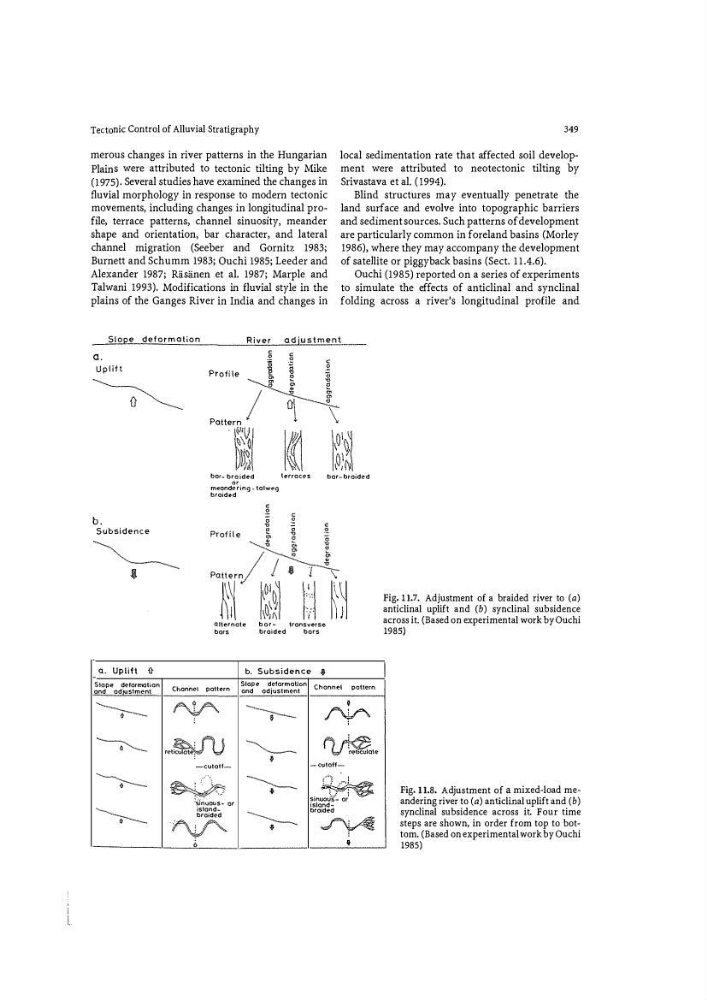
Ouchi (1985) reported on a series of experiments
to simulate the effects of anticlinal and synclinal
folding across a rivees longitudinal profile and
Slope deformation
River
adjustment
a.
Uplift
b.
Subsidence
Q. Uplift
1}
Slope deformation
and ad·us!ment
•
c
� �
.2
Protde
e
't)
-
0P
Pattern
\
·l � � � M , o : � �
I JU ;l �I \ o,�\
bar� bro ided
\erroces
bar- braided
"'
meande ring - tolw<'!'g
broid<'
c
� �
g
Pcofile �
Pattee/ j f 1 ; \.
�� � �; � l ) , : ; ��
Olternote
bortransverse
bors
braided
bors
Channel pattern
b. Subsidence -$Slope de!orma\lon
ond
adjustment
Chonnel
•
pottern
�
-cutoH:s1;uoos- or
islandbraided
'
-cutoff""� island -
braided
Fig. l1.7. Adjustment of a braided river to (a)
anticlinal uplift and (b) synclinal subsidence
across it. (Based on experimental work by Ouchi
1985)
Fig. 11.8. Adjustment of a mixed-load meandering river to (a) anticlinal uplift and (b)
synclinal subsidence across it. Four time
steps are shown, in order from top to botM
tom. (Based on experimental work by Ouchi
1985)
merous changes in river patterns in the Hungarian
Plains were attributed to tectonic tilting by Mike
(1975). Several studies have examined the changes in
fluvial morphology in response to modern tectonic
movements� including changes in longitudinal profile1 terrace patterns, channel sinuosity, meander
shape and orientation, bar character, and lateral
channel migration (Seeber and Gornitz 1983;
Burnett and Schumm 1983; Ouchi 1985; Leeder and
Alexander 1987; Rii siinen et al. 1987; Marple and
Talwani 1993). Modifications in fluvial style in the
plains of the Ganges River in India and changes in
349
local sedimentation rate that affected soil development were attributed to neotectonic tilting by
Srivastava et al. (!994).
Blind structures may eventually penetrate the
land surface and evolve into topographic barriers
and sediment sources. Such patterns of development
are particularly common in foreland basins (Morley
!986), where they may accompany the development
of satellite or piggyback basins (Sect. 11.4.6).
Ouchi (1985) reported on a series of experiments
to simulate the effects of anticlinal and synclinal
folding across a rivees longitudinal profile and
Slope deformation
River
adjustment
a.
Uplift
b.
Subsidence
Q. Uplift
1}
Slope deformation
and ad·us!ment
•
c
� �
.2
Protde
e
't)
-
0P
Pattern
\
·l � � � M , o : � �
I JU ;l �I \ o,�\
bar� bro ided
\erroces
bar- braided
"'
meande ring - tolw<'!'g
broid<'
c
� �
g
Pcofile �
Pattee/ j f 1 ; \.
�� � �; � l ) , : ; ��
Olternote
bortransverse
bors
braided
bors
Channel pattern
b. Subsidence -$Slope de!orma\lon
ond
adjustment
Chonnel
•
pottern
�
-cutoH:s1;uoos- or
islandbraided
'
-cutoff""� island -
braided
Fig. l1.7. Adjustment of a braided river to (a)
anticlinal uplift and (b) synclinal subsidence
across it. (Based on experimental work by Ouchi
1985)
Fig. 11.8. Adjustment of a mixed-load meandering river to (a) anticlinal uplift and (b)
synclinal subsidence across it. Four time
steps are shown, in order from top to botM
tom. (Based on experimental work by Ouchi
1985)