

Tectonic Control of Alluvial Stratigraphy
347
TECTONIC SETTING AND PROCESSES
LOCAL RESPONSE
TYPES OF SYNTECTONIC
INTRAFORMATIONAL UNCONFORMITIES
FORMATION OF
SOUTHERN PYRENEAN
THRUST SEL T
Late phases of nappe
em,pla<:ement
A LATE FORELAND
SASIN MARGIN
ALONG THE
ASSEMBLED COMPOSITE
PROGRESSIVE
UNCONFORMITIES
mCD -�
".*:.= =* ="'-'
(,� 1'!0
(Floor thrust cmergen<:e)
CATALAN CO ASTAL RANGE
STRIKE� SLIP SYSTEM
Uplifting of push-up
5lfU<:IUf(!S
CATALAN COASTAL RANGE
STRIKE-SLIP SYSTEM
Uplifting of complex
push-up stru<:tures
NAPPE FRONT
FORMAllON
OF NEW
SHIFTING
OF THE
SA SIN
MARGIN
BASIN
MARGINS
ISOLATED COMPOSITE
PROGRESSIVE
UNCONFORMITY
COMPOSITE
PROGRESSIVE
UNCONFORMITIES
LINKING ZONE SETWEEN
ISERIAN AND C.C. RANGES
Synsl!dimcntll ry folding
and thrusting
SYNTECTONIC
RESTRICTION OF
OEPOCENTERS.
LATER SPREADING
OF SEDIMENTARY
AREAS.
SUPRA TENUOUS
SYNCLINES
AND
RELATED
COMPOSITE
PROGRESSIVE
UNCONFORMITIES
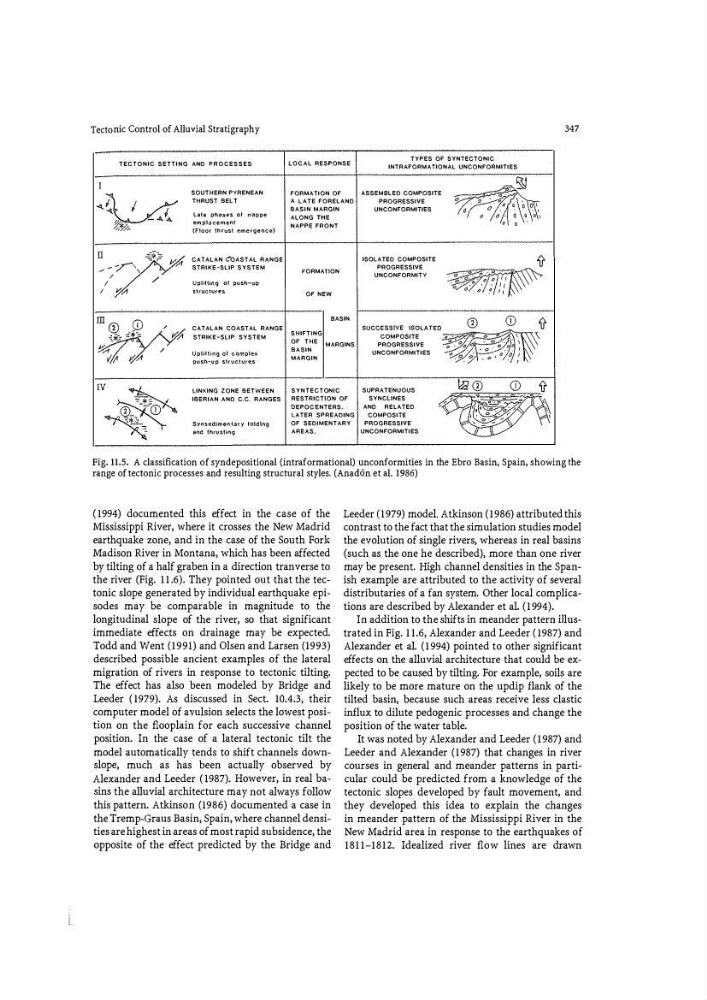
Fig. 11.5. A classification of syndepositional (intraformational) unconformities in the Ebro Basin, Spain, showing the
range of tectonic processes and resulting structural styles. (Anad6n et al. 1986)
(1994) documented this effect in the case of the
Mississippi River, where it crosses the New Madrid
earthquake zone, and in the case of the South Fork
Madison River in Montana, which has been affected
by tilting of a half graben in a direction tranverse to
the river (Fig. 11.6). They pointed out that the tectonic slope generated by individual earthquake episodes may be comparable in magnitude to the
longitudinal slope of the river, so that significant
immediate effe cts on drainage may be expected.
Todd and Went (1991) and Olsen and Larsen (1993)
described possible ancient examples of the lateral
migration of rivers in response to tectonic tilting.
The effect has also been modeled by Bridge and
Leeder (1979). As discussed in Sect. 10.4.3, their
computer model of avulsion selects the lowest position on the flooplain for each successive channel
position. In the case of a lateral tectonic tilt the
model automatically tends to shift channels downslope, much as has been actually observed by
Alexander and Leeder (1987). However, in real basins the alluvial architecture may not always follow
this pattern. Atkinson (1986) documented a case in
the Tremp-Graus Basin, Spain, where channel densities are highest in areas of most rapid subsidence, the
opposite of the effe ct predicted by the Bridge and
Leeder {1979) model. Atkinson (1986) attributed this
contrast to the fact that the simulation studies model
the evolution of single rivers, whereas in real basins
(such as the one he described), more than one river
may be present. High channel densities in the Spanish example are attributed to the activity of several
distributaries of a fan system. Other local complications are described by Alexander et al. (1994).
In addition to the shifts in meander pattern illustrated in Fig. 11.6, Alexander and Leeder (1987) and
Alexander et al. (1994) pointed to other significant
effe cts on the alluvial architecture that could be expected to be caused by tilting. For example, soils are
likely to be more mature on the updip flank of the
tilted basin, because such areas receive less clastic
influx to dilute pedogenic processes and change the
position of the water table.
It was noted by Alexander and Leeder (1987) and
Leeder and Alexander (1987) that changes in river
courses in general and meander patterns in particular could be predicted from a knowledge of the
tectonic slopes developed by fault movement, and
they developed this idea to explain the changes
in meander pattern of the Mississippi River in the
New Madrid area in response to the earthquakes of
1811-1812. Idealized river flow lines are drawn
347
TECTONIC SETTING AND PROCESSES
LOCAL RESPONSE
TYPES OF SYNTECTONIC
INTRAFORMATIONAL UNCONFORMITIES
FORMATION OF
SOUTHERN PYRENEAN
THRUST SEL T
Late phases of nappe
em,pla<:ement
A LATE FORELAND
SASIN MARGIN
ALONG THE
ASSEMBLED COMPOSITE
PROGRESSIVE
UNCONFORMITIES
mCD -�
".*:.= =* ="'-'
(,� 1'!0
(Floor thrust cmergen<:e)
CATALAN CO ASTAL RANGE
STRIKE� SLIP SYSTEM
Uplifting of push-up
5lfU<:IUf(!S
CATALAN COASTAL RANGE
STRIKE-SLIP SYSTEM
Uplifting of complex
push-up stru<:tures
NAPPE FRONT
FORMAllON
OF NEW
SHIFTING
OF THE
SA SIN
MARGIN
BASIN
MARGINS
ISOLATED COMPOSITE
PROGRESSIVE
UNCONFORMITY
COMPOSITE
PROGRESSIVE
UNCONFORMITIES
LINKING ZONE SETWEEN
ISERIAN AND C.C. RANGES
Synsl!dimcntll ry folding
and thrusting
SYNTECTONIC
RESTRICTION OF
OEPOCENTERS.
LATER SPREADING
OF SEDIMENTARY
AREAS.
SUPRA TENUOUS
SYNCLINES
AND
RELATED
COMPOSITE
PROGRESSIVE
UNCONFORMITIES
Fig. 11.5. A classification of syndepositional (intraformational) unconformities in the Ebro Basin, Spain, showing the
range of tectonic processes and resulting structural styles. (Anad6n et al. 1986)
(1994) documented this effect in the case of the
Mississippi River, where it crosses the New Madrid
earthquake zone, and in the case of the South Fork
Madison River in Montana, which has been affected
by tilting of a half graben in a direction tranverse to
the river (Fig. 11.6). They pointed out that the tectonic slope generated by individual earthquake episodes may be comparable in magnitude to the
longitudinal slope of the river, so that significant
immediate effe cts on drainage may be expected.
Todd and Went (1991) and Olsen and Larsen (1993)
described possible ancient examples of the lateral
migration of rivers in response to tectonic tilting.
The effect has also been modeled by Bridge and
Leeder (1979). As discussed in Sect. 10.4.3, their
computer model of avulsion selects the lowest position on the flooplain for each successive channel
position. In the case of a lateral tectonic tilt the
model automatically tends to shift channels downslope, much as has been actually observed by
Alexander and Leeder (1987). However, in real basins the alluvial architecture may not always follow
this pattern. Atkinson (1986) documented a case in
the Tremp-Graus Basin, Spain, where channel densities are highest in areas of most rapid subsidence, the
opposite of the effe ct predicted by the Bridge and
Leeder {1979) model. Atkinson (1986) attributed this
contrast to the fact that the simulation studies model
the evolution of single rivers, whereas in real basins
(such as the one he described), more than one river
may be present. High channel densities in the Spanish example are attributed to the activity of several
distributaries of a fan system. Other local complications are described by Alexander et al. (1994).
In addition to the shifts in meander pattern illustrated in Fig. 11.6, Alexander and Leeder (1987) and
Alexander et al. (1994) pointed to other significant
effe cts on the alluvial architecture that could be expected to be caused by tilting. For example, soils are
likely to be more mature on the updip flank of the
tilted basin, because such areas receive less clastic
influx to dilute pedogenic processes and change the
position of the water table.
It was noted by Alexander and Leeder (1987) and
Leeder and Alexander (1987) that changes in river
courses in general and meander patterns in particular could be predicted from a knowledge of the
tectonic slopes developed by fault movement, and
they developed this idea to explain the changes
in meander pattern of the Mississippi River in the
New Madrid area in response to the earthquakes of
1811-1812. Idealized river flow lines are drawn