

346
strike-slip basins in California were discussed by
Crowell (1974a), and Crowell and Link (1982), and
many examples of their structure and stratigraphy
were given by Ballance and Reading ( 1980) and
Biddle and Christie-Blick (1985). A general discussion of this class of basin was provided by Mia!!
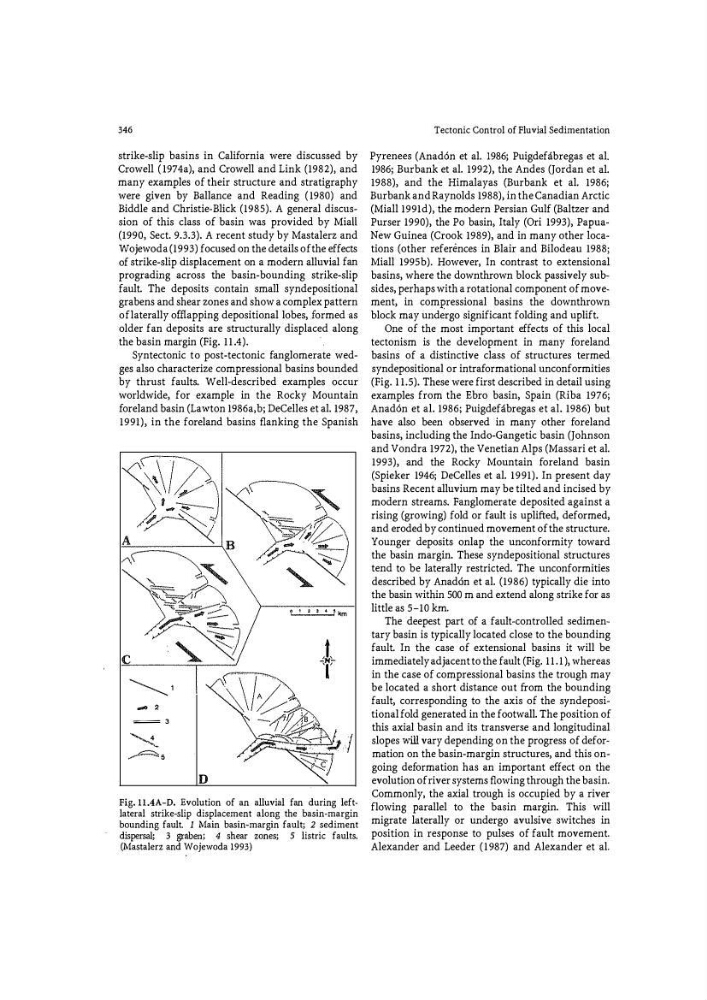
(1990, Sect. 9.3.3). A recent study by Mastalerz and
Wojewoda (1993) focused on the details of the effects
of strike-slip displacement on a modern alluvial fan
prograding across the basin-bounding strike-slip
fault. The deposits contain small syndepositional
grabens and shear zones and show a complex pattern
oflaterally offlapping depositional lobes, fo rmed as
older fan deposits are structurally displaced along
the basin margin (Fig. 11.4).
Syntectonic to post-tectonic fanglomerate wedges also characterize compressional basins bounded
by thrust faults. Well-described examples occur
worldwide, for example in the Rocky Mountain
foreland basin (Lawton 1986a,b; DeCelles et al. 1987,
1991), in the foreland basins flanking the Spanish
- 2
=3
D
0
'
2
3
• 'k m
J
-Nl
Fig. ll.4A-D. Evolution of an alluvial fan during leftlateral strike-slip displacement along the basin-margin
bounding fault. 1 Main basin-margin fault; 2 sediment
dispersal; 3 graben; 4 shear zones; 5 listric faults.
(Mastalerz and Wojewoda 1993)
Tectonic Control of Fluvial Sedimentation
Pyrenees (Anad6n et al. !986; Puigdefabregas et al.
1986; Burbank et al. 1992), the Andes (Jordan et al.
1988), and the Himalayas (Burbank et al. 1986;
Burbank and Raynolds 1988), in the Canadian Arctic
(Miall 1991d), the modern Persian Gulf (Baltzer and
Purser 1990), the Po basin, Italy (Ori 1993), PapuaNew Guinea (Crook 1989), and in many other locations (other references in Blair and Bilodeau 1988;
Miall 1995b). However, In contrast to extensional
basins, where the downthrown block passively subsides, perhaps with a rotational component of move�
ment, in compressional basins the downthrown
block may undergo significant folding and uplift.
One of the most important effects of this local
tectonism is the development in many fo reland
basins of a distinctive class of structures termed
syndepositional or intraformational unconformities
(Fig. 11.5). These were first described in detail using
examples from the Ebro basin, Spain (Riba 1976;
Anad6n et al. 1986; Puigdefabregas et al. 1986) but
have also been observed in many other fo reland
basins, including the Indo-Gangetic basin (Johnson
and Vondra 1972), the Venetian Alps (Massari et al.
1993), and the Rocky Mountain fo reland basin
(Spieker 1946; DeCelles et al. 1991). In present day
basins Recent alluvium may be tilted and incised by
modern streams. Fanglomerate deposited against a
rising (growing) fold or fault is uplifted, deformed,
and eroded by continued movement of the structure.
Younger deposits onlap the unconformity toward
the basin margin. These syndepositional structures
tend to be laterally restricted. The unconformities
described by Anadon et al. (1986) typically die into
the basin within 500 m and extend along strike for as
little as 5-10 km.
The deepest part of a fault-controlled sedimentary basin is typically located close to the bounding
fault. In the case of extensional basins it will be
immediately adjacent to the fault (Fig. 11.1 ), whereas
in the case of compressional basins the trough may
be located a short distance out fr om the bounding
fault, corresponding to the axis of the syndepositional fold generated in the footwall. The position of
this axial basin and its transverse and longitudinal
slopes will vary depending on the progress of deformation on the basin-margin structures, and this ongoing deformation has an important effect on the
evolution of river systems flowing through the basin.
Commonly, the axial trough is occupied by a river
flowing parallel to the basin margin. This will
migrate laterally or undergo avulsive switches in
position in response to pulses of fault movement.
Alexander and Leeder (1987) and Alexander et al.
strike-slip basins in California were discussed by
Crowell (1974a), and Crowell and Link (1982), and
many examples of their structure and stratigraphy
were given by Ballance and Reading ( 1980) and
Biddle and Christie-Blick (1985). A general discussion of this class of basin was provided by Mia!!
(1990, Sect. 9.3.3). A recent study by Mastalerz and
Wojewoda (1993) focused on the details of the effects
of strike-slip displacement on a modern alluvial fan
prograding across the basin-bounding strike-slip
fault. The deposits contain small syndepositional
grabens and shear zones and show a complex pattern
oflaterally offlapping depositional lobes, fo rmed as
older fan deposits are structurally displaced along
the basin margin (Fig. 11.4).
Syntectonic to post-tectonic fanglomerate wedges also characterize compressional basins bounded
by thrust faults. Well-described examples occur
worldwide, for example in the Rocky Mountain
foreland basin (Lawton 1986a,b; DeCelles et al. 1987,
1991), in the foreland basins flanking the Spanish
- 2
=3
D
0
'
2
3
• 'k m
J
-Nl
Fig. ll.4A-D. Evolution of an alluvial fan during leftlateral strike-slip displacement along the basin-margin
bounding fault. 1 Main basin-margin fault; 2 sediment
dispersal; 3 graben; 4 shear zones; 5 listric faults.
(Mastalerz and Wojewoda 1993)
Tectonic Control of Fluvial Sedimentation
Pyrenees (Anad6n et al. !986; Puigdefabregas et al.
1986; Burbank et al. 1992), the Andes (Jordan et al.
1988), and the Himalayas (Burbank et al. 1986;
Burbank and Raynolds 1988), in the Canadian Arctic
(Miall 1991d), the modern Persian Gulf (Baltzer and
Purser 1990), the Po basin, Italy (Ori 1993), PapuaNew Guinea (Crook 1989), and in many other locations (other references in Blair and Bilodeau 1988;
Miall 1995b). However, In contrast to extensional
basins, where the downthrown block passively subsides, perhaps with a rotational component of move�
ment, in compressional basins the downthrown
block may undergo significant folding and uplift.
One of the most important effects of this local
tectonism is the development in many fo reland
basins of a distinctive class of structures termed
syndepositional or intraformational unconformities
(Fig. 11.5). These were first described in detail using
examples from the Ebro basin, Spain (Riba 1976;
Anad6n et al. 1986; Puigdefabregas et al. 1986) but
have also been observed in many other fo reland
basins, including the Indo-Gangetic basin (Johnson
and Vondra 1972), the Venetian Alps (Massari et al.
1993), and the Rocky Mountain fo reland basin
(Spieker 1946; DeCelles et al. 1991). In present day
basins Recent alluvium may be tilted and incised by
modern streams. Fanglomerate deposited against a
rising (growing) fold or fault is uplifted, deformed,
and eroded by continued movement of the structure.
Younger deposits onlap the unconformity toward
the basin margin. These syndepositional structures
tend to be laterally restricted. The unconformities
described by Anadon et al. (1986) typically die into
the basin within 500 m and extend along strike for as
little as 5-10 km.
The deepest part of a fault-controlled sedimentary basin is typically located close to the bounding
fault. In the case of extensional basins it will be
immediately adjacent to the fault (Fig. 11.1 ), whereas
in the case of compressional basins the trough may
be located a short distance out fr om the bounding
fault, corresponding to the axis of the syndepositional fold generated in the footwall. The position of
this axial basin and its transverse and longitudinal
slopes will vary depending on the progress of deformation on the basin-margin structures, and this ongoing deformation has an important effect on the
evolution of river systems flowing through the basin.
Commonly, the axial trough is occupied by a river
flowing parallel to the basin margin. This will
migrate laterally or undergo avulsive switches in
position in response to pulses of fault movement.
Alexander and Leeder (1987) and Alexander et al.